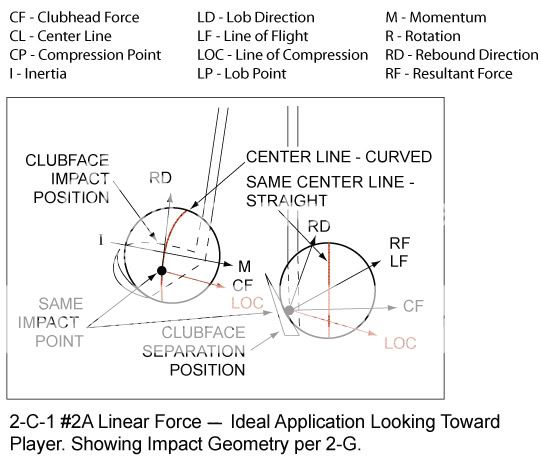
The picture below illustrates the compression deformation of the center picture above.
Notice that Air space in the lower half of the Ball is compressed more than the air Space in the upper half of the ball. This allows the ball to deform.
As the Clubhead enters the Ball Space, the lower part of the ball will reach maximum compression (for the Driver Speed) and Rebound prior to the Upper portion of the ball reaching maximum compression.
The bottom part of the Ball will rebound at a greater force than the upper part of the Ball. The bottom part of the Ball will be going faster. The Upper part of the ball will drag behind. I know that a lot of research says the ball rolls up the face of the club and that produces spin. I think that there's more to it than that. Consider this: a 3/4" diameter Golf ball would be extremely difficult to spin. A 3" diameter Golf ball would be easy to spin.
The experts say that Launch angle is a combination of clubface angle and clubhead path. "Since the ball has a moment of inertia, it takes some torque (force at the edge of the ball) to make it spin. That force comes out of the upwards acceleration of the ball, so it takes off a little lower than the clubface is pointing." More Ball cover theory. It may work with Ping Pong, Volley balls, Basketballs and Tennis balls very well.
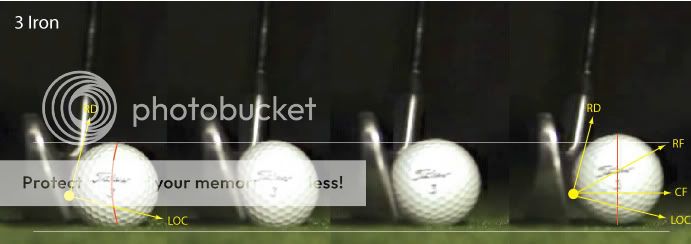
Illustrated below, is another way to look at Launch Angle. The Golf Ball is somewhat solid.
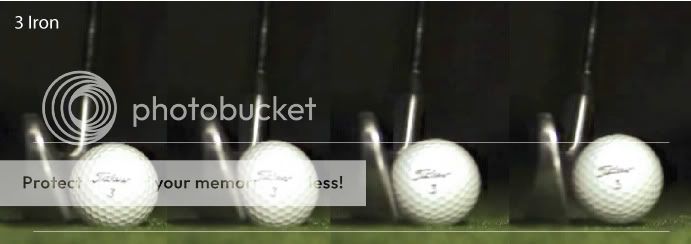
There is a lot to observe in these High Speed Photos.
Notice the Clubface Closing from Impact to Separation?
If the Ball rolled up the face, because of friction, then we should see the ball rise during the compression stage. But the Ball lifts during rebound.
Daryl,
It looks like there is some rolling of the ball on the face during the compression stage. You can see it in the driver and 3 iron photos. Look closely at the logo and ball # and you'll see a slight upward tilting of the ball during compression. Its very, very slight but shows the ball does change its polar axis during impact. Its not just a direct rebound off the clubface from a decending clubhead blow.
This action might explain why sharper grooves help keep the ball in its original axis thereby increasing spin.
Then again, these photos might depict impact after lowpoint.
Just guessing.
__________________
Bagger
1-H "Because of questions of all kinds, reams of additional detail must be made available - but separately, and probably endlessly." Homer Kelly
It looks like there is some rolling of the ball on the face during the compression stage. You can see it in the driver and 3 iron photos. Look closely at the logo and ball # and you'll see a slight upward tilting of the ball during compression. Its very, very slight but shows the ball does change its polar axis during impact. Its not just a direct rebound off the clubface from a decending clubhead blow.
This action might explain why sharper grooves help keep the ball in its original axis thereby increasing spin.
Then again, these photos might depict impact after lowpoint.
Just guessing.
great observation.
The impacts are before Low Point.
I can see the name tilting as you describe. I couldn't tell whether that's from rolling or straight forward deformation. But the spin (rolling) is much more obvious as the ball leaves the face of the club.
Tonight I'll include photos of a Wedge and 7 iron.
Tom Wishon said he did some super high speed research a couple of years back. To my knowledge none of the photographs have been released publicly. His conclusions were that the ball does move slightly up the face as well as deform. His iron and wedge designs since appear to have more bite to them via more grippy faces as well as the groove design work.
Interesting. I've been reading about this lately and it seems the agreement is under normal dry conditions, that groove design isn't significant.
I can see how roughing the face would add friction, but I'm not convinced that Roll-up is the complete answer.
I would think you don't have to have roll up per se, just 'grip' to transfer energy into spin. You might only be using one or two grooves on any given shot for that grip, but I'd have to say grooves matter!
__________________
"Support the On Plane Swinging Force in Balance"
"we have no friends, we have no enemies, we have only teachers"
Simplicity buffs, see 5-0, 1-L, 2-0 A and B 10-2-B, 4-D, 6B-1D, 6-B-3-0-1, 6-C-1, 6-E-2
I would think you don't have to have roll up per se, just 'grip' to transfer energy into spin. You might only be using one or two grooves on any given shot for that grip, but I'd have to say grooves matter!
Hmm? A 'Pool Cue' has grip. The Balls don't. I'll read more about it.









 Linear Mode


