
|
Quote:
The idea is to abandon the fixation on the physical clubshaft. |
End Game (#2)
Quote:
Quote:
Quote:
Quote:
Fact: The Sweetspot resides outside the hosel at Address and Impact.Therefore, one of two conditions must exist: Door #1. The hosel is rotating to accomodate the Sweetspot's orbit; or Door #2. The Sweetspot is rotating to accomodate the hosel's orbit. Your prior position was Door #2. Which door now, Jeff? |
Words and Pictures
Quote:
Bambam . . . Thanks for your imbedded images in post #154. HELP here with a new imbedded post image! http://www.15thnewyorkcavalry.org/Media/charge.wav :smile: After the fact: Thanks, Ben! :salut: |
Quote:
 It works just like the insert link button but displays the image right in your post. |
Yoda - my answer is neither 1 or 2 in terms of keeping the clubshaft on-plane. My answer is 1 when it comes to hitting the ball with a square clubface. Both the sweetspot and hosel rotate at the same rpm, but only the sweetspot hits the ball.
The way you worded/posed your latest question made me think of this quandary in a different way. You used the word "accomodate" and it changed the way I think of the situation. I think that there are two factors in play. Factor 1. Moving the clubshaft in space in a certain way (on-plane) so that one can create an overall club shaft arc that is symmetrical to the ball-target line, and that will allow the clubshaft arc to be in-to-square-to-in with respect to the ball-target line. If one was using a dowel stick (equivalent to a clubshaft without an attached clubhead), then one could paint the last 2" of the peripheral end of the dowel stick red, and the idea would be that one would want to get the red area of the dowel stick square to the ball by impact. Factor 2. The clubhead is an attachment at the end of the clubshaft that extends out at roughly a right angle relative to the peripheral end of the clubshaft and a golfer wants to hit the ball precisely in the center spot of that extension (which we call the sweetspot). Presume that the clubhead width is 4" and that the sweetspot is extended 2" away from the peripheral end of the clubshaft (which we call the hosel). An experienced golfer knows that while he is swinging the clubshaft around his rotating torso with his swinging arms, that he needs to rotate the clubshaft in space in order to keep the clubshaft on-plane throughout the downswing. Now (when a clubhead is attached at right angles to his clubshaft) he is faced with a second need - he needs to square the sweetspot at impact. A golfer knows that his clubshaft will undergo a 90 degree rotation between the delivery position and the ball. He also knows that he must get the sweetspot (which is extended 2" away from the end of the clubshaft) to hit the ball squarely. He therefore has to adjust his swing to accomodate that specific need. In other words, he needs to stand 2" further away from the ball so that the sweetspot (and not the peripheral end of the clubshaft) hits the ball. He then performs the identical swing as before, and the clubshaft still rotates 90 degrees between the 3rd parallel and the ball, but because he is standing 2" further away from the ball, the hosel will end up being 2" away from the ball when the peripheral end of the clubshaft is square to the ball-target line. By making that accomodation, the sweetspot will hit the ball squarely. In other words, the golfer had to allow the hosel to accomodate to the need of the golfer to get the sweetspot to hit the ball. If one considers the geometry of this accomodation, note that the front of the hosel rotated to exactly the same degree as the clubface (sweetspot) between the 3rd parallel and impact because they both rotate equally as much as the back of the left hand rotates, and that the hosel doesn't rotate around the sweetspot (nor does the sweetspot rotate around the hosel because they both rotate at the same rpm as the back of the left hand between the 3rd parallel and impact). In fact, the hosel should transcribe exactly the same-shaped orbit it produced when there was no clubhead attached to the end of the clubshaft. However, the entire hosel orbit had to move in space to ensure that the sweetspot (of the extension piece that is at right angles to the end of the clubshaft) hits the ball squarely. In that sense, the hosel is accomodating to the sweetspot's orbital arc. If the golfer then replaced his 4" wide clubhead with a new clubhead that had a width of 6" (which means that the sweetspot is 3" away from the hosel) then the golfer would have to accomodate himself to that fact. He would keep his overall clubshaft orbit the same, but he would have to stand another 1" further away from the ball to ensure that the sweetspot of the 6" wide clubface hit the ball squarely. So, in that sense the hosel is accomodating to the needs of the sweetspot to swing in an circular arc that allows the overall sweetspot arc to be in-to-square-to-in and that also allows the sweetspot to hit the ball squarely. However, that accomodation doesn't require that the shape of the clubshaft's orbit be altered when the clubhead width changes from 4" to 6". Also, the clubhead shaft will still remain on-plane during its travel through the impact zone, and it will still track along the same inclined plane between the 3rd and 4th parallel positions. The idea of the hosel rotating around the sweetspot (or vica versa) would only have "relevance" if they rotated at a different rpm between the 3rd parallel and impact or between impact and the end of the followthrough. Jeff. |
Mi Casa y Su Casa -- Nyet!
Quote:
Quote:
Jeff, Mi "mental universe" is not parallel to su "mental universe". In fact, we're not even in the same galaxy. Ne're the less . . . I applaud your efforts. :salut: |
Tractor Trailer Jacknifing
 Jeff, AJ Bonar is smiling at you. As you are driving a tractor (hosel) pulling a heavy trailer (clubhead) along a straight road (swing path) seeing a big golf ball in the middle of the road ahead and you want to smack the golf ball with the side of the trailer. How would you do it? 1) Don't aim for the golf ball but drive straight keeping left of the road; turn sharply left the last moment. 2) Drive straight for the golf ball and turn sharply left the last moment. I am not sure it's relevant to your thinking. http://www.youtube.com/watch?v=bn2Z-...eature=related Yoda, My last attempt :) |
Chbkk
Nice illustrations. Very impressive. ob |
chbkk
I think that your tractor trailer analogy has no relevance with respect to the release swivel action for the following reasons. 1) In your tractor trailer example you are trying to hit the golf ball with the side of the trailer, but there is a flexible joint between the tractor (hosel) and the trailer (clubhead) that allows the angle between the tractor and trailer to vary. By contrast, in a release swivel action, the angle between the hosel and the clubhead is fixed, and not flexible and the clubface angle changes relative to the ball-target line because the entire clubshaft and clubface rotates 90 degrees as a single unit while the left wrist uncocks - and the rpm of the clubshaft hosel is identical to the rpm of the clubface's sweetspot and equal to the rpm of the flat left wrist/hand unit. 2) To think of a comparable analogy, I think that you need to think along the following lines. First eliminate the left wrist uncocking action as a confounding variable by imagining the clubshaft at the delivery position - like in this photo of Aaron Baddeley. 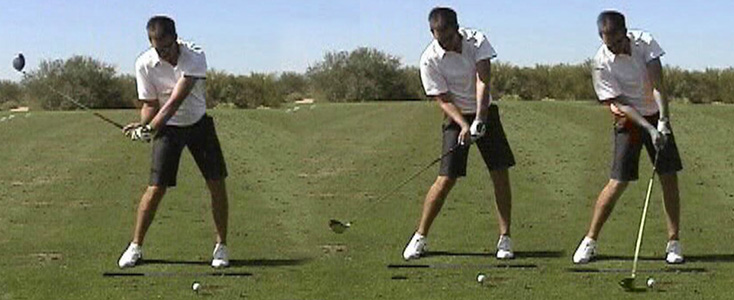 Note that toe of the club is pointing upwards and that the clubhead is fixed at right angles to the clubshaft (and not following in-line behind like the trailer follows the tractor). Note that the clubface is parallel to the back of the left hand. Note that there is a 90 degree angle between the clubshaft and left arm. If Aaron Baddely didn't uncock his left wrist but simply rotated his left hand 90 degrees so that the back of the left hand faced the target at impact - then the clubface would hit a ball squarely if the ball was at the appropriate height above the ground. During that swivel action, the clubface would rotate 90 degrees and the clubshaft/hosel would rotate exactly the same amount - in other words, the flat left wrist/hand unit and clubshaft and clubface would all rotate at the same rpm. The fixed 90 degree angle between the clubshaft and clubhead would remain fixedly unchanged and the toe of the club would still point straight up at impact. There is no rotation of the hosel around the sweetspot (or vica versa) during this 90 degree rotation phenomenon. Jeff. p.s. Your tractor-trailer anlogy has relevance when describing the difference between a random release and a late release of the club. The road path and any swerving off that straight road path is equivalent to the hand arc path, and the flexible joint between the tractor and trailer is equivalent to the flexible left wrist joint between the left arm and clubshaft. |
Yoda - look at that photo of Aaron Baddeley (in the post above this post)
Note that the clubshaft and hosel and clubface and flat left wrist/hand unit are all rotating at the same rpm (while the left wrist uncocks), and that there is no rotation of the hosel around the sweetspot in the downswing period between the delivery position and impact. Jeff |
| All times are GMT -4. The time now is 09:25 AM. |
