|
Jeff,
I can't help you with the math. Depends on the horsepower of the boat, the effective boat draft, how hard the skier pulls the boat sideways, prop pitch and size, water surface conditions, ski design, rope length, etc. The greater the angle from the center of the boat to point C, the greater the angle of the ski "blade" otherwise the skier is decelerating. Trust me, not much application to the golfers release but if you want to do the math, there are plenty of resources to put the puzzle pieces together. Not my cup-o-tea, I was only concerned about rounding the buoy's without dropping an elbow or rope in the water. That takes time off the score and ruins rhythm. Some are Performers and some are Engineers. Rarely the two meet in a single individual, but we need each other collectively. I appreciate what you are attempting here Jeff. About that left shoulder movement. Can you quote VJ in context so there is no misunderstanding? Thanks, |
Bagger - you wrote-: "The greater the angle from the center of the boat to point C, the greater the angle of the ski "blade" otherwise the skier is decelerating."
I cannot understand this point. If the curve passing through all the points A,B and C is a defined curve of a certain shape, then the angle of the ski blade must be constant at all times during the skier's passage along that curved path - irrespective of the angle of the skier to the boat. The angle of the rope changes, but the skiers blade angle must surely remain constant if he maintains a curved path of constant curvacture. What do you want me to clear up about the left shoulder movement? I only made the point that the idea that the left shoulder remains "fixed" in space as the center of a circle with a fixed radius is not what happens in a "real life" golf swing in the late downswing - because i) the left shoulder socket is moving upwards, leftwards and backwards in the late downswing and ii) the distance between the left shoulder socket and the clubhead constantly changes as the clubshaft becomes progessively more in-line with the left arm in the late downswing. Jeff. |
I've always wished I could combine my passions but I could never reconcile skiing and golfing.
I'm not interested in discussing the skier analogy, but I am interested in your comment regarding VJ's view of Hogan's left shoulder. "see the three white dots with interconnecting red lines. VJ's representation of Ben Hogan's left shoulder socket as being a single fixed point in space is an oversimplification, and it doesn't represent true reality. It is a gross over-simplification -" Just want to make sure that VJ's representation is rooted in reality. I haven't read his book so I'm trusting that this statement is fair and contextually accurate. |
Bagger
Here is a copy of VJ's Impact Circle photo from his book. 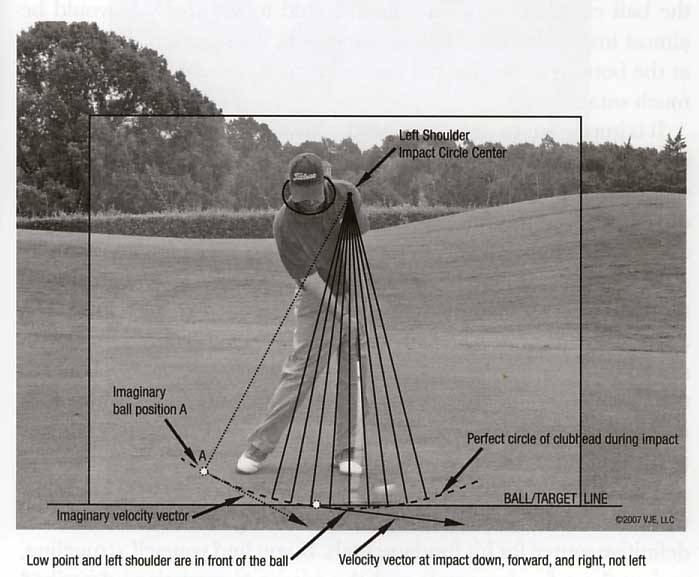 Jeff. |
Quote:
The Endless Belt is a nice way to think about things particularly with different "pulley diameters" contolled by hand path and #3 angle. |
Quote:
|
12 piece bucket
I agree with you - the left shoulder must be well forward at impact to have a low point somewhere near the inside of the left heel. Different golfers get the left shoulder to the "correct" impact location via different mechanisms. A S&T golfer, who has a small amount of left spinal tilt at the end-backswing (leftwards-centered swing style), will have to move the left shoulder far less to get the left shoulder to the 'correct" impact location than Tiger Woods, who has a rightwards-centered swing style. By the way, I have altered the Tiger Woods photo by adding dotted yellow lines to demonstrate that the radius of the circle increases while the center of the circle moves leftwards/upwards/backwards. 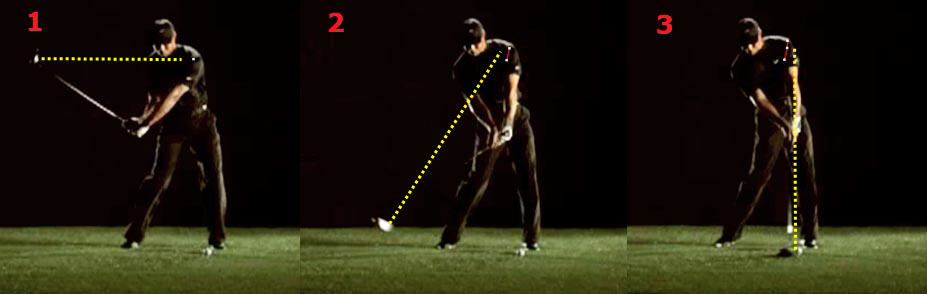 Jeff. |
Straight Line delivery path vs Circle Delivery Path
Hello again Jeff. I am quoting a post by EdZ:
If you imagine the path of your hands traveling in your motion as a wheel (7-23), the 'widest possible' path of the hands would be a circle around your center of balance. In a straight line delivery, your hands go from the 'edge of the rim' at the top, directly in a straight line INSIDE the circle toward your aiming point/both arms straight and at both straight they are again 'touching the wheel rim'. A 'feel' of 'narrow to wide" (top to both arms full extended). Adelayed release/max trigger delay and a more powerful (but tougher to time) motion. In a circle delivery path, your hands effectively 'attempt' to STAY on the rim all the way 'around the circle'. A very 'wide' feel in which you release fully and smoothly from the top - very nearly throw away. A very consistent, but much less powerful motion, much simple to judge distance. You post on pulley wheels seems to focus on the circle or angled line delivery path rather than the straight line delivery path. I am looking at the pictures of Diane on pgs 203-205 of the yellow book. Some where, I think that I remember Yoda saying to set the #3 pressure point at the top and take it straight to the ball. Are we missing that their are three possible TYPES of paths the hands can take toward impact. Donn |
Donn
You wrote-: "In a straight line delivery, your hands go from the 'edge of the rim' at the top, directly in a straight line INSIDE the circle toward your aiming point/both arms straight and at both straight they are again 'touching the wheel rim'." I can understand the idea of mentally "directing" the hands to go in a straight line direction towards the aiming point, but I have never seen a straight hand arc in a "real life" golf swing. All the hand arcs that I have seen are curved arcs/paths that are C-shaped or slightly J-shaped. If you have access to a golf swing showing a straight line hand path, please let me know - I would like to analyse it using my swing analyser program. I can see Diane mimicing a straight line hand path in the early/mid downswing by pulling her hands down that white path on page 203 of TGM, but I have never seen that phenomenon in a "real life" professional golfer's swing. One can try and pull the PP#3 point in a straight line direction straight down to the aiming point, but the hand arc/path will still be curved because while the hands are moving down in the direction of the aiming point, the body is pivoting and the arms are moving around the body at the same time, and the end-result is a curved hand path. Jeff. |
Jeff, I don't have a picture of a straight line delivery path.
If one comes across I will let you know. Maybe their is a curved arc or J-shaped path. The procedure is called an Arc of Approach. Homer does say in 10-23-0 that the paths are taken by the hands - Not the club head Your descriptions refer to the hands - correct. In 10-23-A, STRAIGHT LINE, Homer says "This pattern holds the Hands on a Delivery Path that is a straight line leading from the Top-of-the-line hand position directly at and through the Aiming Point (2-J-3) when there is no Plane Shifts (10-7)." Homer mentions in 2-K that Only the Circumference is NOT a straight line. Even with a slight curve of the Arc, I do not believe that this would be enough to invalidate the concept of the Endless Belt Effect. The pictures of Diane swinging do not seem unusual to me. Yoda put up some excellet pictures of of the Endless Belt Effect. I do not know that he would want to get into the dissussion. All the best, Donn |
| All times are GMT -4. The time now is 04:29 AM. |