
|
Quote:
The way that I measured angular acceleration was to measure the distance between each clubhead (during release) on the Bobby Jones sequence via a paper and pencil on my computer screen. I concluded that there was angular acceleration of the clubhead i.e. the distances between each clubhead was increasing during release but no angular acceleration of the hands or grip end of the club i.e. when I measured the distance between them there was no increase in distance. Now, if the grip was the center of rotation and the shaft was rotating around the grip end- then in that simple experiment- the whole shaft or any portion of the shaft would have the same angular acceleration. However, in the golf swing with #2 and #3 accumulators releasing and various other mechanical features happening simultaneously- you don't have or don't have to have a situation where both ends of the club have the same angular acceleration. Said another way- in a single center rotating system all points of rotation will have the same angular acceleration. However, in a multiple center(s) rotating system- not all of the points in rotation have to have the same angular acceleration. And the golf swing is a multiple center rotating system. |
Bernt
I, unfortunately, cannot understand your physics explanation or its applicability to the release phenomenon. To start with my understanding-problem. Issue 1: Consider your diagram, which could be thought of as a shaft that is hinge-centered in the center of the circle, and rotating in a circular motion. You talk of a tangential acceleration and a radial acceleration. You state that tangential acceleration applies to the direction that the clubhead (which is merely the peripheral end of that centrally-hinged shaft) is moving at any moment in time. I can understand that point and the "correct" applicability of your directional-arrow labelled aT (which is at a 90 degree tangent to the radius of the circle). I cannot understand your term "radial acceleration" as you have drawn the first arrow AR as being directed towards the center of the circle (along the longitudinal axis of the shaft). I can think of that "centrally-directed" force" as being a centripetal force, but not a radially-accelerated force. I can also think of the term "radial acceleration" as being representative of the angular acceleration of the shaft as its rotates around its central hinge-axis point. I particularly cannot understand your use of the two aR arrows drawn at a tangent to the circle at the 9 o'clock and 3 o'clock position - what do those aR arrows (drawn at a 90 degree tangent-angle to the circle) represent? Issue 2: I still cannot understand your concept of a swing center. Are you referring to the upper swing center of the body? Here is an image showing the movement of Tiger Woods left shoulder socket and upper swing center during his downswing. 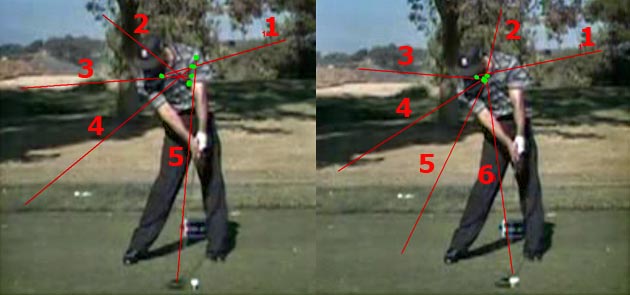 In image 1, the green dot shows the position of the left shoulder socket at different time-points during the downswing, while the red line is a straight line drawn from the left shoulder socket to the clubhead. One can see how the left shoulder socket moves in space during the evolution of the downswing. In image 2, the green dot is drawn at the upper swing center (midway point between the two shoulder sockets as seen in a frontal-view). The red line is a straight line drawn between the clubhead and the upper swing center. One can see that the upper swing center stays very centralised during the downswing. So, in conclusion (using my concept of an upper swing center), the left shoulder socket's sequential movement in space during the downswing has no relationship to the stable movement of the upper swing center (which remains very centralised during the downswing). Issue 3: You state that tangential acceleration and radial acceleration forces are applied to the clubhead via the hands. I don't understand this point at all. I can understand the concept of the terms "tangential/radial" as being applicable to the circular motion of the left arm around a "fixed" point (left shoulder socket). However, in a "real life" golf swing, the left shoulder socket is constantly moving in space during the downswing, and therefore the final speed/direction of movement of the hands during the downswing is the end-product of two interlinked movements - i) the speed of rotation of the left arm at the shoulder socket, and ii) the rate/direction of curvilinear movement of the left shoulder socket in space. The beauty of nm golfer's "release phenomenon" explanation is that he doesn't need to know what moves the hands. He simply states that movement of the hands has two components - i) a constantly-variable direction of movement; and ii) a constantly-variable speed of movement; and that these two variables produce angular acceleration of the clubshaft because the COG of the clubshaft is not in-line with the constantly-varibale directional movement of the hands. nm golfer doesn't have to use the terms "tangential" or "radial" in his explanation of the "release phenomenon", and his explanation makes sense whether the hands travel in a circular, or elliptical, or C-shaped/J-shaped curvilinear manner. Jeff. |
Mike - you state that you can think of the clubhead having angular acceleration, but you don't equally think that the clubshaft can have angular acceleration because you presumably perceive that the grip end of the club is not simply rotating around a"fixed" point in space.
The problem for me regarding your statements relates to the question as to where is the locus of the central point of the "imaginary circle" that allows you to describe the clubhead's movements in terms of having angular acceleration, while you are not willing to accept the idea that other parts of the clubshaft also have angular acceleration? You seem to be willing to entertain the idea of an "imaginary" central locus for the clubhead's movement, but you are unwilling to apply that same conceptual idea to any other point on the clubshaft eg. grip end. By the way, I think that even if the left hand is moving at a constant speed during the release phenomenon, it doesn't mean that the grip end of the clubshaft has to travel at the same speed as the hands - because the left wrist is uncocking during the release phenomenon. In nm golfer's explanation, the central hinge-point locus for the clubshaft's rotary movement is always at the hands - even though the hands have a constantly-variable directional movement and constantly-variable speed of movement. At each fractional moment in time, the clubshaft can develop angular acceleration with respect to its radial movement around the "instantaneous" hand-axis hinge point. In other words, the clubshaft has a circular motion around a constantly moving central locus hinge-point at all time-points during the downswing (even during the release of power accumulator #2) and all points on the clubshaft have the same degree of angular acceleration because the shaft is a rigid structure, but the clubhead's motion (or grip end's motion) relative to "any" locus point on the body is not circular, and cannot therefore be precisely described in terms of "angular acceleration". Jeff. |
Bernt
I am sorry that I didn't explain that when I produced Tiger's photo showing the "release phenomenon", that I didn't accurately time-sequence the clubshaft placement events. I only wanted to produce an illustrative photo showing many clubshaft time-points, but I didn't attempt to make sure that the "time" between each clubshaft point was perfectly time-equalised. Jeff. |
Quote:
First, I'm only referencing your posts - in that- I took a cursory look at nm's stuff and wasn't interested in trying to figure out what he or she was saying. I don't think that should cause us a problem. I think you misquoted or mis-understood me in your first paragraph above. The center of the hands would be combination of the "top of the spine" and the left shoulder moving centers. The clubhead would have centers at those two places plus accumulators #2 and #3. However, I did describe how I made the measurements of the clubhead and the grip end of the club. Why don't you make the measurements of the grip end and tell me what you come up with in regards to the angular acceleration? |
Mike
When you refer to an "imaginary point" located "somewhere" between the left shoulder and upper spine as being the "center" of an "imaginary circle" circumscribed by the hands, then I can basically understand your conceptual idea in a certain way. What you are apparently doing is simply taking the hand arc movement => then you are perceiving it as being a circular arc (even though the arc doesn't have a perfectly circular shape) => then you are trying to locate its "central locus point" with respect to the golfer's body ("central locus point" being "equivalent" to the central axis point of the circle that represents the hand circle). So, for example, here is a diagram showing the movements of the hands, and clubshaft, and clubhead in a low handicap golfer. 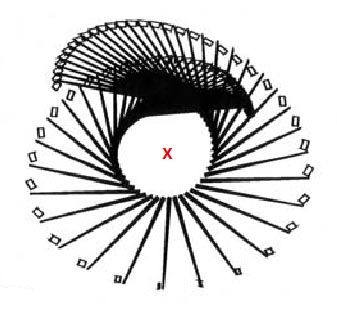 Point X is the center of the circle for both the hand arc and the clubhead arc, and one can conceptually think of the angular acceleration of the hands and/or clubhead with reference to that central "X" point (which is conceptually located "somewhere" in the golfer's body). However, that doesn't help us understand the release phenomenon, because the clubshaft is released (and not the clubhead) with respect to the hands and the clubshaft in that diagram is not rotating in a circular fashion around point X. Therefore, one cannot conceive of the clubshaft having angular acceleration with respect to point "X". nmgolfer gets around this problem by using the double pendulum swing model. 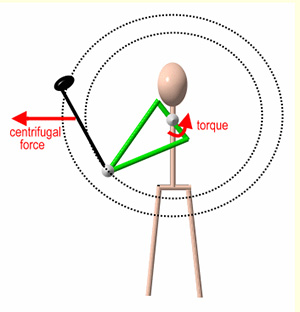 The double pendulum swing model involves a central arm ( represented by the golfer's conjoined two arms) and a peripheral arm (clubshaft) connected together at a peripheral hinge point. nm golfer's mathematical explanation attempts to explain the release phenomenon occurring at the peripheral hinge point using the following assumptions - i) that the hinge joint is passive and therefore the forces causing the clubshaft's release is passive (not directly related to any active hand unhinging action); ii) and that the clubshaft's movement in space can only be affected by movement of the peripheral hinge point (hands) in space - without having to be concerned about the underlying body forces that cause the hands to move (body forces that torque the central arm). Regarding nm golfer's explanation, the clubshaft can be angularly accelerated at the peripheral hinge point, which serves as the "center" for the angular rotation of the clubshaft around the peripheral hinge point (hands). In other words, the clubshaft rotates around a central point (hands) and therefore the grip end of the club must (by definition) angularly-rotate at the same rpm speed as the clubhead end of the club because the clubshaft is a rigid structure rotating around a central hinge point (although the clubhead end obviously has a faster curvilinear speed than the grip end). In nm golfer's explanation, what's the source of power that allows the clubshaft to develop angular acceleration? It is derived from the fact that the peripheral hinge point (hands) constantly move about in space, and the hand movement has both a directional quality and a velocity quality. The movement of the hands (peripheral hinge point) causes the club to develop angular acceleration, because the movement of the hands is at an angle to the COG of the clubshaft. The clubshaft therefore rotates in a circle relative to the hands, and the angular rpm acceleration of every part of the clubshaft (grip end and clubhead end) must be the same. nm golfer's explanation explains how the club develops angular acceleration with respect to the hands, and how the club releases with respect to the hands. nm golfer's explanation doesn't have to concern itself with "imaginary" locus points - point X in the first diagram. Jeff. |
Hello Jeff,
Quote:
I had a look at the nm golfer link. It wasn't very detailed at that specific page, but the point of departure seemed to be Newtonian enough for me :happy3: And, I suspect that the not-inline condition that you are referring to is a very close cousin to the momentum that I drew around the golfer's neck, and also the tangential force that appears by the clubface in my sketch. I didn't read any more than was on the very page you referred to - you must have read more somewhere. But nevertheless, I think that focussing on angular acceleration does cloud the issue somehow. If for no other reason, angular acceleration can be had without increasing the speed of the golf club. And angular deceleration can be combined with increased clubhead speed. As far as my own, very simplistic and very mechanical and geometrically oriented approach goes, I think it is a big issue in understanding the golf swing that only tangential force can generate clubhead speed. Anyway, thanks for the opening statement and the follow-ups. It has been very stimulating, and such threads have been a rare thing to me at LBG lately. I cannot say how much I appreciate that you ask questions that goes to the fundament of TGM. TGM is by far the best golf book I've ever read, but even masterpieces has limits. If Homer Kelly found all the answers it would be the first time in the history of knowledge creation. And even if that should happen to be the case during the course of time, we will become wiser if we dare think a little bit outside the yellow box from time to time. I have noted a few negative reactions to some of your posts, but I enjoy them because they trigger the incubator. :salut: |
Quote:
But imo it is not entirely complete. A third circle around the neck, tangenting the shoulders are missing. The golf swing is basically three-lever system: The left shoulder spinning around the neck, the left arm spinning around the left shoulder. And the club spinning around the left arm. The Torque around the neck is required as long as we wish to accelerate the club. And the quality and quantity of this is THE determining factor for clubhead speed. But in addition, torque is reqired for the shoulder/arm joint (extensior action or a driving right side). And torque is also required for the arm/club joint - early in the down swing. |
Bernt
I can understand why you would envision the need for what you call a "three lever" system to represent a body-driven/pivot-driven golf swing where the third lever can be conceived to be a "lever" between the central torque generator and the left arm at the left shoulder socket hinge point. However, whether you mentally envision a three-lever system (equivalent to a body-generated/pivot-driven dowswing action), or a two-lever system (equivalent to a pure arm swinger - ala Leslie King's or Peter Croker's teaching philospophy), the basic physics of the release phenomenon is going to be the same - dependent on the direction of movement/speed of movement of the most peripheral hinge point (at the hands) during the downswing as it relates to the COG of the club. The clubshaft has no idea what is driving the hands to move in a certain direction at a certain speed, and it only responds to the direction/speed of the pulling force at the most peripheral hinge point - a hinge point between the left arm (at the left hand) and the clubshaft. The clubshaft is unaware if there is another hinge point in the golfer's swing system - a central hinge point that must exist in a three lever system. Jeff. |
Quote:
In the first part of your post above, you accurately describe my previous post i.e. my viewpoint. However, I still need to get my mind around your viewpoint and also go back and see the purpose of the thread and what we are analyzing here. But in the meantime, I'll make a quick comment regarding your quote below in case you can help me understand where you're coming from. "However, that doesn't help us understand the release phenomenon, because the clubshaft is released (and not the clubhead) with respect to the hands and the clubshaft in that diagram is not rotating in a circular fashion around point X. Therefore, one cannot conceive of the clubshaft having angular acceleration with respect to point "X". " I can understand your concept of isolating the clubshaft in relation to the hands and saying that the entire clubshaft has the same angular acceleration- so conceptually I see what you are saying. But I would think that if there was anything that you would say that the clubshaft is release with respect to - it would be the ball- in regards to what forces will be created and not the hands (if that gets the discussion off base in regards to the context that you are discussing - just ignore it for now). Secondly, When you say that the clubshaft in that diagram is not rotating in a circular fashion around point X- therefore....... - you lost me there - looks to me like it is moving in a circular motion around X to me- generally speaking - so IF you wanted to I could see one conceiving of angular acceleration with respect to point X. Enlighten me. |
Mike
You wrote-: "But I would think that if there was anything that you would say that the clubshaft is release with respect to - it would be the ball- in regards to what forces will be created and not the hands (if that gets the discussion off base in regards to the context that you are discussing - just ignore it for now)." When you want to relate the release of the clubshaft with respect to the ball, then you are discussing a totally different subject. I am simply trying to understand the physics of the release phenomenon - the reason why the clubshaft releases in the mid/late downswing (the reason why power accumulator number #2 releases). It is also equivalent to understanding the physics of the flail release - why the end swingle stick releases when the central stick is swung smoothly along a curved path. HK used the endless belt analogy to explain the clubshaft's release phenomenon. He uses the analogy of ducks (equivalent to a clubshaft) on a belt at a fairground. The belt travels at constant speed, which means that the ducks (which are attached at their foot-base to the endless belt) travel at the same speed as the belt - during the straight line travel section of the endless belt. When the belt swings around the pulley at either end, then the ducks have to swing around so that their upper end (head-end) travels faster than their lower end (foot-end). In other words, the ducks are angularly accelerated during the time period when the belt (traveling at constant speed) swings around the end pulley. HK's endless belt analogy is a nice visual concept to explain how a club can be angularly accelerated when its attachment point (to the hands) goes around a bend. However, the endless belt concept only makes maximum sense if the attachment point (hands) moves quite abruptly from a straight line path to a curved path (eg. along a J-shaped curve). It doesn't explain how clubshaft release can occur with a C-shaped curve (Bobby Jones swing) or a circular curve (PingMan machine). nm golfers' single mathematical explanation can explain all those release phenomena equally well. When I stated that the clubshaft cannot be conceived to be rotating in a circular fashion around point "X", I basically meant the following. The concept of angular acceleration of a linear object (rather than a point-object) generally relates the angular movement of the linear object to its "fixed" lower end, which must be at the center of a circle, while the peripheral end is always on the circumference of that circle. In that diagram, point "X" is the center of a circle relating to certain point-objects (hands or clubhead end of the clubshaft), but the linear object (entire clubshaft) has no constant circular rotational relationship to "point X" because an extension line drawn from the butt end of the club doesn't pass through point "X". From my perspective, the concept of angular acceleration of the clubshaft only makes sense with respect to its "fixed" point of attachment - which is at the hands. Jeff. |
Jeff: Consider the Snap, Randon and Sweep Releases and how the wristcocks act differently. The pulley size changes but there is still a pulley in the wristcock itself.
|
Paul
I don't know what you mean when you state that there is a pulley within the wristcock itself. I also don't know what you mean when you imply that the wristcock acts differently in the different release patterns. My concept of HK's pulley (in his endless belt analogy) relates to the curvilinear path of movement of the hands over time, and a pulley exists when the hand arc over a short period-of-time becomes particularly curved rather than straight. In a snap release, the hand arc path is very J-shaped with a very small pulley, while in a sweep release it is very C-shaped with a large pulley. The random release pattern has an intermediate pulley size. Jeff. |
Quote:
|
| All times are GMT -4. The time now is 05:08 AM. |