|
The Perfect Pivot
Quote:
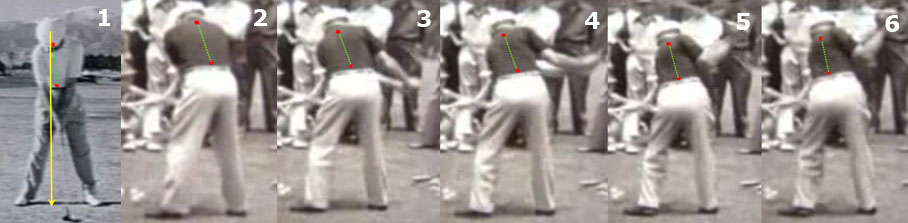
The reason I've hammered on this is that many teachers take the opposite approach; namely, that the Head should Sway to the right on the Backstroke and that the player's back should assume a significant lean away from the target. They presume that this so-called "slice of pie" -- the 'wedge' created when the back leans away from the vertical -- is characteristic of the ideal pivot and a source of additional power. Nothing could be further from the truth. In fact, it is nothing more than an old-fashioned Sway that only disrupts the ideal Centered Arc and makes any real consistency diffficult, if not impossible. I recommend golfers adopt the Pivot shown here: http://www.putfile.com/pic/5075264. [Golf, Bob MacDonald, 1927] Note the vertical spine and the relative degrees of circular Hip and Shoulder Turns. To my mind, this is one of the most important illustrations in the history of written golf instruction. :salut: |
Phew!
We sure disagree about this point. I believe that a golfer should adopt a certain degree of rightwards spinal tilt at address. One can acquire that small degree of rightwards spinal tilt by keeping the head in the center of the stance (or minimally right-of-center) and then shifting the pelvis left-laterally. Then during the backswing, one rotates the torso around that small degree of rightwards spinal tilt in a neutral manner - with no swaying or tilting or movement of the head. That results in no change of the degree of rightwards spinal tilt at the end-backswing position (compared to the address position). I personally believe that Ben Hogan and Tiger Woods do that. However, the issue is complex because of the spiraling of the spine. When the pelvis rotates 45 degrees, that shifts the lumbar spine to the left and reorients the front of the lumbar vertebrae to the right (by about 45 degrees) as shown in this next diagram. 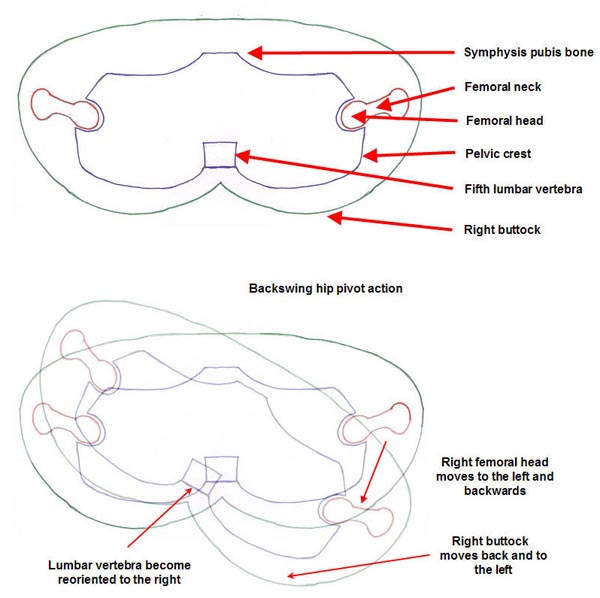 The reorientation of the lumbar vertebrae affects the thoracic spine (because the lumbar vertebrae are incapable of much rotary movement due to the anatomical structure of their pedicles) and this causes the upper torso to rotate around a thoracic spine whose vertebrae are also reoriented (face) to the right, and this thoracic vertebral reorientation allows the upper torso to rotate freely around the rightwards tilted/spiraled spine. When the lumbar vertebra are moved left-laterally (due to the 45 degree pelvic rotation) and the head remains stationary, then theoretically the degree of rightwards spinal tilt should increase. However, the rotation of the upper torso is greater than the lower torso and it torques the spine in a clockwise manner. That torquing action has a verticalising effect on the spiraling thoracic spine and gives the mid-upper spine a more vertical appearance - although the overall spinal tilt is rightwards. The overall rightwards spinal tilt causes the right upper torso to slant rightwards - and that rightwards torso tilt is not due to swaying. Here is Brian Manzella demonstrating his Guardsman drill. 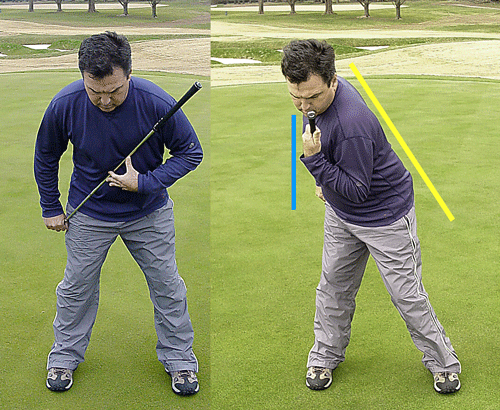 That significant degree of rightwards torso tilt (away from the target) is not a sway - it is secondary to rotating the pelvis 45 back while allowing his head to freely move with his tilting upper torso into a reverse K posture. If he kept his head rigidly stationary while performing this pelvic maneuver, then he would "feel" a tightening in the mid-upper thoracic spine area as the spine becomes verticalised. When one keeps the head stationary it forces the mid-upper thoracic spine to become more vertical and prevents such an exaggerated degree of rightwards torso tilt. However, there will still be a small degree of rightwards torso tilt away fom the target, and that can be seen in Hogan's end-backswing reverse K posture (despite a verticalised mid-upper thoracic spine). 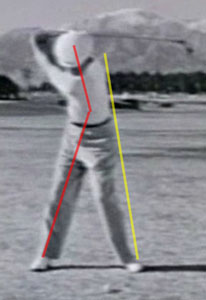 That MacDonald exercise 4 is a distortion because she is standing erect. If the she performed that same pivot maneuver while bending over 40 degrees, she would develop a reverse K posture - because the degree of rightwards torso tilt increases slightly more with each degree of forward bending. Jeff. |
Quote:
One of the main deals too is if you move your head back there . . . and then LEAVE IT back there or worse move it more back on the down stroke . . . . it's like a that bulldawg that chases Tom from Tom & Jerry . .. eventually the chain don't let you go no more . . . . hello my lil' friend Mr. Checkrein . . . . the dawg wants to keep going but can't . . . well in our case the dawg is the club . . . that hang back garbage leads to compromised flails . . . and at best a clubface that SLINGS shut REALLY REALLY fast. Fleeting clubface alignments = ball go everywhere if timing no good. You want a pivot that allows you to 1. Control Low Point 2. Control Selected Plane Angle 3. Have the ability to have a predictable Clubface motion |
Quote:
You guys can try to figure out the most biomechanically efficient pivot for creating speed if you want . . . I chose to pivot in a way that you get sufficient speed with out compromising precision. http://www.youtube.com/watch?v=bVZ0wY03rjk Hang back make clubface shut fast . . . |
Quote:
|
Quote:
|
12PB
I never stated that one should allow the head to move 12" in response to the pelvic rotation. I merely stated that the head would move by that amount if the golfer didn't deliberately restrain that natural movement by keeping the head stationary. Keeping the head stationary forces the mid-upper thoracic spine to become verticalised, which is a necessary biomechanical phenomenon if one wants to keep the upper swinger center stationary during the swing (which is very desirable). Jeff. |
Quote:
What does "natural" movement mean and in what context? Is there anything "natural" about swinging a golf club? I understand the deal with biomechanics . . . . but biomechanics to WHAT PURPOSE? Do biomechanic types know how golf clubs work? Golf instructors have created a whole world of slicers with this concept that you have to "get behind the ball." Question for you . . . . How would you teach a beginner to draw the ball? |
Quote:
Are you in some sort of whackjob cult or something meatball? |
Quote:
U know I have trouble reading between lines...... |
That Manzella drill is the worst crap I've ever seen.
You need to look into the bow / flex motion of the spine, and how it pertains to golf and other sports. |
Pivot Model
Quote:
And trust me, the Hogan Backstroke Pivot is a model for the MacDonald Pivot.  Head position, degree of Hip and Shoulder Turns, the Flat Backstroke Right Shoulder Turn, Knee and Foot Action . . . it's all there. The Pivot illustrated in the 'Guardsman' drill is a distortion of the Standard Pivot as defined (7-12) and illustrated (9-1 and 10-12-A #1) in The Golfing Machine. I strongly suggest you adopt the MacDonald / TGM model and leave the 'guard' duty to others. |
MacDonald's is simple - and guess what? It works! Golly, I spent my entire life examining 1000's of women and Mr MacDonald doesn't resemble any of my former patients. I wonder!
|
12PB
You wrote-: "Jeff . . . Why should we pivot like that?" Because there is no other way. What I mean is that if a human being does nothing more than rotate the pelvis 45 degrees by moving the right femoral head backwards/leftwards, and he lets his body/head move naturally/passively in an unrestricted manner, then he will end up with a reverse K posture. BM is exaggerating the upper body rightwards tilt motion. In a human golfer, who consciously decides to keep his head stationary during the 45 degrees pelvic rotation movement, the natural movement of the upper torso becomes restricted and that is why the mid-upper thoracic spine becomes verticalized (when it would normally continue to spiral rightwards in a natural spiral arc). Jeff. |
Quote:
Couple of questions would like to ask... Is there any way to have a "look" of 45 degrees hip turn that did not come from rotation? If you practice your quoted "drill", did you hit fat? |
Quote:
And what's the problem with "the natural movement of the upper torso becoming restricted and that is why the mid-upper thoracic spine becomes verticalized (when it would normally continue to spiral rightwards in a natural spiral arc)." Sounds like the way it should work to me. If it's optimum to have the head move off the ball . . . what's optimum the other way? Let it move forward and keep your waist bend? Why wouldn't you want to tilt your teacup on both sides? I've done a bunch of "unnatural" stuff in my day . . . so I ain't stoppin' now. How about this backswing? Unnatural? I think this is your pic too right? Is the Slammer servin' up pie? 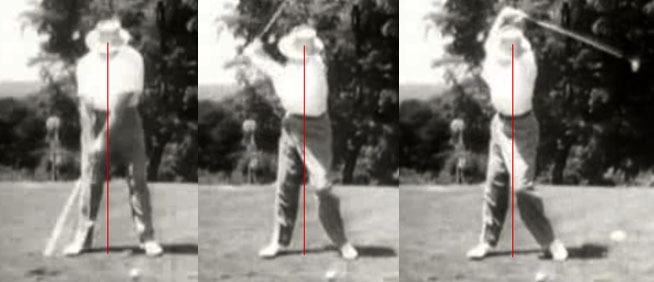   |
KOC
If the pelvis is square to the ball-target line at address, and then 45 degrees angled to the ball-target line at the end of the backswing, then it has rotated 45 degrees. How it got to that 45 degree rotated position could vary from a biomechanical mechanism perspective. For example, in my diagram I show how the right femoral head has moved backwards and leftwards. That could occur via different biomechanical mechanisms. One could use pelvic girdle muscles to pull the right pelvis back and secondarily the right femoral head back (because of its snug-relationship to the hip socket joint). Alternatively, one could shift the torso right-laterally against the resistance of a "fixed" right knee => that causes the deflected forces to slant the right thigh to the left => that drives the right femoral head left-backwards => then the pelvis moves secondarily to the movement of the right femoral head. I only tried the drill once to understand the biomechanics. I think that BM was using that drill to teach golfers not to sway the pelvis laterally, but to rotate the pelvis. Brady Riggs is teaching the same basic principle is this swing video lesson. http://www.youtube.com/watch?v=WvOr5...elated&search= Jeff. |
12PB
You wrote-: "And what's the problem with "the natural movement of the upper torso becoming restricted and that is why the mid-upper thoracic spine becomes verticalized (when it would normally continue to spiral rightwards in a natural spiral arc)." Sounds like the way it should work to me." I agree. I stated the same thing in the previous post. It is a good idea to keep the head stationary. That is my photo of Snead. It is interesting because Snead turned his pelvis more then 45 degrees (? 70 degrees). That causes the lower lumbar vertebra to move so far leftwards that the front of the lumbar spine will almost be facing away from the target. With the addition of an erect posture, one could then rotate the upper torso around a near-vertical spine. Then, one would not end up with a reverse K posture - like Hogan. In fact, Snead has a small degree of reverse pivoting. The reason is that he has a near-vertical spine, and then the addition of a >100 degree shoulder turn torques his upper thoracic spine even more left-of-vertical. Jeff. |
Quote:
I am seeing it a little differently. I am seeing Mr. Manzella creating some tilt by moving his head and shoulders back over the right foot. I am seeing Mr. Riggs create some tilt by moving his hips forward while keeping his head more stationary. Mr. Riggs motion reminds me a lot of VJ Trolio's Hogan "secret" move. I really like that motion. What am I missing? Kevin |
Kevin - we see reality differently.
I think that BM and BR are performing the same pelvic rotational movement from a biomechanical perspective, except that BM is deliberately allowing his head and upper torso to rotate as far as possible to the right (head is outside his inner right foot) to exaggerate the drill effect and to get that clubshaft perpendicular to the ball-target line. By contrast, BR is probably attempting to keep his head more stationary and within the boundaries of his stance. Jeff. |
Quote:
Thanks, Kevin |
Quote:
I'm confused Jeff . . . could we clear up exactly where we stand here . . . are we moving our head or not? We have one post where we've got people moving their head to their right foot . . . then we have posts where we should leave the head where it is . .. I'm lost . . . what was the point of the deal with the head moving over the right foot? What exactly is the biomechanic "optimum" . . . and "optimum" to what end? I think I got lost in all the spine talk as to what the point of this is . . . would you mind restating your position? Sorry to be such a doofus. |
Most folks see movements of the whole spine differently or similarly depending on what it is that they agree upon to see. There are three academically agreed upon sections of the spine that can manoeuver independently from each other or in concert with each other. If any or all of these sections pivot from a starting condition then there can be no sway (or bob). Each section can likewise sidebend, flex, or extend in concert or independently. The lumbar joints are typically less flexible and offer less range of motion than the thoracic joints, and thoracics likewise are less flexible and mobile compared to cervicals. Things get mighty complicated when the three sections are connected and thereby influenced by movements of scapulas, shoulders with humeral heads, pelvises with femoral heads, etc.
Regardless of the inherent complexity of observed spinal movements, if any section of the spine pivots from an original vertical, sidebent, flexed, or extended condition, then that section will retain its original condition. Otherwise the section or sections in question did not pivot. Most golfers start with a bit of sidebend away from the target with all three sections of the spine. If they truly pivot then the original sidebends are retained. Perhaps "pivot" needs to be redefined for golf swing observations and resultant commentary. Perhaps golf swing observations and commentary concerning pivots are intrinsically too difficult for the human eye to accurately perceive because in the pivoting of any object with girth, the frontal view of a point on that object will move in the opposite direction of a point 180 degrees away on the backside of the same pivoting object. If all agree that any segment of the spine is tilted or sidebent away from the target at address then all must agree that that segment will remain in that tilt or sidebend if it truly pivots thereafter, even though it may not look like it is truly pivoting from a different point of view. Otherwise we need to call segmental movements of the spine during the golfswing something else as we tend to do when we observe that at least a portion of the spine sidebends a bit more away from the target(secondary axis tilt) to facilitate a good downswing. By the way, I'm probably like most experienced video teaching pros in that I have never witnessed what I could honestly diagnose as a pure backswing or downswing pivoting of the segments of a given spine in any given swing I have ever analyzed. |
Beyond Reconciliation
Quote:
In your posted video, the excellent instructor Brady Riggs is advising (and executing) a pure, gyroscopic Pivot Motion. He is teaching golfers to rotate in a centered fashion -- "create space" -- and that instruction is correct. To even imply that what he is doing in any way represents the BM "Guardsman Head Sway" drill you posted above -- and are now defending in arrears as a "pelvis rotation" drill -- is an abomination to the sensibilities of intelligent golfers everywhere. We encourage debate on the fine points, Jeff, and we welcome your contributions. We also can handle being patronized (as long as we feel we are being educated). But, don't continue to insult us with obvious contradicitons. That tactic does nothing to further the objectives of this fraternity and destroys your own credibility within it. |
Dumb and Dumber
Quote:
:confused1 |
Really!
Quote:
:laughing9 |
A Rose By Any Other Name . . . Is Still A Rose
Quote:
A Sway. It robs the Pivot Motion of its Center; disrupts the ideal Centered Arc of the Clubhead; and deserves well its exalted status as the 4th Snare (3-F-7-D). Absent its necessary Center, the Pivot fails to maintain its essential geometric alignments and is thus "only superficially correct" (7-12). Hang in there, Kevin. You're on the right track. Study 1-L #1 and #2. Be extremely skeptical of novel ideas -- from whatever pulpit preached -- that don't square with these axioms. |
Common Sense And Pivots
Quote:
:sad: |
Yoda - you wrote-: "We encourage debate on the fine points, Jeff, and we welcome your contributions. We also can handle being patronized (as long as we feel we are being educated). But, don't continue to insult us with obvious contradicitons.
That tactic does nothing to further the objectives of this fraternity and destroys your own credibility within it." ----------------------------------- You seem to be implying that I am acting in "bad faith" by tactically trying to get away with some obvious contradiction. That's terribly unfair! I may be arrogant and stupid and uninformed and totally wrong, but I am not trying to intentionally mislead anybody. I got that BM drill from this BM article. http://www.brianmanzella.com/forum/g...backswing.html Brian was concerned that golfers tended to reverse pivot if they rigidly kept their heads too still. He suggested that a golfer should learn to pivot the pelvis correctly by having a free rotation of the pelvis that would allow the spine to acquire a rightwards spinal tilt. Brain was not concerned if the head moves slightly to the right. He wasn't promoting a deliberate movement of the head. He was simply stating that it is more important to keep the base of the neck still. His exaggerated drill may produce an excessive upper torso tilt to the right and excessive head shift to the right, but he was not encouraging upper torso swaying (which is a lateral torso movement without a major rotary component). In fact, I think that he was essentially dealing with the same problem-issue that Brady Riggs was talking about - a reverse pivot due to swaying the pelvis right-laterally instead of rotating the pelvis. Both instructors were encouraging a movement of the right femoral head left-backwards, thereby inducing a pelvic rotation, and that pelvic rotational movement would naturally cause the spine to become more oriented towards the right (as I previously described). I think that both golf instructors are encouraging the correct method of rotating the pelvis in the backswing, which inevitably causes the spine and upper torso to acquire a rightwards-tilt. However, my personal belief is that this reverse-K postural movement should not be exaggerated to such a degree that the head moves more than 1-3" right off its central position. My personal bias is that a small amount of rightwards head movement is acceptable during the backswing, but that it is very unacceptable to allow the left side of the head/face to move closer to the target at any time point during the backswing or downswing (compared to its address position). I may be wrong in my opinions, but I am definitely not trying to mislead anyone or reconcile obvious contradictions. Jeff. |
Jeff,
Pay attention to photo sequence 1, 2 and 3…compare 1 and 2, compare 2 and 3 then 1 and 3 1. Standard Address… http://img339.imageshack.us/img339/9807/36972075ho3.jpg 2. Half way back and look like what Jeff’s opinion…head, spine toward to the right… http://img265.imageshack.us/img265/7383/56936993wp5.jpg 3. Top of the swing….and strange thing happened…head back to where at address http://img339.imageshack.us/img339/7079/61007507sn8.jpg Last two…just great, nothinig to say! http://img211.imageshack.us/img211/662/70076097tl9.jpg http://img339.imageshack.us/img339/9824/57284338wa6.jpg p.s. Hope that the teacher doesn’t mind my attempt to verify a few points as other quoted his drill. |
Quote:
Not sure how that drill encourages the base of the neck to be still but whatever . . . . So now that we know your theory on proper backstroke pivoting . . . . What should the head do on the way through the stroke? Move forward the amount it moved back or move forward that much more or just stay back there? That article doesn't mention anything on the spine's ability to side bend or extend in either direction . . . . If you don't extend your spine on the backstroke you'll end up looking like the drill does. |
Quote:
I'm here to learn some TGM structure. Thanks Yoda for keeping us on the proper path! Kevin |
12PB
You wrote-: "Not sure how that drill encourages the base of the neck to be still but whatever . . . ." I don't think that you understand why he proposes that drill. I think that many beginner golfers tend to reverse pivot. One cause is a tendency to "fixedly" keep the head still while swaying the pelvis right-laterally (as demonstrated by Brady Riggs). That causes the upper torso to sway to the left in order to keep in balance. All these lower and upper torso motions are lateral swaying motions without any rotary component. What both BM and BR are saying is that one needs to rotate the pelvis during the backswing. I believe that the natural result will be the production of a reverse K position - as previously described. Therefore, a golfer must have the distinct feeling that his upper torso is slanted to the right. BM was presumably promoting that exaggerated drill so that a beginner golfer would get the "feel" of how the upper torso slant-rotates to the right when the pelvis rotates 45 degrees back. That doesn't mean that a golfer should have that amount of right slant-rotation of the upper torso in his "real swing". I think that it is better to minimise the slant-rotation of the upper torso so that it doesn't move the head back more than 1-3". I believe that any unnecessary movement of the head or upper swing center is a disadvantage because it means that the golfer has to move back again in the downswing. It is possible to keep the head back and not move it forward to where it was at address and still hit the ball well. Tiger Woods does that - see next image. 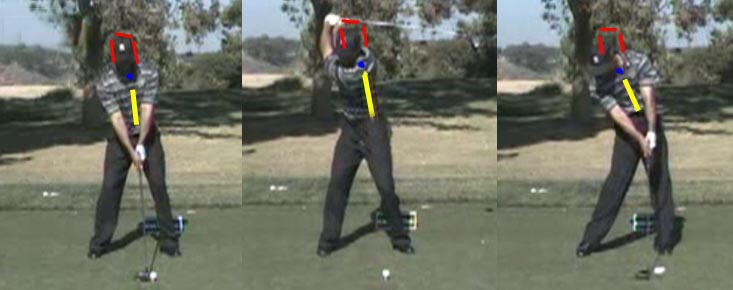 Note that his head moved down-and-back in the downswing. I think that it doesn't affect his swing because his upper swing center (blue dot) remains in the "correct" position. I am not at all promoting any unnecessary movement of the head. My favorite swings are of golfers who keep their head stationary despite acquiring a reverse-K position at the end of the backswing. Here are two examples. 1) Mike Finney. (requires Applet to view). http://homepage.mac.com/brianmanzell...ver05front.mov 2) Anthony Kim http://www.youtube.com/watch?v=oqmejmw-lu4&NR=1 http://www.youtube.com/watch?v=Cuu6KJZMUdg The first video shows that he gets a lot of rightwards slant-rotation of his upper torso by the end of the backswing. Also, one can learn a lot about spine movements by watching that second view. Note how his mid-upper thoracic spine gets torqued by his large shoulder turn and how its verticalizes his mid-upper thoracic spine, and therefore allows him to keep his head stationary. That is optimum from my perspective. He doesn't allow his head to move as far rightwards as BM. Jeff. |
Kev
My theory is that BM gets his head too far to the right during the mid-backswing because he starts off with his head too far over to the right at address. I suspect that he keeps his pelvis central and then tilts his upper spine to the right at address. That moves his head to the right of center of his stance. Then, when he rotates his pelvis in the mid-backswing, his head moves further rightwards. I think that he would be better off if he followed Yoda's advice for getting rightwards spinal tilt at address - keep the head centralised between the feet and then shift the pelvis sightly to the left. Jeff. |
Quote:
What is a "reverse pivot"? I'd like to define terms please . . . How would you teach those reverse pivoting beginners to hit a draw? |
Small Crowd
From your post #26 above:
Quote:
Quote:
|
Tiger's driving accuracy . . .
Driving Accuracy Percentage 57.86% 169th Total Driving 1,998 197th Total rank from stats 1 & 2 Not sure about all this analysis . . . but here's a Tiger swing that I'd say is at the very least DIFFERENT . . . http://www.youtube.com/watch?v=eUl82HFvFVM GIR Stats . . . Greens in Regulation Percentage 71.39% 1st Wonder what may happen if he swing a little more like this with a driver? hmmmmmmmmmm. |
Yoda - very good point about Hogan. That demonstrates my foolishness and yet again demonstrates to me that I should never make strict rules that are not 100% biomechanically solid. Hogan slides his pelvis quite a lot left-laterally in my photo series and that moves his torso/head slightly leftwards. That's obviously not a problem for the golfer who is without doubt one of the greatest ball strikers in the history of golf.
It is interesting that VJ Trolio shows in his book that Hogan didn't have that much slide later in his career. In fact, he states that Hogan didn't have any slide during the downswing because he moved his pelvis left-laterally in the backswing. I am still conflicted by this issue and I wonder if there was a major change in his pelvic movements later in his life, or whether we are having a problem with camera angle distortion issues. Jeff. |
Quote:
I still don't get all this . . . I got no beef with biomechanics . . . but to what end? Are we trying to hit it the farthest? Are we trying to hit it far and straight blending the two? How much distance are we to believe Tiger is gaining by moving his head back and bobbing? Or is that an accuracy deal? |
12PB
I am a student of golf biomechanics because I think that a golfer is likely to swing better if he moves in a biomechanically natural manner. That's why I constantly study the swings of good players to try and identify biomechanically sound golf movement practices that are consistent with sound TGM mechanical principles. HK did wonderful work on the mechanics/physics/geometry of the golf swing, but he didn't have much to say about how the body must move biomechanically to achieve desirable TGM practices. I suspect that Tiger Woods' head falls back-and-down because he develops so much secondary axis tilt in his driver swing. He has far less secondary axis tilt in his mid/short iron swings. I simply define a reverse pivot as a backswing action where the spine tilts left towards the target, so that the golfer is leaning over to the left at the end of the backswing. I think that a severe reverse pivoting golfer cannot hit a draw because he is forced to throw his club OTT to get his hands down to the ball. There is no space below the right shoulder as occurs when a golfer has the standard pivot-driven swing which allows one to establish a reverse-K look at the end-backswing position. Jeff. |
| All times are GMT -4. The time now is 05:08 AM. |