
|
Quote:
|
I think that a reverse-K position is simply a sign of a good backswing pivot action. One can shape all types of shots from that position.
A golfer can draw the ball slightly by swinging down the ball-target line and employing a horizontal hinging action. Or, to increase his draw power, he can perform the same action but have a plane line that is closed to the ball-target line while still having his clubface pointing at the target at address. I don't identify any necessary causal connection with the reverse-K posture at the end-backswing. Jeff. |
Quote:
Horizontal Hinging = Draw? Do you think you can hit a draw with a vertical hinge motion? Do you think if the head hangs back the club goes left faster? Would the face shut faster? Does the face have to rotate to hit a draw? |
I just had a "great find" experience on U-tube - an overhead swing video view of great golfers. That allowed me to study their hula hula flexibility.
http://www.youtube.com/watch?v=StKkT9sTTtQ As you can see, they all have great hula hula flexibility. Here is their end-backswing position. 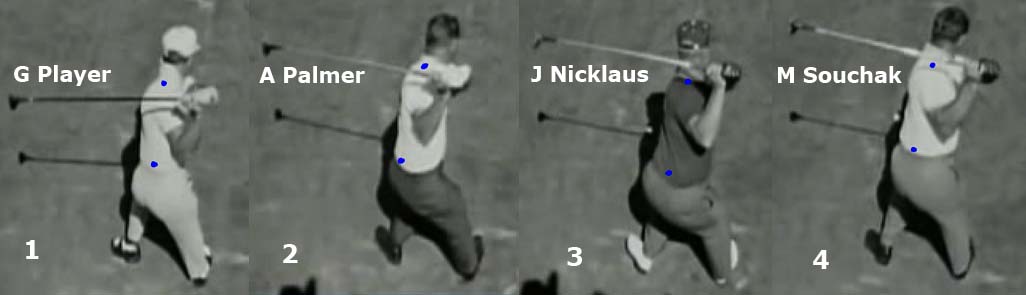 I placed blue dots over L5 and C7. Note that all the golfers have-: 1) A good pelvic rotational movement in the backswing. 2) That pelvic rotation causes their lumbar spine to have a rightwards orientation. 3) A large shoulder turn that torques the mid-upper thoracic spine, and verticalizes it. 4) Rightwards tilt of the spine and the upper torso thereby producing a reverse K position at the end-backswing. Jeff. p.s. Side-issue - It's interesting to see how much Palmer's left foot rotates during the followthrough/finish phase of his driver swing. |
Quote:
Pretty cool to look at their hip slants and the angle of the right leg . . . those backswings are pretty close. We can debate all that reverse K and stuff . . . but the all look they are going to tip over to the left in these pics to me. As to the side issue . . . place your cursor on Player's left hip . . . . see how much more forward his hips go . . . no place it on Palmer's . . . his hips don't go forward very much at all. Palmer has way less axis tilt than Player. This is one of the big deals in Palmer's whirly bird finish . . . he don't push his hips foward . . .note Souchek has the same deal going on. You can see the results of these moves too . . .Look at the down the line views. Pause Player when his left arm is parallel to the ground on the downstroke . . . note how much more back and in it is. Pause Palmer . . . he's more "out" on his plane . . . shifted his plane line left due to not getting tilted as much. Also note how FAST Player releases #4 . . . I like Player has a nice motion . . . he had to get a lot out of his body power lb 4 lb. I have seen the video before . . . but great job on the pics. Thanks for sharing . . . Should we continue the fight :) |
Here's some nice footage of Palmer . . .
Pretty steady head . .. http://www.youtube.com/watch?v=wGoA0FjQUZ0&NR=1 |
12PB
I am not into 'fighting". I am into sharing different perspectives. You think that they all leaning left, while I think that they are all leaning right (C7 further away from the target than L5) . Jeff. |
Quote:
Nice video and pics . . . thanks for putting them up. |
Homer's Position On Backstroke Spine Angle
Quote:
In The Golfing Machine and in his recorded teachings, Homer Kelley never once mentioned Backstroke Spine Angle. He never once mentioned "leaning left" or "leaning right" or even "staying vertical". All he asked was that golfers understand the necessity of maintaining a fixed point at the top of the Pivot (Pivot Center / The Glossary). He recommended the Head but did not mandate it (2-H). In fact, he offered an alternative, i.e., the "point between the shoulders" (Stationary Head / The Glossary). <table border="0"><tr><td> <img height="300" src="http://www.lynnblakegolf.com/forum/imagehosting/thum_42249447123a40c9.jpg" /> </td><td> </td><td> <img height="300" src="http://www.lynnblakegolf.com/forum/imagehosting/thum_422494471e63c806.jpg" /> </td></tr></table> He expected that we readers could see the obvious validity of a Centered Arc (1-L #1 and #2) and made little bones about it in the first six editions. He simply illustrated the Standard Pivot (Photo 10-12-A #1) and placed a white marker behind his model's head (Photos 9-1-1/12). See also the Top in Photo 9-3-6. All clearly indicat that the Pivot Motion should be Centered (and emulated as depicted). As he prepared his revisions (in 1982-83) for his 7th edition (published posthumously in 2006), he realized our ineptness -- his three Authorized Instructor GSEM Classes helped here! -- and added this explicit text: The important thing is that the true Swing Center for ALL COMPONENTS is around a Hinge Pin with one end at the top of the Stationary Head and the other in the ground, precisely between the Feet, with no regard for Body Location or Position at any time. [All text effects by Homer Kelley / 2-H.]"Swing Center" . . . "ALL COMPONENTS" [including spine] . . . "Precisely between the Feet." Jeff, on your wonderful captured overhead photos of these four great golfers, please draw a vertical line from Mr. Kelley's "true Swing Center" (the Turned Head or the 'point between the shoulders') to the ground, and let's see where it lands. Thanks. :salut: |
Yoda - you wrote-: "All he asked was that golfers understand the necessity of a fixed point at the top of the Pivot (Pivot Center / The Glossary). He recommended the Head but did not mandate it (2-H). In fact, he offered an alternative, i.e., the "point between the shoulders" (Stationary Head / The Glossary)."
I think that the upper swing center is a better reference point for the idea of a fixed point at the top of the pivot. I think that the upper swing center usually remains more stationary than the head in a good golfer. I don't need to draw lines on those photos for forum members to mentally picture the location of the upper swing center. It is defined as a point midway between the shoulders - which is roughly a point within the chest cavity a few inches in front of T2 vertebra. That point is about 2-4mm (actual amount dependent on computer screen resolution) south-east of the C7 blue dot in those photos. A vertical line drawn down from that "imaginary" point would hit the ground roughly in the center of their stance. Jeff. |
Just Do It
Quote:
You've made this a big deal, and it is a big deal. You've been drawing lines for some 90 posts in this thread, and I've studied and appreciated every one. Don't wimp out now . . . Just draw the lines. :smile: |
Yoda - I got stuck trying to draw those lines.
I have lost confidence in my ability to accurately locate the upper swing center. I can see the right shoulder. Now, I have to mentally "picture" where the left shoulder is located - which depends on the degree of shoulder rotation and the angle of the shoulder turn relative to the ground. I cannot clearly "picture" where the left shoulder is located in this birds-eye view where the upper torso is so spiraled. Can you offer any advice? Jeff. |
Drawing Assignment . . . No Creativity Required
Quote:
I truly value your visual and textual additions to LBG. Thanks once again for your insights! :salut: On this assignment -- thank you for your indulgence -- I gave you an explicit directive: Draw a vertical line between either of Homer Kelley's recommended Pivot Centers, i.e., the Turned Head or the 'Point between the shoulders', and the ground. Take your choice . . . there's only a fraction of difference between the two (if that).In other words, the pressure's off: I'm not looking for an assessment of your nouveau "Upper Swing Center" or its relation to the Left Shoulder's Rotation or the Spine's Spiral. [Great stuff for a new thread, though. Have at it! :smile: BTW, with all due respect to your term "Upper Swing Center", Homer's term Pivot Center works better for me. There can be only ONE Central Axis in a Centered motion. Your term implies there are (at least) two: An Upper and a Lower. Now, that may well be your model (if so, please address that, too.]For now . . . Please just draw a vertical line between your preferred 'Homer Center' and the ground. Personally, since you've asked my advice, I'd start with a vertical line touching the left side of the Turned Head. :golfcart2: Thanks! |
Yoda - here is a revised image with red lines drawn alongside the left side of the turned head.
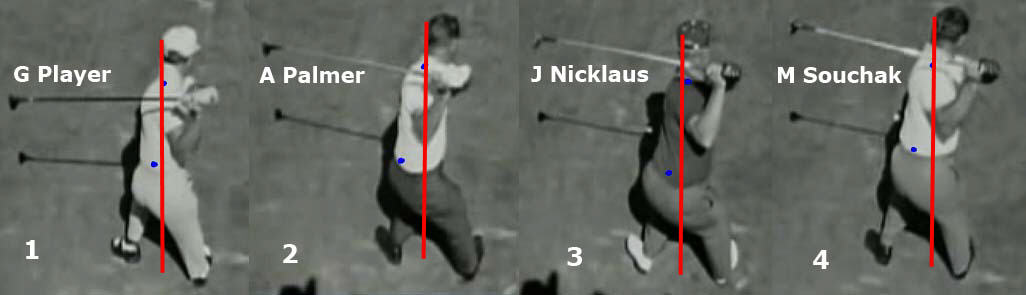 I started to use the term lower swing center after reading the Golf Digest S&T article, where Bennett/Plummer used the term to indicate a point midway between the hip joints. Jeff. |
Mr. Right
Quote:
Homer Kelley and his advocates (including me) have taken a lot of heat in some quarters for his teaching that the "true Swing Center ... is around a Hinge Pin ... precisely between the feet" (2-H / 7th edition). Your work provides ample proof that he was right . . . Again. :salut: |
It appears to me that Player is off plane at the top with a bent left wrist.
Palmer arched left wrist. Nicklaus and Souchak flat left wrists. What do others see? I moved this post to another thread, "Clubshaft Alignment at the top". |
| All times are GMT -4. The time now is 05:07 AM. |