|
Line Country
Quote:
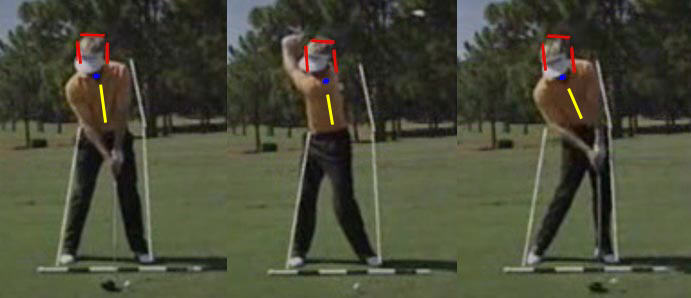
Thanks for these sequences. We all do better when we can actually see these principles in action, and your skills in this area are a wonderful contribution to the educational mission of our site. A question regarding your sequence of Stuart Appleby: In Photos #1 and #3, my guess is that the yellow line represents the spine and its inclined angle to the ground ("axis tilt"). But what does the line in Photo #2 represent . . . the original angle per Photo #1? Thanks. :salut: |
Quote:
 |
Quote:
I cannot get the link. |
Quote:
Yoda, When you teach your students the correct pivot, do you than teach them the pivot while they at the same time are aware of their hands or can you teach the pivot separately of the hands? Thanks |
Zone One Training
Quote:
However, I always coordinate this training with the On Plane assignments of the Hands, using a series of drills that emphasize Clubshaft alignments with the Plane Line. :salut: |
Yoda - the yellow lines represent the spinal tilt angle.
The yellow line in photo 2 is only an approximation because I believe that it is impossible to accurately represent the spine position when the golfer is at the end-backswing position - when viewing the golfer from a face-on view. At the end-backswing, the pelvis has rotated about 45 degrees and the shoulders about 90 degrees. That causes the spine to twist in a spiral manner, so it is impossible to draw a single line as being accurately representative of the degree of spinal tilt (of a spiral structure). I draw my "approximate spine line" as follows. I know that the pelvis rotates 45 degrees in the backswing which shifts the lowest lumbar vertebra to the left. I then start the bottom of my line just left of center (approximately where I think the L5 vertebra is located). I then look for a point at the base of the neck where I imagine the C7 vertebra is located (which is near the blue dot = upper swing center between the shoulder blades), and I draw a straight line between those two points. Jeff. |
"Show Some Backbone, Will Ya?" -- Indiana Jones
Quote:
I respect your scientific and biomechanically-based methodolgy, but . . . I also trust you and your innate sense of movement! Please gimme a Jeff's freehand approximation of the "spiraled" -- I agree with and love this description! -- spine angle. With all due respect to any perceived straight-line relationship between L5 and C7, just let it go, and let's see what we get. [Can we use the color red? I like red!] Then, let's compare that rendering to the yellow line. FWIW, it appears to me that the Head has remained within its 'box' during the Backstroke and that the Hips have Shifted decidedly to the right (we now can see a pine tree!). And that means -- according to my own theoretical 'grandfather clock' model expressed above -- that the lower spine tilts ever so slightly 'away' from the target on the Backstroke, not 'toward' it. Whatever it is, is, of course . . . So, let's figure out just what is, is. Sounds like I ought to be running for office! :laughing9 |
Yoda
I personally don't think that there is any advantage trying to free-draw a spiral line on a face-on view. If I did, I think that it would approximate the overall angle of that yellow line. The following capture photo taken from a birds-eye view swing video may help you make a point. 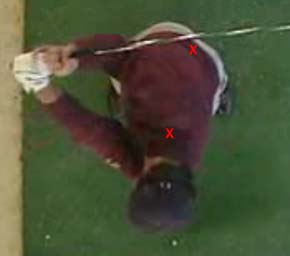 I have placed a red X over the position of L5 and C7 vertebra (based on my best guesstimation as a person with a BSc degree in anatomy and a MD degree). I have not drawn connecting lines because I think that the spine spirals too much (especially in the mid-upper thoracic spine region). However, it cannot be too far from an imaginary straight line drawn between those two points. I am sure that you have stood behind a golfer at the end-backswing position and run your finger up his spine to get an idea of how the spine spirals. Jeff. |
For reference only...might be or might not be useful...
   |
Yoda - here is another series of images that you may enjoy.
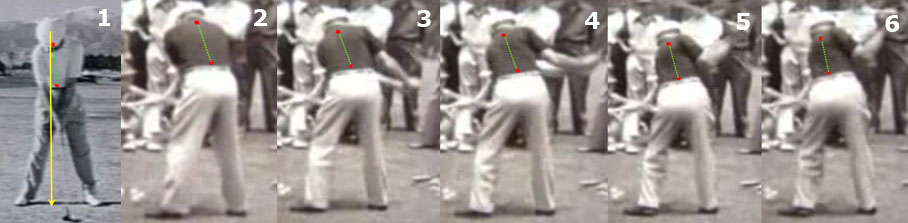 The two red dots were placed approximately over L5 and C7, and the green dotted line is simply a straight line joining those two points. It may look like the spine is tilting left. However, that is only because one is looking at a three-dimensional motion (viewed from an angle) as a 2-dimensional image representation. Conceptually, I have no reason to believe that the spine angle tilt changes during the backswing action - even though the spine is spiraling in space. Jeff. |
| All times are GMT -4. The time now is 02:39 AM. |