
|
Luke, Drewit anybody.
1L-11 "Clubhead Force and Motion is On Plane at right angles to the Longitudinal Center Of Gravity and varies with the Speed , Mass and Swing Radius." Im having trouble picturing this one fully. By clubHEAD is he referencing the force and motion of lag pressure? What is meant by "right angles to the LCOG"? Is LCOG referring to the string or the sweet spot point on the clubface? Where does force (when focused) point? Down the sweet spot plane and tracing the plane line like a laser or flash light? I dunno. I really dunno. OB |
Quote:
Maybe but I tend to think that there is a very good reason that manufacturers dont make clubs that way. I think. They would never lie to us would they? No need for an answer. Remember titanium centered golf balls? Perhaps trying a center shafted, face balanced putter at full speed vs a heel shafted, toe drop one would answer this question but maybe ruin some putters. Im thinking that with the face balanced one it would be harder to control the initial direction of the ball (face angle) and less powerful. Just a guess though. I do know that Homer thought the old school 1930's longer nosed irons enabled CF to "have more control over the alignment of the club face, more powerful, more difficult to disturb". Here is the link to the Croker sites audio tape. Its mainly about hip motion, action, Hula Hula etc but about 5 minutes in there is some stuff relevant to this discussion. http://www.crokergolfsystem.com/Home...n_2-64kbps.mp3 Cheers OB |
Quote:
Hey Jeff Nice thread again. With lots of contributions and food for thought. I have responded above In caps. Regards OB |
OB Left
You wrote-: "MAYBE THEY THINK THEY ARE DOING THAT. BUT IF THEY ACTUALLY ARE ROTATING THE CLUBHEAD ABOUT THE HOSEL , THEY ARE IN FOR A SHANK". I don't think that a golfer ever rotates the clubhead around the clubshaft axis. It only "feels" like it is happening when the golfer notes that the toe passes the heel in the followthrough. What causes the clubface to close is simply the phenomenon of the flat left wrist/hand rotating in space. What causes this rotation? Pre-impact, the release swivel action is due to external rotation of the left humerus within the left shoulder socket combined with a small amount of left forearm supinatory movement - all these biomechanical actions are passive and are merely the reversal of the rotary biomechanical actions that occurred in the backswing. Post-impact, the flat left wrist/hand rotates around to the left due to a horizontal hinging action, which is biomechanically due to external rotation of the left humerus within the left shoulder socket while the left shoulder socket moves left/backwards due to continued torso rotation. The clubface remains neutral relative to the left hand and it doesn't roll-over relative to the flat left wrist/hand because the left hand always firmly grips the club and never allows the clubshaft to rotate within the grasp of the left hand. The clubface simply rotates to exactly the same degree as the flat left wrist/hand rotates pre-impact and post-impact. Jeff. |
1 Attachment(s)
Quote:
I think there is more at play here than just the swivel. Swivel does play a part but not the only part Im guessing. Consider this photo of Homer Kelley. Somewhere on this site (I cant find it) is a post by Yoda describing what it is that Mr Kelley is swinging around his head. Something like a balsa wood club head with a small metal screw acting as the sweet spot and creating a COG similar to a real club. You'll note the position of the string from #3 to the sweet spot. Not so "imaginary" here is it? Also of note is that the club face stays aligned nicely via CF without any involvement what so ever of forearm rotation or swivel. It was Yoda who took this photo, he said the smiles seen here were due to Mr Kelley's first failed attempt that saw the string wrap itself around his body. Regards OB http://www.lynnblakegolf.com/assets/...attach/jpg.gif |
PP#2 vs PP#3
Yodasluke. Anybody.
Why should the "virtual clubshaft" be defined as the string from pp#3 to sweetspot? Why not pp#2 to sweetspot instead, since the CF is involved with pp#2 as one of the swing centers? |
Quote:
|
39 for a few more days
Quote:
I'm 39 until the 26th of this month. I'm aware that some use age as an excuse, but I won't put up with that garbage. Tell them to get in the gym, take a lesson, or stop complaining. Unfortunately, there's news that they are eliminating the Super Senior Division at the World Long Drive Championship. There's a man that's taken many lessons from me that has competed in the event. But if you saw him walk up, you'd bet your life savings that you could hit it past him. He's presently 60 years old, and he's had both knees replaced. He doesn't walk as well as he swings. He just set his personal best drive of 343 yards, last year at 59 years old. Another student, age 51, is the one that I've written about recently that in one year has gone from 84 mph with the driver to averaging well over 100 mph in clubhead speed. He's having the time of his life and has taken double digits off of his handicap. So, I'm not playing the violin for your "old-timers". I don't believe that Gary Player will drop a tear, either. Quote:
Quote:
|
Yodas Luke
You wrote-: "I'm 39 until the 26th of this month. I'm aware that some use age as an excuse, but I won't put up with that garbage. Tell them to get in the gym, take a lesson, or stop complaining." Phew! I have seen that attitude among many golf instructors. It is a great pity! The problem is not age per se, it's age-related physical inflexibility problems. Many elder people don't suffer from age-related flexibility problems - like Gary Player. However, others do - like Arnold Palmer. He has such poor torso flexibility at present that he virtually has to stand erect to execute a torso rotation. The age-related torso inflexibility problem is not remedial with gym workouts if the problem is genetic - an increased age-related genetic predisposition to calcification of spinal ligaments and/or increased fibrosis of the intervertebral discs and paraspinal ligaments that causes a major loss of disc/ligament elasticity. OB Left That photo of Homer has no relevance. Look at how he swings the string - his hand and arm is outstretched away from his body. In a "real" golf swing, a swinger has his right elbow in a pitch position alongside his right hip at the delivery position with the right elbow still bent - like Aaron Baddeley in the next photo. From that position, consider the biomechanical events involving the left upper limb that must occur if he wants to rotate the flat left wrist/hand 90 degrees into impact. 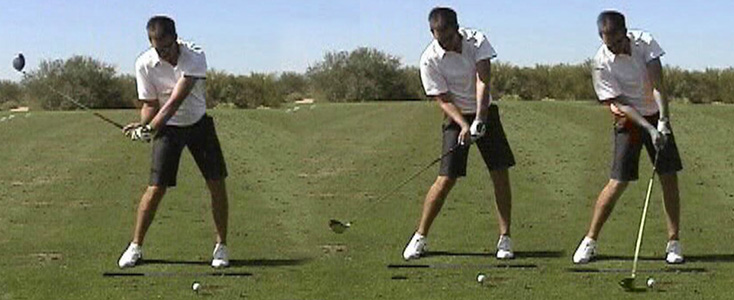 Jeff. |
Quote:
Id bet that in Homers swirling balsa wood clubhead experiment, the club face conditions and string line from #3 to sweet spot would be present regardless of any degree of bend in his right elbow. These things have nothing to do with the right elbows condition in his demonstration. That is the reason for the string line, there being no mechanical or rigid connection, just CF seeking to establish an aligned club face. This should be good news! I cant fathom how to play good golf without this sweetspot "feel". This phenomena is our best friend when properly applied. Imagine swinging the club shaft instead: "Ok so this is now my pitching wedge and therefore given its heel to sweetspot measurement of x inches I now need to swing x inches parallel to and inside of the target line" And then, "Now for a 9 iron the measurement changes so Im just going to swing ........Ok now for my 6 iron which has a different measurement again .......etc etc. A different plane line for every heel to sweetspot measurement! Why not just swing the sweetspot at the ball or aiming point? It's the sweetspot that our hands feel afterall. OB |
| All times are GMT -4. The time now is 09:19 PM. |