
|
Hula like pivot
It has been a long time, 3 months after my elbow accident, I have not start a thread here.
During the "No Golf" period, I typed the whole TGM book into a file and that was a great experience to re-read the whole book and easy to find any "words" of the book and continue to find "my way" along with Bruce Lee's JKT concept and V.J. opinion on Hogan missing piece and the 5 lesson book. In recent practice sessions, although my elbow was still a lil’ bit not feeling good, I finally felt that I got it through as I could "feel" any target and react to the target with a very high % of pure strokes. Pre-called stroke of 6-iron could successfully fly 190y+ (longer than before accident); 150y, 100y or 5y. That was really a surprise. I would like to share a photo of a 50's golfer, Fred Gronauer illustrating a so-called "hula like pivot" which claimed to be in perfect balance and control during the swing. This golfer is also referenced in the book of V.J. Hogan Missing piece...a few who identified the missing piece.  Hogan said in his 5-lession..."The first really important change I effected was the action of my left knee. Mine used to shoot straight out when I took the club back. Ed Stewart's knee, I noticed, broke in nicely to the right. I practiced correcting my knee action on the lawn at home until there was no lawn left.... " Homer also used the heading "Hula Hula" for 7-14 and 7-15…I think it’s time to hula hula and “be water” my friends! |
Clear Your Right Hip (For A Change)
Quote:
From the waist down, very few 'average' golfers look like Gronauer (or, for that matter, Vardon or Jones or Hogan or Snead or Nelson or Palmer or Nicklaus or Trevino or Mickelson or Singh or any one of almost all the great players in history). <img src="http://tbn0.google.com/hosted/images/c?q=3a981a091d9e0731_landing" /> In other words, most golfers don't fully clear (turn) their right hip. Hence, their left knee is not pulled around so that it points behind the ball and their left heel is not pulled off the ground. Or is the other way around? Their left foot remains flat on the ground, their left knee points forward and their right hip doesn't turn. Either way, the Pivot fails to function as it should, the Hands cannot possibly take their required route, and performance remains 'average'. There are at least three reasons for this malfunction: 1. They don't know they are supposed to do it, therefore they unconsciously are not doing it. 2. They are following some modern theory, e.g., "X Factor", and therefore they consciously are not doing it. 3. They have some form of disability that prevents them from doing it, even though they know they should and would if they could. In my experience, the third reason is rarely the case, so most average golfers -- and even many above-average golfers who are not playing to their potential -- fall into camps one and two. If you're tired of being 'average', I suggest you print out the Gronauer photo, and tape it to a full length mirror. Then, practice your lower body move until you look like him from the waist down. I asked Homer Kelley one time why most golfers were average (at best) and did not improve. He didn't hesitate a second: "They don't clear their right hip." Now you know what to do, how to do it and have been encouraged to make the change. Go for it! :golfcart2: |
Thanks Yoda and the quote "They don't clear their right hip." That's money!:salut:
|
Yoda - excellent post.
A good right hip clearing action allows a golfer to create a good reverse K alignment - like Hogan in the next photo. 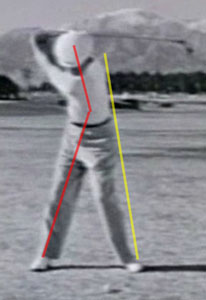 Jeff. |
3 Attachment(s)
Here are my "right hip back" hall of fame photos. The long haired guy had a nice action and could really hit a fairway wood according to some.
O.B. http://www.lynnblakegolf.com/forum/a...d=122858456 6 http://www.lynnblakegolf.com/forum/a...d=122858459 5 http://www.lynnblakegolf.com/forum/a...d=122858461 5 |
Ohh thanks for this timely reminder. I was just writing down somethings that I learned at Cuscowilla and clearing the right hip was one of them. Pulling my left foot off the ground is something that is not in my swing and I really didn't think about it as I can swing to the top of the backswing without lifiting my left heel off the ground but it has been noted that I have trouble clearing my right hip properly.
Alex |
Quote:
|
Perspective Matters
Quote:
Please, somebody put in the appropriate 'spine line' here. Thanks! :salut: |
The red line doesn't represent the spine angle. It represents a line drawn from a point just above the lower swing center (midpoint between the pelvis) and the center of the head, and it roughly represents the slant of the upper torso away from the target. I think that the spine is situated behind the red line, but very close to being parallel to that line.
Here is a view of Hogan from behind and one can clearly see his rightwards tilted spine, although his right thigh slants left-upwards -that gives him the reverse K position.  One can see where his lower lumbar vertebrae are, and roughly where the base of the neck is situated. A straight line drawn between the lowest lumbar vertebrae and the base of the neck has a rightwards tilt and therefore the spine must have an overall rightwards tilt. However, the upper thoracic spine is always verticalised in a golfer who has a big shoulder turn that torques the upper thoracic spine. That gives the spine a S-shaped (spiralised) appearance, which often leads to unresolved debate about where the spine is precisely located. Jeff. |
Hogan's Back At Top -- Pie Or No Pie?
Quote:
Thanks for this Start Down rear view. Homer Kelley defined 'balance' as keeping the Center of Gravity "Inside the Stance (Glossary). Please draw a line from the Pivot Center (Top / Turned Head or Point-Between-the-Shoulders) to 'Between the Feet' as you deem fit). Then, lets discuss any anomolies you find. Thanks. |
Yoda - here is the photo from VJ Trolio's book.
 Feel free to make a comment? Jeff. |
Quote:
|
http://www.youtube.com/watch?v=V7eIVD8OZAE
Here's some Hogan footage . . . . Almost looks like he gets his spine in front of the ball. http://www.youtube.com/watch?v=rIBHnO6nSq4 Not convinced on that K stuff. |
Bucket, if this video is of you in a grass skirt, I'm not clicking....
|
Quote:
|
If everyone on the forum donates $5 we can get that Hula Studio you always wanted turned from dream to reality.
|
Quote:
|
Quote:
My first thought was changing component 10-14 to 10-14-D Reverse Hips, but perhaps 10-14-C Shiftless is more applicable. Am I even using the proper thought process? Apologies in advance if it's a silly question, just trying to learn... Thanks, Kevin |
"I'm not sure this is a "true" top pic . . . it's startdown." :naughty:
I think it is closer to top. Which is the point VJ makes in his book. He is over there before he starts down. Which does make it top. You can tell when you see the video, the shaft is not stressed yet when his lower body is already shifted. So he get its over there, then starts down. I believe Vj has the sequence correct.:) |
Quote:
But what I will say is IF Hogan has created proverbial "PIE" at Top (which I'm not sure he has by strict definition) . . . he HAS NOT DONE IT by moving his head off the ball like some sort of Jimmy Ballard type move. IF he makes it . . . it's because his hips went forward at some point NOT because his upper body went right. AND again . . . . you can find swings were Hogan doesn't do that move in the backstroke. But the thread was about Hula Hula . . . . Hogan's head doesn't "load" right much typically but his hips do go right and then back left again . .. and then they continue going left as much as anybody that has laced 'em up. . . . HULA HULA. |
12PB
You wrote-: "NOT Yoda . . . but most of that spine is left . . . Looks like the upper and lower are pretty much lined up". We see reality very differently. I see the classic Hogan reverse K position with a lot of rightwards torso/spinal tilt. The upper torso/spine is only left-of-center because his entire pivoting body is left-of-center. That body-left-of-center pivot is classically seen in the S&T swing (where the body is loaded over the left leg and not the right leg at the end-backswing position) - but S&T golfers don't have a rightwards spinal tilt like Hogan. Jeff. |
Quote:
 |
Nor here
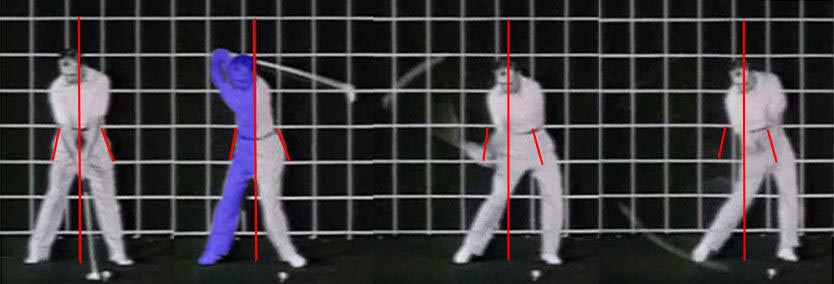 Jeff. |
Quote:
Jeff is there a frame between the address and the top? I think he pushes his hips right and then they go left early back to his original address waste bend giving the impression that he baked a lil' pie at the top. When his backfield has really reversed field. Again . . . I think people can find a Hogan motion to support several pivot theories . . . He could manipulate everything . . . . true genius. |
12PB
You wrote-: "Jeff is there a frame between the address and the top? I think he pushes his hips right and then they go left early back to his original address waste bend giving the impression that he baked a lil' pie at the top. When his backfield has really reversed field." There are many missing frames. Hogan definitely moves his pelvis left-laterally during the late backswing (when his club is still moving backwards). I am not sure why Yoda wanted to discuss Hogan's move. He may have a particular point that he wants to make. Jeff. p.s. As a side-issue, Yoda states in his Alignment Golf DVD that one should center the head between the feet at address, and then acquire rightwards spinal tilt by shifting the pelvis left-laterally. Hogan doesn't do that - you can see that his head is behind the center of his stance at address. He also moves his head ahead of that center line during the downswing. |
Spine Line
Quote:
:salut: |
Hogan's Axis Tilt -- Not?
Quote:
What I advise is that golfers work diligently to acquire a stable Pivot Center, either the Head (2-0) or Point-Between-the-Shoulders (Glossary). Homer Kelley recommended the Head Center but did not mandate it (2-H). The Head 'Centered between the Feet' is a good idea, especially with the proviso -- per 1-L #2 -- that the Chin be permitted to Swivel right and left. [As Johnny Miller has observed, "The chin has a 'swing' of its own."] In any event, Geometric Golf demands a Centered Arc (1-L #1 and #2). At least as Centered as we humans are able to accomplish. Now, assuming that stable Center is in place, any Hip Shift (right or left) will result in a Spine Tilt. As with the pendulum of a grandfather clock swinging from its hinge pin, that tilt will be either away from the target or towards it. Clearly, through Impact, Hogan has both a Centered Head and a decided Hip Shift. Are you saying that he does not acquire a "rightwards spinal tilt by shifting the pelvis left"? :smile: |
Quote:
|
The Grid Test
Quote:
Put up a handicap golfer -- or even a TOUR player or three (past and present) -- and let's see how they do on the 'grid' test. Now, the surveyor gets out his transit, measures off against his control points, and says "Ben set his head 1.1263 inches to the right of center at address and then moved it to .34 inches ahead of center at impact." I say, fine. Does that mean I should teach my students to set their heads 1.1263 inches to the right of center at address and move it .34 inches ahead at impact? Please. :rolleyes: Students need to learn the correct Pivot -- the correct circular motion of the Body -- and the correct Action of its Components (Feet, Knees, Hips and Shoulders) . . . not how to move the Head back and forth one inch. Learn to Pivot, guys. And learn to keep your Head still while you're doing it. Picture the spinning skater and Center your arc. Make it the subconscious lynch pin of your Stroke, and introduce a new consistency to your game. :salut: |
Yoda - I agree with everything you say in post #27.
I personally like your idea of keeping the head centralised between the stance at address, and then shifting the pelvis slightly leftwards to get slight right spinal tilt. However, I have noticed that many PGA tour players prefer to have their head slightly behind the center of their stance at address. I agree that they generally all have very stationary heads, except for slight head swivelling. Here are two examples. Stuart Appleby 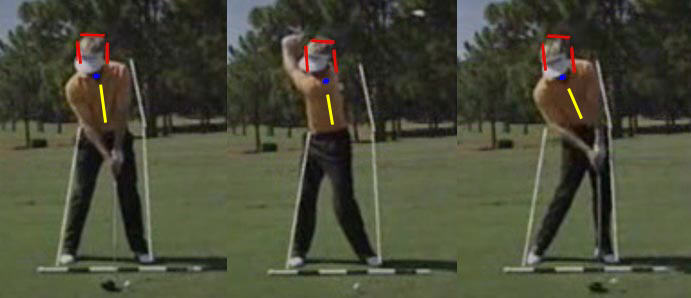 Aaron Baddeley 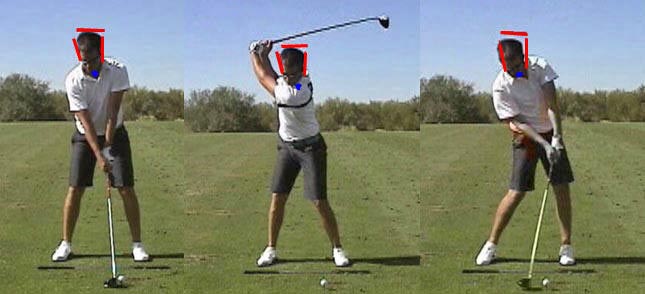 Jeff. |
Line Country
Quote:
Thanks for these sequences. We all do better when we can actually see these principles in action, and your skills in this area are a wonderful contribution to the educational mission of our site. A question regarding your sequence of Stuart Appleby: In Photos #1 and #3, my guess is that the yellow line represents the spine and its inclined angle to the ground ("axis tilt"). But what does the line in Photo #2 represent . . . the original angle per Photo #1? Thanks. :salut: |
Quote:
 |
Quote:
I cannot get the link. |
Quote:
Yoda, When you teach your students the correct pivot, do you than teach them the pivot while they at the same time are aware of their hands or can you teach the pivot separately of the hands? Thanks |
Zone One Training
Quote:
However, I always coordinate this training with the On Plane assignments of the Hands, using a series of drills that emphasize Clubshaft alignments with the Plane Line. :salut: |
Yoda - the yellow lines represent the spinal tilt angle.
The yellow line in photo 2 is only an approximation because I believe that it is impossible to accurately represent the spine position when the golfer is at the end-backswing position - when viewing the golfer from a face-on view. At the end-backswing, the pelvis has rotated about 45 degrees and the shoulders about 90 degrees. That causes the spine to twist in a spiral manner, so it is impossible to draw a single line as being accurately representative of the degree of spinal tilt (of a spiral structure). I draw my "approximate spine line" as follows. I know that the pelvis rotates 45 degrees in the backswing which shifts the lowest lumbar vertebra to the left. I then start the bottom of my line just left of center (approximately where I think the L5 vertebra is located). I then look for a point at the base of the neck where I imagine the C7 vertebra is located (which is near the blue dot = upper swing center between the shoulder blades), and I draw a straight line between those two points. Jeff. |
"Show Some Backbone, Will Ya?" -- Indiana Jones
Quote:
I respect your scientific and biomechanically-based methodolgy, but . . . I also trust you and your innate sense of movement! Please gimme a Jeff's freehand approximation of the "spiraled" -- I agree with and love this description! -- spine angle. With all due respect to any perceived straight-line relationship between L5 and C7, just let it go, and let's see what we get. [Can we use the color red? I like red!] Then, let's compare that rendering to the yellow line. FWIW, it appears to me that the Head has remained within its 'box' during the Backstroke and that the Hips have Shifted decidedly to the right (we now can see a pine tree!). And that means -- according to my own theoretical 'grandfather clock' model expressed above -- that the lower spine tilts ever so slightly 'away' from the target on the Backstroke, not 'toward' it. Whatever it is, is, of course . . . So, let's figure out just what is, is. Sounds like I ought to be running for office! :laughing9 |
Yoda
I personally don't think that there is any advantage trying to free-draw a spiral line on a face-on view. If I did, I think that it would approximate the overall angle of that yellow line. The following capture photo taken from a birds-eye view swing video may help you make a point. 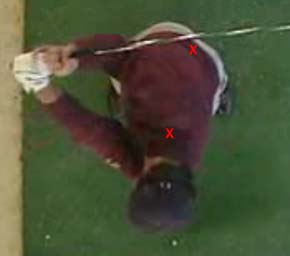 I have placed a red X over the position of L5 and C7 vertebra (based on my best guesstimation as a person with a BSc degree in anatomy and a MD degree). I have not drawn connecting lines because I think that the spine spirals too much (especially in the mid-upper thoracic spine region). However, it cannot be too far from an imaginary straight line drawn between those two points. I am sure that you have stood behind a golfer at the end-backswing position and run your finger up his spine to get an idea of how the spine spirals. Jeff. |
For reference only...might be or might not be useful...
   |
Yoda - here is another series of images that you may enjoy.
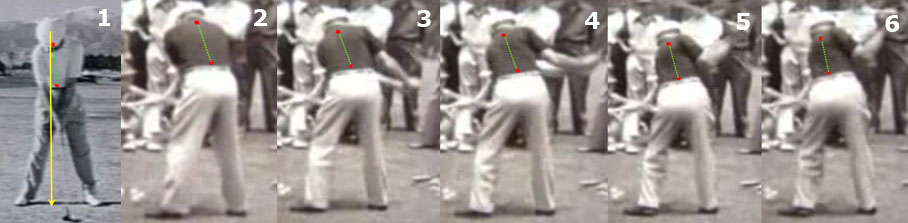 The two red dots were placed approximately over L5 and C7, and the green dotted line is simply a straight line joining those two points. It may look like the spine is tilting left. However, that is only because one is looking at a three-dimensional motion (viewed from an angle) as a 2-dimensional image representation. Conceptually, I have no reason to believe that the spine angle tilt changes during the backswing action - even though the spine is spiraling in space. Jeff. |
| All times are GMT -4. The time now is 04:16 PM. |