
|
Homer assumed Separation to be at Low Point but what if it isnt?
Homer in the diagrams of 2-C , for illustrative purposes (I think) assumed Separation to occur at Low Point. But what if it isnt? What are the implications?
Lynn has said that the impact interval is approx 3/4 of an inch in length , which implies to me that for balls positioned further than 3/4 of an inch back of Low Point, Separation will occur prior to Low Point. What are the implications of this to the Arc of Approach , the Angle of Approach , the Line of Compression, clubface angle etc etc if any? In 2-J-3 Homer writes that you determine the Angle of Approach by drawing a straight line from Impact to Low Point. So would I be right in thinking that the Arc and Angle of Approach are unchanged but the clubface angle per 1-L-17 needs to be square to the target at Separation.......... That picture would be a bit of shock to most golfer wouldnt it? A square to the hole clubface at Separation but a clubhead still way back of low point on the Arc of Approach. The clubhead needing to continue its Inside/out journey long after the ball has gone. Most golfers would assume this to be a draw or hook shot deal wouldnt they? But it isnt. Is it? Sorry I cant do any fancy computer graphics which would help illustrate this. Maybe our good buddy, Daryl could help out. If this is true , no wonder most divots point to the left ..........a straight line base line has way more Down and Out to it than you'd ever imagine... especially for shots played back in your stance. |
Quote:
7-2 covers the alignments-per grip because swinging (horizontal hinge) would be vertival club face, on plane lag pressure- Hitting (angled hinge) would be both clubface and lag pressure on plane. Then the low point can be moved a long way by #2 and even to down and out with an up and in clubface {a bad thing but possible} The Bear |
Impact, Ball Location and Low-Point.
6 Iron. This illustration indicates Impact at 6" behind Low-Point. Ball probably separates at 5 1/2" and Clubhead enters the ground at 5" behind Low-Point. Dirt starts to show at 4" behind Low-Point. Divot depth is 3/8".
Question is: Does one side of Low-Point have more divot? Why?  Innercityteacher played 57 rounds of golf this summer and must have hit thousands of balls. Do you think he ever measured a single Divot? |
Quote:
Yes. because #2 accumulator is still going down, until both arms streight. longer in front of LP longer arc. Except with zero (or fixed) #3 then balanced divot. (Scoop) The Bear |
2-C-1 #3 Full Scale
Print this out and turn upside down for Players View. Average Club: Impact 4" behind Low Point.
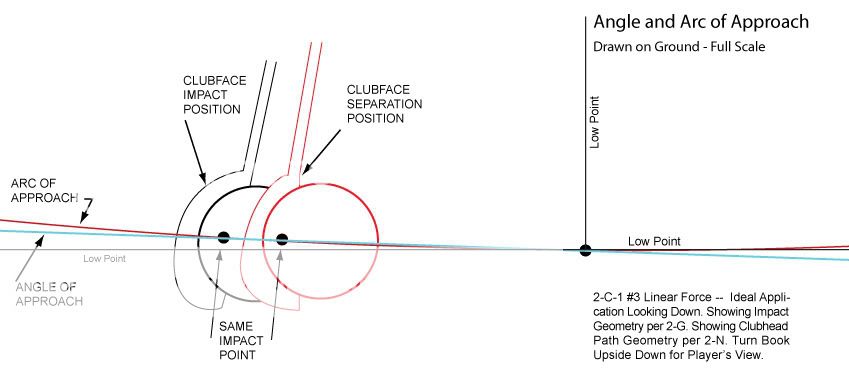 |
Quote:
In regard to clubface implications for Separation prior to Low Point: Let me try this another way. First read the first paragraph of 2-J-2 INSIDE OUT IMPACT. (Its a great read but for brevity Ill jump ahead to the main point.) "..........Though it is an "inside-out" Impact it is not an "inside-out" Stroke unless the Plane Line crosses the Line Of Flight as depicted in photo 10-5-E. (closed- closed). Per 2-J-1 and 1-L-17 while the clubface is positioned in accordance with your Hinge Action at Fix (slightly open for Horizontal etc) at Separation the clubface must be square to the Target Line. Now look at Picture 2-C-1 #3 and turn it upside down for the players perspective. Its not to scale obviously and assumes Separation at Low Point but lets imagine Separation prior to Low Point......Imagine Separation about where Impact is depicted......the clubface now square to the Target Line and THE INSIDE-OUT ANGLE OF APPROACH LIEING AHEAD OF SEPARATION. Straight shot or draw? |
Quote:
AWSOME thats exactly what Im talking about....... Straight shot or draw? Its very interesting to look at this drawn to scale, thanks D. I always thought Homer avoided scale for illustrative purposes......but now Im also wondering if he did so to heighten the readers appreciation for the Inside-Out nature of Impact along the Arc of Approach. I dunno Maybe. He did say that "its inside-out and should feel inside-out". |
Very fun Post.
Where did Homer say that Separation occurs at Low Point? I can't find that anywhere. Lets agree on the Flat Left Wrist and that Both Wrists are Level at Impact. We know that the Right Wrist is Level, Bent and Vertical at Impact. Then, is the Left Wrist Vertical at Impact or at Low Point? The Club is gripped so that the Hands align to the Longitudinal Center of the Club. That's why the Left Thumb must be on that Line (aft side of shaft). When you grip the shaft and adjust your Flat Left Wrist to Vertical, the Clubface looks shut. I gotta run. Wife is rushing me to go for a walk in a park 30 miles from here. Go figure. |
Quote:
But the question makes for a different "look" than most would assume to be associated with a straight shot. Or is it a straight shot? It has implications to grip rotation, grips with spines on them etc. We havent even got to the Line of Compression yet! |
Quote:
(I could be wrong here) The Bear |
Quote:
Thanks Bear. Its interesting isnt it? Anyone else? Straight shot or not? |
Quote:
Bear, that's my geometry. Perfectly straight with a straight ballistic upward trajectory (maybe the "Rifle" Shafts help). Compression rating: "Very High". The ball doesn't have a floating, curvy trajectory look although it carries farther than it seems and lands soft. It takes off like a bullet.  |
Down and Out
If the true face angle is closed to the true path of the sweetspot then it would be a draw. This swing illustrates a that has a rather shallow verticle angle of attack considering how little "out" there is after seperation/low point. The more down = the more out.
|
Two votes for a draw and a post from D bragging about how great his traj is. Which it is , Ive seen it "up close and in person".
|
Quote:
We all do realize that the two Black lines representing Low Point, the Horizontal one is below ground and represents the Low Point Plane Line (Bottom edge of the swing Plane) and the vertical one is at the Left Shoulder. It's a perfectly On Plane Stroke before and after Low Point. Anyway, it's only important to note that "Approach Lines" are drawn on the ground and guide the Clubhead. |
Analysis
Now, if we look at it with "D" plane analysis we ....??
The Bear |
Low point is in the ground past the ball. Homer wanted the golfer to drive the ball into the ground aka china!
|
Straight shot or draw?
Come on guys, who cares if you're wrong.......I'm not sure my self. J |
If you contact the ball with an open clubface, the separation happens from a square clubface and the stroke otherwise has as good ball compression as Homer regarded as practically possible, it will be a slight draw. The ball will stick to the clubface, the clubface rotates through impact. And the ball will continue to rotate after separation.
Daryl, If you're hitting it dead straight, I think you can add some 5-10 yards to your effortless 185 yard 7 iron if you get rid of that unneccesary compression leak :salut: All you need is a hint of a draw. A ball that lands towards left and spins left on the green. |
Daryl, let's not be so presumptuous.
Quote:
Coming to the first tee in the "D" flight at 5:47am, the Civitan person stepped up and hit a terrific drive that did some impressive mountain climbing. (The Civitan's were the more competitive group in town, being primarily business people. They would often use very talented players in lower level flights so they could win everything in sight.) I congratulated the guy on his really great stroke. I then got nervous, remembering my 138 the year before. I hit such a bad dropkick of a drive that I popped the ball up and was soaked in the early morning dew. I couldn't see. I was soaked and embarrassed. That ended though, when the good player behind me mumbled that day, "Great, I got stuck playing some stupid cripple! " I knew what I wanted to do, suddenly, just not how to do it. So, I pretended I was my friend playing at the qualifier for the US Amateur. We had discussed Hogan's books and JM had a very simple 1/2 rhythm . So that's what I did. 1/2, 1/2, turn/turn, get it near the hole; don't quit! I shot a 78 that day. The championship flight winner shot a 74, and no other flight winner shot lower than 79. I won a set of golf clubs, Cobra's, and several dozen golf balls, towels, umbrellas, gift certificates, etc. Until TGM though, I never came close to breaking 90 on a regular basis. In getting ready for the 1994 US Amateur, JM took lessons from Loren Roberts's coach at the time. We would goof around seeing how far ahead of the ball strike we could set the tees and still hit them. Does that qualify as "measuring?" TGM is the most technical instruction I have ever encountered, but I'm stuck sometimes on technical details given the shortness of my front leg and the artificial hip. My divots vary in size and shape depending on the day but are usually very steep to start as I come in at a pretty high angle. Of the thousands of balls I've hit, most have been off of rubberized grass on top of cement. I concentrate on ball flight, a lot. Losing any kind of contest, or any kind of match is like death. It happens to everyone. The big questions are how will we become better after the loss or after the win (supernaturally). Better technique is easy to achieve with this website and with all the fine contributions from everyone, including yours, Daryl. But getting a better soul is a much tougher challenge. I need supernatural help to do it. Honestly, it is a much bigger goal than winning a golf match, or golf accolades. Golf is just so much fun for me having spent 9 months in body casts at Mayo Clinic and having had 11 hip operations over the years. It's just great fun to concentrate on such a demanding game. So I have set a challenging goal of beating you on a golf course I've never played. Impossible? Nope. Laws of gravity and physics operate everywhere for everyone. Hitting DOWN works everywhere for everyone, and thoughtfulness on a putting green is a beautiful thing. Hopefully, we will have great fun in playing and improve our skills and our souls. :) Patrick |
Ive lost count but Im thinking its:
3 people say draw. 1 says straight. And a great story from City. |
Quote:
Centrifugal Force will always Swivel the Clubface Square to the Longitudinal Center of Gravity of the Club. The Pivot must be designed and executed to coordinate that with Turn and Roll for Plane Line compliance. So, a Push or Pull can be a very well executed Stroke. Because Swingers use CF to Swivel the Clubface, Side Spin can be developed by changing the Plane Line/Target Line relationship and by moving the Ball Aft and Forward to coordinate Turn and Roll. This is ALWAYS an On-Plane Stroke. Because it's an On-Plane Stroke, they are named Fades and Draws. Cross line Strokes are named Slices and Hooks. Fades and Draws don't produce the high side spin Rates associated with Cross-line strokes combined with Clubface Alignment adjustments. 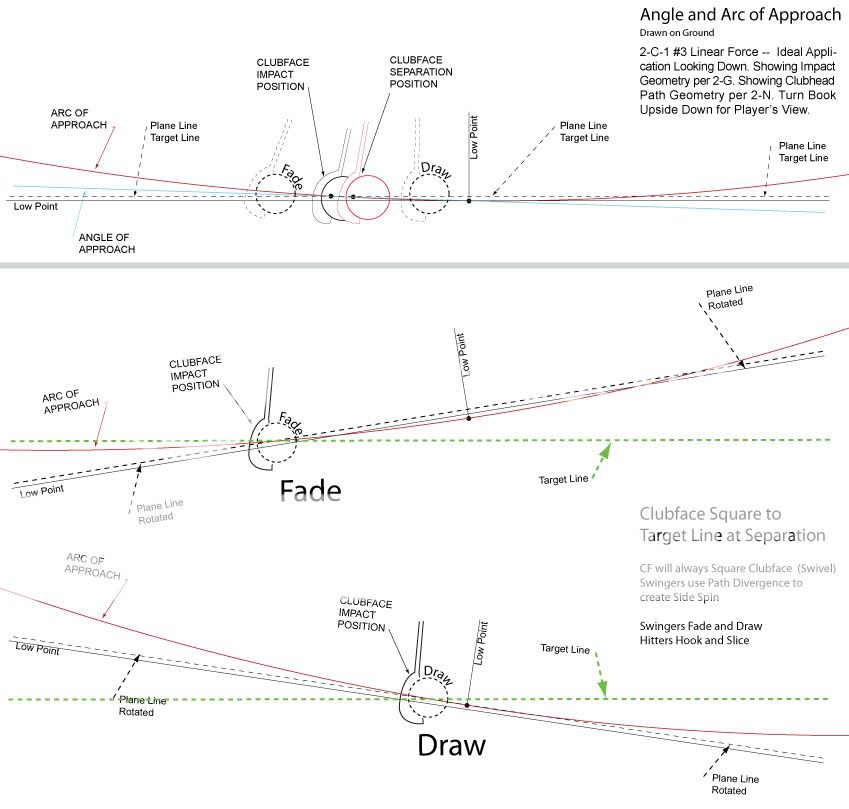 |
Those are fantastic drawings Daryl. But Im not sure about the "fade" and "draw" in the first one. I know your coming from a True Swinging perspective , but the face angles seem wrong to me. The fade looks like a push fade to me........my head hurts...
Per 1-L-17 the ball leaves at right angles to the clubface at Separation. Side spin coming from any divergence in the clubhead path to the clubface angle. The opposite of the old ball flight rules but now confirmed by Trackman.......which casts a peculiar light on a lot of past champion's own instruction books. Homer was adamant that they couldnt have actually done what they were teaching. A belief that didnt go over too well with his listeners but he insisted. And we now know he was right. To think that some of golfs greatest champions were manipulating the clubhead path and face angle perhaps subconsciously, in the direct opposite manner than that to which they subscribed theoretically makes for an interesting discussion. Sean Foley has said that he likes his players to draw the ball with an open face angle of 3 degrees and then create the side spin with their arcs. So the ball starts right then curves back. He's probably got a Trackman on the range at OCN I'd imagine. |
Quote:
The Top drawing only shows the amount of clubface Roll with three different ball locations with an On-Plane Swing.
Quote:
Trackman sets up behind the ball and doesn't "see" the actual Clubface-Ball contact because the clubhead obscures it. I'm not a mathematician and I couldn't begin to wonder how complex or simple the calculations might be although models to determine distance have been used by clubmakers for a long time now. I don't know if Trackman measures ball flight and then calculates clubhead/face path and geometry or the other way around or a combination of both. What if you swung the club without a ball? If Trackman uses any ball flight data to calculate clubhead path, face angle and swing plane, I can't be a "True Believer" in it's use as a training aid because I can't accept mystery. Besides, ball flight cause and effect are Apples and Swing Mechanics are Oranges. But I imagine it would make an excellent clubfitting tool and it does make for fun TV ball flight instant replays. Quote:
|
Quote:
Im still wondering. Straight shot or Draw? Maybe we have to assume a Hinge Action.......so lets say Horizontal and Arc of Approach, manipulated hands swinging or Hitting. I was initially thinking straight cause its not an inside out stroke but now I honestly dont know. Life line.....Yoda!!!!!!! |
Draw.
If the club head closes and the impact point doesn't move from contact to separation, the ball will "close" too. It will rotate the same way as the club face did during impact. And there you have the draw. If you hit the ball human-like and produce a fade, there's o way you can keep the impact point on the ball fixed during the release interval. Perfect ball compression and a fade would require reverse horizontal hinging. |
What's up?
Daryl,
Can you elaborate on what you mean by "Centrifugal Force will always Swivel the Clubface Square to the Longitudinal Center of Gravity of the Club." |
Quote:
Background: There are three Clubface Alignments. We're concerned mostly with 2.
A Swivel is a Rotation of the Toe of the Clubface and Heel of the Clubface around the Sweetspot on the Clubface. Simply stated, it’s the Toe and Clubshaft Rotating around the Sweetspot. The Sweetspot Plane is the longitudinal center of gravity of the Golf club. It’s an invisible line that connects the Sweetspot on the Clubface up through the top Right side (ideally) of the Golf club grip (because of the forward leaning shaft). Simple Experiments: These are "Swivel"
My intention while addressing the Swivel issue during a discussion or Fades and Draws, is that CF will Orientate the Clubface (Hood-Layback) while the Player moves the Ball Location Fore and Aft for Plane Line/Target Line (Pivot Turn and Roll). This controls trajectory on Fades and Draws. But more important, it's integral to sustaining the Line of Compression during all three procedures, Closed, Open and Square Plane Line relative to the Target Line. Hey, it was just a passing thought. |
Quote:
|
Quote:
|
Quote:
|
Quote:
|
Ya, Ive been to the website but they won't tell me. I was hoping that you would know for sure.
|
Quote:
Spin Loft* Face Angle* Total Distance* These are the interpreted numbers the other readings are measured. Obviously total distance cannot be measured since the ball is running along the ground. Face angle is the concern. Homer wrote the ball leaves the clubface at essentially right angles. Jorgenson wrote (D plane) the ball curves away form the path. If you hit the ball with TM reading zero path and zero club face the ball flies dead straight. I have confirmed this with my own eyes/swing. |
Quote:
Oh, you are saying that face angle is measure by TM Radar. Oh, I thought that it had only one radar gizmo behind the ball. It has 2? |
Quote:
|
Quote:
|
Quote:
I believe that the line of compression, relative to the vertical centre line of the ball is what will determine the amount or absence of curve. |
You've got a point there, 3putt.
It will probably just be draw-ish. Perhaps it makes a slight difference to where the ball goes when it bites the green. Perhaps it makes a small trajectory difference with a driver and not with a middle iron. Don't know really, but I guess it is practically straight. Personally I like to see a hint of a draw in my stock shots. If I also see a divot that is reasonably shallow I know that the ball compression is good. |
Assuming a centered hit, if the club face angle at separation is at the target and the direction of the club head after separation is right of that direction, the ball will draw. No question.
As far as trackman goes, it calculates face angle based on initial launch conditions. Using impact tape and a knowledge of gear effect and D-plane, ball flight can be explained quite nicely. Vertical swing plane is measured and has nothing to with the shaft plane angle. It measures the movement of the sweet spot relative to the ground. |
| All times are GMT -4. The time now is 01:12 AM. |