
|
"Exit" Plane. The Plane from Follow Through to Finish
Quote:
What do you guys think about the Plane of Follow Through? Finish? Homer had a clear preference for and an ingenious insight into the Turned Shoulder Plane and its ideal geometry for Startdown. But does this mean it has the same advantage at Finish? I'd say ..........no. Im thinking that given the Downstroke Sequence of 6-M-1, "swinging from the feet", the Shoulders, the Right Shoulder specifically should pull the Hands Downplane in Startdown. A situation which leads one to deduce that its best for the Hands and the Right Shoulder to therefore be on the same Plane Angle in Startdown. So geometrically the TSP is "the ideal plane" for Startdown. Whereas in Follow Through or Finish the Right Shoulder is no longer pulling the Hands anywhere as the sequence has long since past that stage. Making the determination of ideal Plane Angle subject to different considerations for that part of the swing. Plane shifting being dangerous, Im thinking that in Follow Through you should, in the ideal anyways, be on the same Plane you travelled through Impact on. In Finish you'd probably have to shift a higher plane angle if you rode through Impact on a low one. You just cant get to Top or Finish on some of the lower planes. Im sort of waxing theoretically and in the ideal here , I know there are plenty of exceptions on the PGA tour. I dunno. I honestly dont think about plane angle too much personally, it just sort of "is what it is" for me. Normally Single Shift , Elbow then TSP but Im wondering what I exit on? OK, I just looked at video .....TSP exit. Ill have to check some old pre Yoda video to see what my Pivot to Hands swing looked like. Id guess way under plane going back then a lot of lifting then a vertical drop and ........ generally all over the place with a Zoro like sword action. Getting on plane can make such a difference. |
OB, do you have both wrists level at Address?
Quote:
ICT |
1 Attachment(s)
Quote:
It is not all that Steep really . Especially if you locate ONE of the flatter Turned Shoulder Planes. (Gotta think about that a little I know. There is a range of available TSP planes that the Hands and Right Shoulder can locate , meet up on, like "Strangers in the Night" ). The one you locate with a "FLAT turn back of the Right Shoulder" in Startup is going to be amongst the flattest but its not all that flat per say either. One of Brian Gay's preferred swing thoughts apparently. The combo of Flat Back and Downplane forming the Standard Shoulder Turn , 10-13-A which Homer recommended for both of the two Basic Patterns , 12-1 and 12-2. As an aside though some famous golfers are regarded as having flat swings and some are regarded as having upright swings......you can find in sequenced photos that they end up on or real close to a TSP Angle in Startdown. Hogan and Nicklaus for instance, although not on the same one if you know what I mean. Jack obviously had some business to do to get down there from where he was at End but... that he did. Hogan could sometimes even appear slightly under the TSP, under being far better than over Id imagine. See the photos below.....maybe the camera being 3/4 to Mr Hogan makes him seem under a TSP when he isnt? From DTL he would appear closer to it I believe. One thing is for sure he's not pointing the butt end at the ball at that moment but he will when he gets down to his lower plane. I dunno. Yoda how big of a mess am I making here? How do you best describe the divergent vectors of the "flat back" of the Right Shoulder with the " UP" of Back , In and Up for the Hands and how it all nets out with the Hands on plane? Dang its like rubbing your stomach and patting your head at the same time. Cant be done Pivot to Hands which would see a Flat Back of the Shoulders take the Hands flat back too....... |
I have a feeling that we're often misinterpretating the various planes involved because we wrongly assume that the plane line equals the target line. "Turning left" can simply mean striking the ball a good while before low point, when the club is moving down, forward and out. And it takes an open plane line to produce a divot that goes down the target line.
When I do air swings in front of the mirror with a wedge, I swing from TSP to TSP if I aim to the right of the mirror. If I aim straight at the mirror I look steep & high in the back swing and really flatt in the follow thru. And the hands start turning left before the ball is struck. I am pretty sure that I do the same on most strokes when I play too. But perhaps not with the driver. |
3 Attachment(s)
Some golfers have a Finish that can make you think they never re planed the club after Follow Through but photos often tell a different story. Mr Palmer for example or Moe even. The photos below are from an impromptu demonstration Moe did at the 1984 Canadian Open hosted by Glenn Abbey G.C. A place from which I have some very fond memories. See that bunker deep in the distance at the end of the range? Yoda's been there.
|
Please get me to the plane that meets these requirements at impact. Rffw on plane, rf on plane, left fw, left wrist level, tracing??
I have been under the impression that the alignments at impact are( SHOULD BE) elbow plane. Am I wrong? This topic needs a "starting alignment" . Impact is the ONLY critical alignment, whatever anyone "agrees" it is/should be. How the golfer gets to and from impact alignment is important but not as critical. The Bear |
TSP or EP at impact is a matter of choise I believe.
I believe Daryl prefers and uses TSP for impact as well. Moe Norman was TSP. But most top golfers today seem to be on EP. |
Quote:
Is impact fix a TSP setup? Or an EP setup? Does the shaft lie on a plane through your shoulder at impact? or your elbow? Can you do this without a ZERO accumulator #3?? If it can be done please show the alignments required to get there because I can not visualize them? Thanks. I would "think" the "exit plane" would depend on the alignment and physics that procede it? The impact fix would "seem" to be an alignment that everyone can identify with precision. Then follow through alignments are , dependent on hinge action, fairly well defined alignments. Then there is physics that take you beyond followthrough and then manipulation takes over???? O.B.Left- I am very excited about your "EXIT" thread. There is an "humungus" pile of material that can be considered. You will probably have to tell me to SHUT UP, so, at your discretion! The Bear |
Bear, perhaps your problem relates to the definition of Elbow Plane. There is to my knowledge only one Elbow Plane which is defined as the point where the Right Elbow would touch the body. Plane and simple. However it is possible to get the Right Forearm on a Plane, a Shaft Plane, which is higher than the Elbow Plane at Address or Impact. Homer liked this bit of business as it lent itself to the possibility of zero shift. Given his strong preference for a TSP Angle in Startdown , Zero shift would ideally be started and finished on a TSP with the Right Forearm on this Plane as well at Fix and Impact.
That being said its a bit "ungolf like" if you will. And so we are left to what I believe to be the practical ideal......what I term "minimal shift". The Right Forearm lies on a Shaft Plane which is above Elbow Plane but below TSP at Address with the TSP you locate being the flattest you can comfortably locate ......which isnt all that flat really. "Flat Back" turn of the Right Shoulder. From a DTL view you are minimizing the degrees of shift necessary be it a Single or Double or Triple shift. Bear, If you are trying to drop to a lower Elbow Plane and not getting there.......try something higher but with the Right Forearm on that Plane. Minimize your Shift in terms of degrees from DTL or take out a shift even. Go Single Shift instead of Double. The level Left Wrist at Address , the on Plane Right Forearm ....work on your Arm Set at Address. Its structure is sturdy. Hit little chips and pitches with just your RFFW attached to the club, you'll feel its structure which you can use Swinging or Hitting. The problem most people have with the Arm Set is that their Left Wrist is not Level at Address. Simply put, to raise your Right Forearm to the Shaft Plane merely Level your Left Wrist. There is often some stiffness or built in #2 Angle at the Left Wrist which is inhibiting the correct Arm Set. |
Quote:
The problem , as I see it, is the talk about planes is almost always relating Basic Plane's , 7-6 but we are talking about the down swing plane(s) 7-23, delivery path. As I see it, 7-23 paragraph 3 (6th edit.) must be read with care. It says, at least to me, that if you have accumulators #2 and #3 then you have elbow plane to the extent they are used. It isn't hard for me to get there but I am sure that will stand the hair up on the back of a lot of necks. Shouldn't have said that but it is likely true.?? The Bear |
Daryl, is Bernt correct here?
Quote:
Unless, you'd like to start a thread. If you don't do it in a day. I'll add it to my "Learning and Teaching...." ICT |
Nose Against the Window Pane
Enjoying the action from afar, guys. Keep it going!
:golfcart2: |
Quote:
Lynn, Homer's appreciation for and definition of the Elbow Plane evolved over the editions, I believe. The paragraph Hungry Bear astutely referenced from the 6th seems to be incongruous with the definition of the Elbow Plane from the 6th in regard to there being a range of possible Plane Angles for the Elbow Plane. At least as I read it. Maybe I read wrong. It is consistent with the definition of the Elbow Plane from the first edition however. Could there be an editorial "situation" going on here? From the first edition: Quote:
Which to me implies there can be a range of Elbow Plane Angles. From the sixth edition: Quote:
And from the sixth edition 7-23 paragraph 3. page 111. And the first edition , 7-23 paragraph 3 page 61: Quote:
In other words by latter day Homer definition is there one Elbow Plane? |
Quote:
Bear while we wait for clarification .....I believe you are perhaps subject to a change in thinking by Homer regarding the Elbow Plane. He had a fondness for it in the early editions that he didnt share in the latter days. So Id say the fact you cant get aligned on the Elbow Plane is no problem vis a vis Homer. No problem at all actually, especially if you listen to the audio tapes from the early 80's. Not saying there arent plenty guys who teach it, love it , embrace everything to do with it. But there'd be no hair standing up on the back of my neck or Homers I dont think. Im talking fixed , low Elbow Plane not just any old plane you can get your Right elbow and shaft on. I must admit that I dont follow you in regard to Accumulator #2 and 3 and the Elbow Plane. Dont be alarmed there's a lot I dont follow. But all planes could have both coudnt they? In that paragraph from 7-23 Homer isnt saying that you must zero out #3 for the "higher" Elbow Planes. In regard to Plane Angle Variations and Power Package Delivery Paths, one of the notations Yoda made in my 6th edition was on the bottom of page 158 ,right under the pictures of Dianne demonstrating various Shifs. It reads " Relates to 10-23- B/C/D" . |
O.B, HK is referring to putting when he says "Steeper than normal Elbow Plane".
Place the Grip in the cup of the Left Hand and adjust the right hand to correspond, then reach out with the arms to move the Right Elbow to the Steeper Plane. Then the Right Elbow, Right Forearm and Clubshaft are on the same Plane throughout the stroke. It's a "Straight Line Path" Elbow Plane. I'm sure that someone can make longer strokes and maybe use a Pivot Stoke too.  |
Moe Norman is one hellacious ENDLESS BELT EFFECT!
Quote:
So I was trying to do TSP back and through with Moe's set-up. I made sure nothing moved by spreading my anchors W-I-D-E. My wrists were high and level! I concentrated on Body-Centered Hands and did as Moe said "I always keep my triangle together...if anything my arms get tighter." Well, if you do the maths, so to speak, the only thing left to feel is the # 3 PP! As a matter of fact, that's all you can feel! :dance: You can feel the # 3 PP so well that you can BREAK IT OFF ON THE BALL!!!! Imagine the Vertically Un-cocking Left Wrist on steroids!!! Imagine compression so focused on your # 3 PP that my heavy impact bag leaves the ground for about a yard with my driver and further with my ZB forged 5 iron. Both impacts were very loud!! So, if I understand all the terms I think I understand, a "Zero Shift TSP " is possible and it happens pretty damn fast, and all I remember is that I felt as if I bent the shaft in half with my # 3 PP. (When you tell me how I'm off on this one be gentle because I know I'm right about ooohh, perhaps 50% of what I thinking I said. I haven't hit any balls with this yet due to the cold weather. Besides, you know how sensitive I am.) :eyes: :eh: WHAT I'M TRYING TO SAY HERE AND FORGOT TO PUT IN, IS THAT THE "ENDLESS BELT EFFECT" HAS TO BE ON PLANE FOR THE STROKE TO BE DESIGNATED AS "TSP," OR "ELBOW PLANE," IN OTHER WORDS THE PULLEY DETERMINES THE CLASSIFICATION, I THINK. Holla at your boyyyyyyyyyy! ICT |
1 Attachment(s)
Quote:
Chapter 7 deals with the 24 Basic Components, 7-23 deals with the Power Package Delivery Path, " From the Top". The sentence in question deals with Straight Line Path vs Angled Delivery Paths similar I believe to the photos in the similarly numbered 10-23. Straight Line relating to Zero Shift , Angled to Double or Triple. He goes on to discuss Longitudinal and Radial. D, I may be wrong , its easy to do with this stuff but Id say your definition of the Elbow Plane and Higher Elbow plane in that drawing is consistent with the 1st Edition but not the 3 rd on. Take a look at this photo, is that an Elbow Plane or a TSP Dianne has here Right Forearm on? |
Sorry about all the cut and paste O.B.
The scary part is that I think I understand some of it. All the black is cut and past - hope I didn't mess-up your context badly!! From the first edition: Quote: 10-6-A. ELBOW The location of the Elbow during Impact is the reference point used for this Plane Angle. This alignment not only allows the Right Forearm to move On Plane through the Impact but also allows the torso to be postioned at righ angles to the Plane --which are the unexcelled alignments for Right Arm Power and Control. Which to me implies there can be a range of Elbow Plane Angles. From the sixth edition: Quote: 10-6-0 GENERAL Basic Plane Angles are classified on the basis of reference points on which the Inclined Plane can be set. Five such settings are considered here – three fixed, one moving, one moveable – each named for its particular reference point. Remember the Right Forearm is not “On Plane” unless the Right Elbow also is still – or again – On Plane (2-F). 10-6-A ELBOW Where the Right Elbow touches the waist is the reference point used for this Plane Angle. It is the “flattest” normal Plane that will still allow the Right Forearm to be On Plane during Impact. This should produce a very flat Angle of Attack (2-B) with reduced Backspin and should be avoided for Short Shots unless it is also part of your Full Stroke Pattern. The Elbow Plane allows maximum #3 Accumulator requiring earlier Release per 6-N-0. This procedure is executed by the Right Forearm per 7-3 and 10-6-B and Elbow Location per 6-B-3-0-1. Which seems to change to a fixed location for the Elbow Plane as I read it. I think (my thinking) HK changed his frame of Ref. from defining EP at impact to EP at set-up And from the sixth edition 7-23 paragraph 3. page 111. And the first edition , 7-23 paragraph 3 page 61: Quote: The Straight Line Path is a simpler procedure than the Angled Line Path. But the latter is very natural movement and has the advantage of the true Elbow Plane through Impact. The former can have a steeper-than-normal Elbow Plane compensated with a reaching-out of the arms and a shifting of the Left Hand Grip that places the Clubshaft in the Cup of the Hand instead of under the heel of the Hand, and the Right Hand Grip adjusted to correspond. *Bold by me. Again I think HK was saying you can have a EP while on TSP but you must zero accumulator #3 and adjust grip accordingly In other words by latter day Homer definition is there one Elbow Plane? ________________________________________ I must admit that I dont follow you in regard to Accumulator #2 and 3 and the Elbow Plane. Dont be alarmed there's a lot I dont follow. But all planes could have both coudnt they? In that paragraph from 7-23 Homer isnt saying that you must zero out #3 for the "higher" Elbow Planes. That is my thinking- You MUST have an “elbow” plane to have #2 and #3 In regard to Plane Angle Variations and Power Package Delivery Paths, one of the notations Yoda made in my 6th edition was on the bottom of page 158 ,right under the pictures of Dianne demonstrating various Shifs. It reads " Relates to 10-23- B/C/D" I will not dare speak for Yoda and he is likely near enough to answer the question but I will assume that the note was meant to tie the demonstrated plane shifts on 158 to the plane shifts of 10-23 “Angled” lines The Bear |
She has the Forearm resting on the TSP. But Her Right Arm Wedge is not On-Plane. Her Right Wrist is Fully Uncocked. The Purpose of the Photo is to illustrate the Angle of the TSP. In that it does that well is sufficient for the Photograph.
The Wedges have a very Specific Alignment to one another. But, is everyone aware that the Wedges also need to be aligned to the Swing-Plane? The Alignment to the Plane is substantially different on the TSP than on the Elbow Plane. In 10-23 HK was explaining how to keep the Elbow Plane Alignment of the Wedges onto a Steeper Plane in order to use a Straight Line Path. |
Guys I know we're supposed to be talking about Exit Plane but .......this is good stuff, it does relate. " What exactly are the Elbow and TSP planes. "
They get used really loosely , lets tighten em up definition wise. Its necessary, Id say, for proper discussions. Man I used to give Mike O a hard time about always defining things before discussing .........now Im Mr. Definition too. It works well at home too..... "Ah Honey what exactly do you mean when you tell me to "shut up" ? " Anyhow ,if one of you have a picture from the yellow book for 10-6-A Elbow Plane please put it up. You'll see the Plane Board runs from the ball to the point where Diane's Right Elbow touches her side. Quote:
I dunno, I could be way wrong but it seems like there's one place where the elbow touches the side and a whole range of plane angles which the Right Forearm and Clubshaft can get on (between TSP and Elbow theoretically, if not practically). |
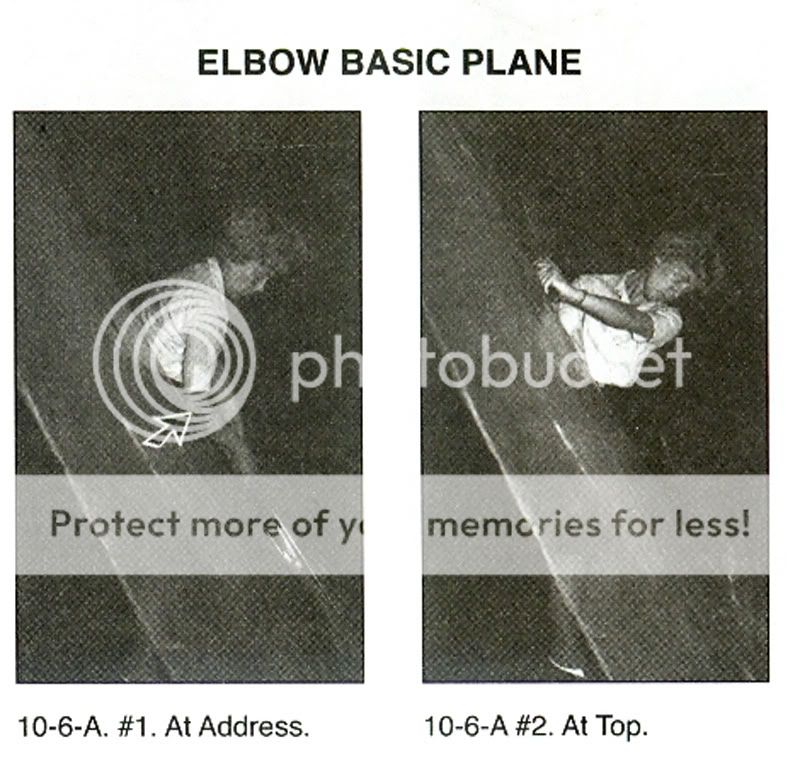 |
Quote:
I will try and be simple and precise- (wish me luck) 7-3, the elbow plane is defined PRECISELY in 7-3. http://www.lynnblakegolf.com/index.p...mp-Wedges.html When the rffw is "on plane" that is a GOOD EP. "Remember the Right Forearm is not “On Plane” unless the Right Elbow also is still – or again – On Plane (2-F)." Because you leave -starting backswing- from impact fix and return to prior to impact. Chipping, you stay on EP The/A TSP is a 1-L plane that also touches the right shoulder at TOP/END. Hope I'm close to right. The Bear |
And then you know what's going to happen O.B.?
That EP is going to swing around and get "steeper" and #2 and #3 are going to vanish. We are going to have both arms straight and pointed at the extended plane line. We will be on A TSP. We are going to call this beautifull place "follow-through". From there we will swivel and glide on up to finish. Hold-Rest, our work is done. How does it look? :) We "hope"? maybe with alignments we can change hope to understanding?? Ya think?. The Bear |
Whether the clubshaft plane angle gets steeper, more shallow or stays the same after impact depends on what you do with your PP's pressure through impact and beyond. I think.
|
Life Line to Yoda
Quote:
Im all for the Right Forearm being on Plane , I love the alignment personally. "No, you cant take that away from me". I can work under either definition of Elbow Plane but lets ask Yoda for clarification and work under his definition. "Yoda, if the Right Elbow is on Plane (through impact) is that an Elbow Plane? Despite the fact the Elbow and Shaft can align to higher planes such as the TSP per Homer. Does that make for a Elbow/TS Plane? How 'bout TSP is there a range?" Is that question good by you guys? |
Quote:
That's "kind-of" why I put "steeper" in quotes. Feel steeper, (Hogan?) works also- This thread may get to that also?? The Bear |
I am pretty sure that in a well executed stroke with a "heavy" right hand on the shaft the right forearm will be on plane whether you're swinging on TSP, EP or something inbetween.
Look at Jim Furyk and Moe Norman. They are probably as far apart plane wise through impact as you get. Yet, both have the RF on plane through impact. The difference will be how close to your right hip the elbow goes. There are a few good golfers who has the right forearm slightly under plane through impact. I attribute that to a "late hit" timing. |
Quote:
(Then we can run wild on other forums correcting people and getting em all mad at us and using weird capitalizations and terminology and stuff. Some of which we make up for the occasion.............) Lynn how do insert smilie faces I cant even get "The Shadow of your Smile" E faces working here. |
That sounds like a great plan:salut:
But let's make a strategy before we hit the road with this one. First we start off with a couple of months worth of telling what's wrong without telling what's right....:laughing9 Back on topic; I'm not quite sure where your emphasis. I'm thinking that the CF imposed by the club on the hands potentially can pull the hands out of their ideal path and that this again will pull the club out of it's ideal path. Thus, you get a situation where the tail is wagging the dog. PS I hit the range today and tried Gary Players tip on plugged lies out of the bunker; Square to closed face and lot of wrist action. It worked like a charm. But the wind is blowing in Texas so now I have half a bunker in my hair :sad2: |
Ok, so am I completely wrong?
Quote:
Is that like saying "rain is wet?" If it is, I'm sorry. I'm trying to be technical and, well, it's not a naturally given skill. ICT |
OK- here we GO!
OK--"so lets get er done once and for all.
My opinions, with reasoning; Although there may be minor variations for hinge type. I am going to call the exit plane by extrapolating beyond 2 sequential alignments. Impact fix and follow-through. at impact fix we have on plane shaft tracing plane line- and ON THE ELBOW PLANE. at follow through we have on plane shaft tracing plane line with both arms straight- no accumulator #2 or #3 left. This an TSP. There is little to disrupt the continued planar motion of the club and hands. the swivel should be minimally disruptive. So what happens. between impact and follow through there is a "raising" of the plane, elbow to tsp, so I will extrapolate a continued plane elevation above TSP. This would be facilitated by the rising shoulders of the golfer towards finish. My reasoned conclusion is the EXIT plane is plane "moderately" steeper than a TSP . What are the alternatives?? Advanced chicken wing or the AP Helicopter? Those a very special purpose planes. Wait till you see the whites of the Bears eyes. The Bear |
1 Attachment(s)
Very nice Doctor. I like that as a possibility perhaps even a common one. "Exit plane is moderately steeper than TSP."
As an aside I think we'd both agree the Finish swivel is not at all disruptive to the on plane orbit of the clubhead.......the effort to block it is however as you allude to with your Arnold Palmer reference. There is no hand guiding the planets orbit , the universe etc. We havent finished our definition thing on TSP but given that TSP has a range of possible angles to my mind.....that could be a pretty steep angle. Do we need to define where the Exit is? Its a DTL view of the club coming out from behind the golfers back. Finish Swivel if there is one you'll see the clubhead with a block you get chicken wing'd left elbow etc. Moe is maybe in the process of shifting up to his higher plane for Finish here. I bet a photo at the moment of Exit would show a slightly lower plane. |
Quote:
Daryl has posted a series of drawings depicting the downswing plane(s). They are a great discussion tool. I could not relocate them. Perhaps Daryl or yourself know where they are and can repost them here??? Thanks The Bear |
The concept of multiple angles of multiple Planes is daunting.
Quote:
I feel like I just wandered into Hebrew class after the much more intuitive Greek. But I'm sure I'll benefit from the mind expanding terminology, eventually. ICT |
Quote:
Did you note how I slipped in the Hogan tilted downswing plane without as much as a flinch? The Bear |
"Insight" G.O.L.F.
Flying an airplane requires a BASIC but counterintuitive understanding and "reflex". That is, speed is controlled by the elevators and altitude is controlled by the throttle.
"IF" Homer had titled TGM as "Elbow Plane Golf" , we could be at a different level. But, alas,(sigh) we are not. Best place is to go back and listen and watch Yoda because he has covered what we need to know, but, in many instances we had our mind elsewhere. The Bear |
You saying Im being too literalist compared to Yoda? That is a compliment in my books.
Im steering my nose with my feet right now....lots of wind sheers... waiting for the ground effect. Might not happen , abort landing. |
We should pick this up. Its important and Lynn hasnt come in yet.
Exit plane. K. You cant get to Finish on the Elbow. Getting to Follow Through on your impact Plane would means no shift through that period, thats a good thing. But then we often finish pretty high given how we get out of our address bend posture , spine angle thing. I dunno about Exit .......wait I shouldnt capitalize that Homer didnt identify exit. Lynn, time for you to come in like the Count in I've Got You........... "Run for cover " boys. |
Quote:
HK seems to have a perverse sense of humor on occasion. I should re-read 1-J and 1-k and be re-reminded that in 1-K HK points at 10-24-F, which contains "every man's" aspirations and DOOM. Too lightly do we all wonder past chapter 13 and fail to incubate its vital message. I feel free to comment on either basics or variations, but who am I? I can understand lynn's point if he does not comment on the question of variation because it would be like the Dr. doing diagnostics without seeing the patient. On the other hand that may not be it at all because I am just wrong. The Bear |
I am enjoying this discussion and it has made me think of a number of things.
Quote:
http://lynnblakegolf.com/forum/showt...ht=Elbow+Plane I think this is an Elbow Plane board. TGM encourages the building of a plane model. We know this. We also know that Mr. Kelly only spoke about (or mostly spoke about) the right or trail side of the Swing/Hit. Could it be that with a concentration on Both Arms Straight, and the Finishing Swivel and the choice of Hinges and the maintenance of the Flying Wedges until Finish, that there is no increase in the effectiveness of Impact to be obtained by other possible considerations? I know you have considered that idea. What is interesting, though, is that by asking your questions about an Exit Plane, it really highlights The Endless Belt Effect, Both Arms Straight and The Finishing Swivel's essential contribution to the selected Plane. And those essentials bring about many other essentials! We are talking about Zone 3 here, though, not Zone 2. Consider Yoda's remarks about "Bending the Plane" at the end of this video: http://www.youtube.com/watch?v=HYfOw_7jCTA What is Bending the Plane? What causes it? What is the essential protection from Bending the Plane? Then there's this in # 27: http://lynnblakegolf.com/forum/showt...ht=Elbow+Plane Thanks for the insights so far. Please don't stop. :) ICT |
| All times are GMT -4. The time now is 05:00 AM. |