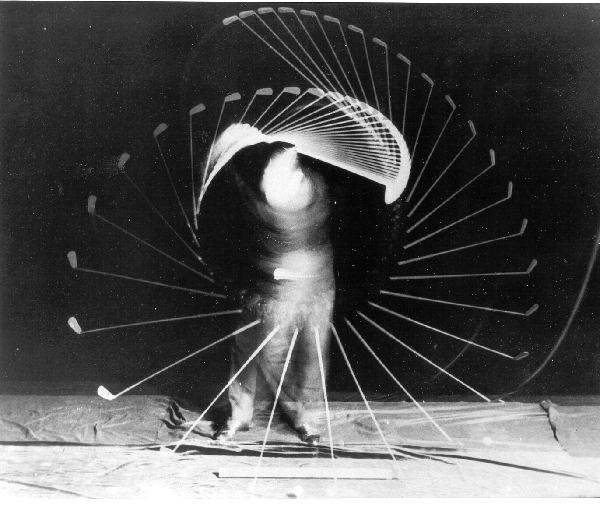
From my reading of the TGM book, I gather the impression that HK believed that the club released in the downswing because of a change in direction of movement of the hands from a straight line path to a curved path, and that the endless belt model explains the release phenomenon. Conceptually, the endless belt model theorizes that the club will travel at the same speed as the hands until the hands enter the pulley section of the endless belt model. Then, as the hands turn around the pulley, the club will accelerate relative to the hands and this represents the release phenomenon. However, this conceptual model is dependent on there being a straight line path movement of the hands in the early/mid downswing followed by a curved hand path later in the downswing, and "reality" doesn't seem to confirm this fact. If one looks at the hand path of professional golfers, their hand path is always curved and there is no straight line section. Here are two examples.
Bobby Jones strobe photo.
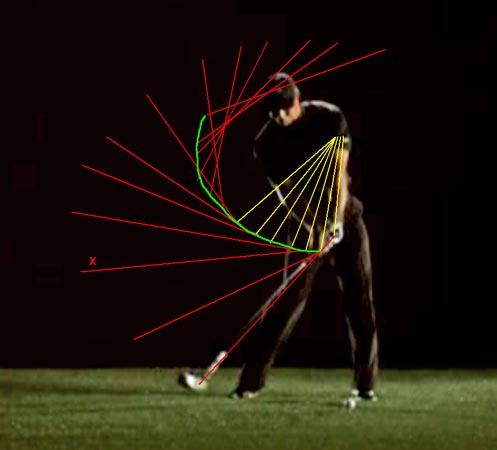
Tiger Woods photo
I used the slow motion Nike commercial swing video of Tiger Woods to produce this image. The red lines represent the clubshaft. The yellow lines represent the left arm (and I only plotted the left arm's location in the later downswing so as not to have too many lines cluttering the image). The green line is a hand-drawn line that plots the sequential movement of the hands over time. Point X is the point when release of the club is definitely apparent, although there is seemingly a small degree of release earlier.
Note that the hand path in both these images is near-circular, and there is no straight line path. Therefore, "reality" doesn't support HK's endless belt concept as explaining the release phenomenon.
Surely, a much better explanation is this mathematical model, which demonstrates that the club develops angular acceleration at all time points in the downswing when the pull on the grip is at an angle to the COG of the clubshaft.
You need a big gunner for this one! I command a cracked straw with ample spid wads, so I will bow low. BUT...Thanks for the Jones pic, it is the best example of the how concentric circles apply to the endless belt effect . I never saw it that clearly until now...THANKS!
If you permit me to opine on this endless field of debate, namely TGM. I have never considered a straight line delivery to be absolutely straight seeings that it J's out at the bottom, for that matter I know that my frozen bent and level right wrist is not perfectly level and probably bends and flattens a little extra during the course of my procedure (but as close as this human can get it) I also suggest to you concerning myself that if my tripod were used to take wedding pictures the bridesmaids would not make the shot! Unless of course Bucket it taking the picture! I do know that if I keep my hand path moving straighter relative to the circular delivery line of the club head then I can utilize the effect that conceptually is best explained by the endless belt effect. Kinda like a swingers utilizing that irrepressible fictitious fleeing force! The golf stroke is not the county fair ducky disappearing around the corner bit! I may add something cheeky here. If he of the Impregnable Quadrilateral and The One moves in a straighter line I dare say they could improve!
I am but a bantam weight on a forum of super heavy weights so I am probably not furthering this debate or enhancing this thread. But I reserve the right to speak my brand of twaddle!
Here is some additional commentary that I think may have significant relevance to understanding the release phenomenon (as explained mathematically by nmgolfer in that link).
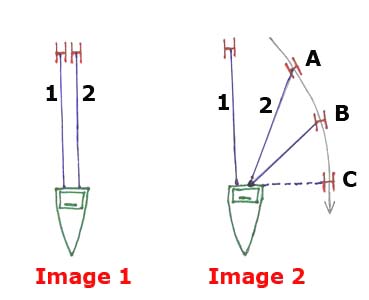
Consider this image of two waterskiers being pulled behind a motorboat.
Image 1 shows the two skiers (1 and 2) traveling at the same speed as they are pulled behind the motorboat. Presume that the motorboat travels at a constant speed, which means that the pull force on the connecting rope is constant, and that both waterskiers will therefore travel at the same speed (which is the same speed as the motorboat).
Image 2 shows what will happen if waterskier number 2 angles his skis outwards so that he travels along a curved path. He will start to travel faster than waterskier number 1 even though the pulling force exerted by the motorboat (which is traveling at a constant speed) along the rope is unchanged. Why does he travel faster? I believe it is due to the fact that the constant pulling force is angled relative to the direction of travel of the waterskier, and therefore the waterskier acquires angular acceleration. With the progression of time, waterskier number 2 will travel along a curved path, and travel through point A, pass point B and eventually end up at point C. During this time period, the waterskier number 2 will be travellng faster-and-faster, and eventually the waterskier will catch up to the boat (point C). Interestingly, the pull force exerted via the rope (as a result of the motorboat traveling at a constant speed) remains constant, but the waterskier eventually catches up to the boat. I think that this catch-up phenomenon is "equivalent" to the release phenomenon described by nmgolfer in his release mathematics explanation - that a golf club develops angular acceleration when the constant pulling force on the grip is at an angle to the COG and directional momentum of the club, and that the clubhead end of the club will eventually catch up to the grip end.
If you find my waterskier analogy reasonable, then you may also consider another fact. Waterskier number 2 travels faster-and-faster along the curved path as he progressively moves through point A and point B to point C. Also, the closer the waterskier gets to the boat (and the faster he travels), the less the drag load he imposes on the connecting rope. So the question becomes, does COAM apply to this situation? Does the motorboat have to slow down (given an unchanged level of engine thrust) if waterskier number 2 progressively speeds up along the curved path as described?
Assume your water skier has already reached point C. In doing so, he could have arrived there at a constant rate of acceleration, or accelerated to say point B and then stayed at a constant rate. He will never catch up to the boat on muscle power alone unless he had a head start from the other side, or he is very strong. In addition, as he nears the boat he will actually slow down until he reaches his original speed, yet the pull on the rope will be significantly greater than the pull on skier 1. You have to have the arms of a power lifter to stay at point C all day due to the resistance of the water against the bottom of the angled board you are standing on.
When he makes his turn to go back towards point A it must be a sharp turn while keeping the rope taut or else he will temporarily sink into the water. Once started, he won't have nearly the effort of pull as he did catching up to the boat, rather a slight turning of the ski will whip him down to point A and momentum will hurl him over the wake, likely catching his fin on Skier #1 rope and thereby plunging both into the water.
A better analogy might be the water-skier preparing to jump the wake or a competition slalom skier which I once was, but due to the nature of skiing which is essentially a flat board resisting the force of water, I don't think there are parallels to be found.
The Golfing Machine model of the endless belt involves an intentional straight line thrust of the hands to their aiming point, not a literal, ungolf-like straight line path of the hands to the bottom of the swing arc. The intent is another practical application which is difficult to measure mathematically. The actual straight line of the hands can sometimes be seen for a few inches at start down, but it depends on the procedure.
__________________
Bagger
1-H "Because of questions of all kinds, reams of additional detail must be made available - but separately, and probably endlessly." Homer Kelly
In the picture of Tiger, counting from the right, the 6th
red line for the clubshaft seems to be length wise for
for Longitudinal Acceleration using a rope handle
technique. I would think that the blue line from red
line 6 to redline 7 would be straight rather that curved. Your curved line appears to suggest radial acceleration. Red line 6 is length wise down
to approx hip level. Would this be the point where
pulley starts?
Do you buy Homers concept of Longitudinal Acceleration
vs radial acceleration?
You then responded as follows-: "The picture of Tiger, sure shows the Impact Circle Axis and the Left Shoulder Center of Impact Circle that V.J. presents in his book."
You are making a big mistake. In constructing my composite photo, I only used one image of Tiger Woods, and superimposed the yellow lines on that photo to show the general change in position of the left arm in the downswing time sequence. However, those yellow lines do not point at the same point, because the left shoulder is always changing position.
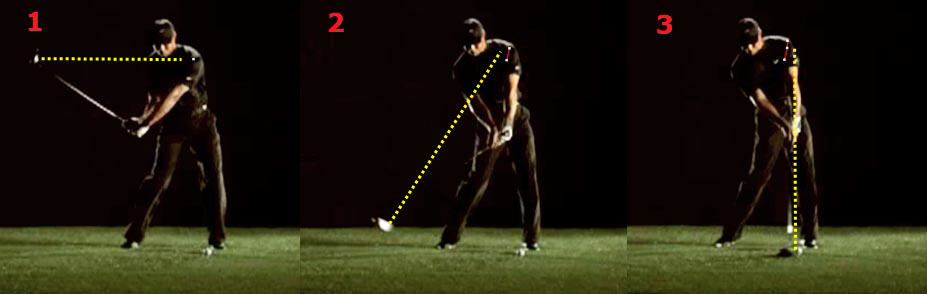
Here is the true reality.
I used a spline tool to trace the movement of Tiger's left shoulder during the mid/late downswing. You can see that his left shoulder continuously moves upwards and to the left as the downswing progresses - see the three white dots with interconnecting red lines. VJ's representation of Ben Hogan's left shoulder socket as being a single fixed point in space is an oversimplification, and it doesn't represent true reality. It is a gross over-simplification - equivalent to representing Ben Hogan's downswing clubshaft plane with a single plane line when the clubshaft is actually changing planes continuously as it moves down from the turned shoulder plane (at the end-backswing) to the hand plane (at impact).
Jeff.
Last edited by Jeff : 06-04-2008 at 09:47 PM.
Reason: Add material
Donn - you wrote-: "Do you buy Homers concept of Longitudinal Acceleration vs radial acceleration?"
I will deal with a swinger's swing - where HK implies that the hands supply a constant pulling force along the length of the club longitudinally (along its longitudinal axis). It is true that as the left hand moves in space it is pulling the grip end of the club in a particular direction, and that the directional force can be perceived to be pulling the grip end of the club along its longitudinal axis. However, the true reality is that the club develops angular acceleration from the very start of the downswing (because the hands are constantly changing direction) and the hand pull cannot therefore remain along the longitudinal axis of the clubshaft throughout the entire downwsing (because the club has inertia and the COG of the club doesn't move instantaneously in the same linear direction with respect to the pulling force). As the downswing evolves, and as the club progressively releases, then the hand pull direction is increasingly at an increasing angle to the longitudinal axis of the shaft.
You also wrote-: "I would think that the blue line from red line 6 to redline 7 would be straight rather that curved. Your curved line appears to suggest radial acceleration. Red line 6 is length wise down to approx hip level. Would this be the point where
pulley starts?"
I don't think that the hand movement arc is ever straight in a golf swing, and that it is always near-circularly curved. I actually think that there is no "pulley" in the hand curve of "real life" golfers (like Tiger Woods and Bobby Jones) because the hand arc curve is essentially C-shaped, with no abrupt changes in direction as would occur with a J-shaped curve.
Jeff.
Last edited by Jeff : 06-04-2008 at 09:53 PM.
Reason: Add additional commentary
I agree that although the rope pull is theoretically constant (because the boat is traveling at a constant speed) that the actual pulling force exerted on waterskier number 2 must become greater when the skier angles the skis to the side and moves along a curved path (instead of a straight line path) - because of the resistance of the water. Do you have the know-how to estimate/calculate the magnitude of this greater pulling force at point A, point B and point C - taking into account the facts that the i) waterskier is progresively moving faster as he moves along that curved path, and ii) the rope is an increasing angle relative to the directional movement of the skier?
You also seem to imply that the pulling force felt by the skier at point C would be at its greatest. I would imagine that it is at its least at point C - because of two factors - i) The waterskier is now moving much faster than the boat, and ii) the angle of the rope is nearly at right angles to the direction of travel of the skier. I would think that the pulling force felt by the waterskier would be at its greatest in the earliest part of the curved path (prior to point A).
From my reading of the TGM book, I gather the impression that HK believed that the club released in the downswing because of a change in direction of movement of the hands from a straight line path to a curved path (that would not be the case- you've mis-interpreted/mis-represented Homer Kelley's concept of release. In his book section 7-20/ 10-20 he gives some ideas of what releases the "power accumulators"), and that the endless belt model explains the release phenomenon.
Note that the hand path in both these images is near-circular, and there is no straight line path. Therefore, "reality" doesn't support HK's endless belt concept as explaining the release phenomenon. (Here again, you haven't understood his concept and therefore arrived at an inaccurate statement)
Surely, a much better explanation is this mathematical model, which demonstrates that the club develops angular acceleration at all time points in the downswing when the pull on the grip is at an angle to the COG of the clubshaft.
http://nmgolfscience.tripod.com/release.htm That explanation is either really terribly written or definitely has a minimum of a couple of errors in it. I wouldn't rely on much information from that "site".
Jeff.
Jeff,
Some brief comments are bolded above in relation to your post. Also, by the link that the author has for basic physics I would presume that the author doesn't "believe" or isn't capable of explaining the concept centrifugal force- another reason to question the degree of intellectual acumen of the author.
__________________
Life Goal- Developing a new theory of movement based on Brain Science
Interests - Dabbling with insanity
Hobbies- Creating Quality







 Linear Mode


