Are you stating that the clubhead has a certain speed at that time point due to the CF-release force that causes the clubhead to be in that position, and that the central clubshaft cannot keep up? If correct, where do you perceive the PP#3's thrust action force being directed at that exact moment in time - is it down-and-out-and-forward; level and forward, up-and-forward-and-inside?
Are you stating that the clubhead has a certain speed at that time point due to the CF-release force that causes the clubhead to be in that position, and that the central clubshaft cannot keep up?
Jeff,
You know what makes my life so difficult with you? Its because of posts like the above. First, you call me out -- "Yoda". Second, you put words in my mouth ("Are you stating . . ."). Always gotta be careful there! Third, you ask a multi-part question. Finally, you imply you want only a simple 'Yes' or 'No', yet your responding bombast always demands far more.
Once I've satisfied myself that you've reasonably summarized any prior comment I may have made -- no easy task! -- I then have to parse your typically voluminous posts and questions. In this last instance, you have dictated your premise, "The Clubhead has a certain speed" -- and, then, as usual, there are at least FOUR questions to give a 'go' or 'no go' (all of which are based on a previous mountainous distillation):
-- At that time point;
-- Due to the Centrifugal Force-Release Force
-- That causes the Clubhead to be in that position
-- And that the Central Shaft position not to keep up.
Any one of which I get "wrong" -- even if only by omission or contrary opinion -- or fail to address adequately, and you and other detractors stand ready to roll out the cannon. I don't like this. I applaud your efforts, but I cannot continue to devote my time -- this past week or so was a gift -- to digesting your voluminous posts, correcting your misguided concepts and answering your indefatiguable challenges. I am the proprietor of this site, but I am not your personal 'pocket pro'. Nor will I leave blatant challenges unanswered in open Forum.
To the point, I'm done here. You are a significant contributor, and I encourage your innovative efforts. However, I have come to believe that you need your own Forum to do it and hereby establish Golf By Jeff. Challenge Homer, me, the world order or the nature of the universe . . . I won't care as long as participants adhere to a reasonable decorum. Given your innate curiosity, scientific background and visual posting capabilities, I expect your Forum to be very popular. I will participate as I see fit, but my lack of comment will not be deemed acceptance of any outrageous and incomplete ideas posted therein. I've previously Private Messaged you on this coming constraint. You will post only in your own Forum or another as approved personally by me. Otherwise, nada.
-----------------------------------------------
Now, to your first question:
Yes.
More precisely, the Sweetspot leads . . . but for now, your term "clubhead" will do.
Originally Posted by Jeff.
If correct, where do you perceive the PP#3's thrust action force being directed at that exact moment in time - is it down-and-out-and-forward; level and forward; up-and-forward-and-inside?
From the Top of the Line Delivery Path (10-23-A), the golfer directs Thrust at and through the Aiming Point (6-E-2). Note the ghosted arrow to the Ball in Photo 10-23-A #1.
But, careful, Jeff . . .
You're risking jacking your own thread.
Thrust Direction is a Delivery Path Concept (#23), not a Pivot Concept (#12).
Yoda - thank you for very much for giving me a place in your forum where I can ask probing questions, debate the validity of certain TGM concepts etc. It is very gracious of you. There is zero chance that certain others would do this, because it requires a great deal of confidence for a TGM golf instructor to allow certain TGM beliefs to be deeply explored and even challenged.
I will definitely adhere to the guideline of decorous behaviour and I would not think of insulting another forum member who has contrary opinions. I like contrary opinions because it forces me to rethink my own position, and I often change my thinking in response to insightful posts that are contrary to my own thinking.
I also will not expect you to participate in the forum and I will therefore not address my posts to you. Of course, you can post freely if you are interested and you want to selectively make a point.
My interest in participating in this forum is to learn more about TGM and about golf mechanics and biomechanics in general, and any LBG forum member should freely participate if they are interested.
------------------------------------------
Regarding the clubhead kick situation. This represents my understanding at present.
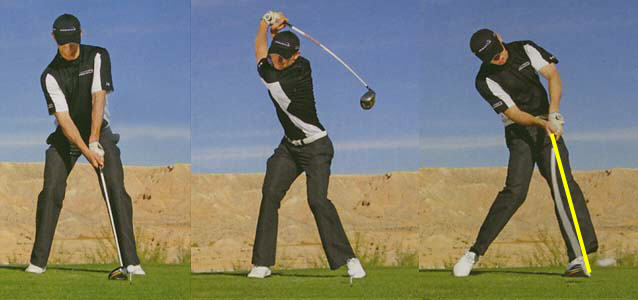
Consider this composite photo.
Note that Jamie's clubhead is sagging at the end-backswing position. If one looks at his early dowswing, one will see that the clubshaft bends backwards. I believe that this is due to clubhead inertia. Long drive competitors, like Jamie, pull the grip end of the club forward with tremendous force and the COG of the club is near the clubhead. Therefore, the clubhead lags behind in the early downswing due to its inherent inertia, and that causes the clubshaft to bend backwards. Theoretically, in a double pendulum swing system the peripheral arm is rigid and cannot flex. However, despite the golf manufacturers making their lightweight shafts extra-stiff for long-drive competitors, they cannot make them so stiff that the shafts cannot flex/bend at all.
In the final image, I have drawn a yellow line indicating where the clubshaft should be if it were ultra-rigid and incapable of flexing. I base the position of the yellow line on the direction of the central clubshaft, which has a very small amount of forward shaft lean at impact. Note that the clubhead has kicked forwards, which causes the clubface to have a slightly greater amount of loft at impact (layback situation) because the ball is positioned slightly forwards of the standard position (which is usually behind the low point).
Why does the peripheral end of the clubshaft bend forward? This represents my explanation.
I think that Jamie is a swinger and that he uses PA#4 and then PA#2 and then PA#3 in that sequence. After PA#2 release, the clubhead is traveling at increasing speed towards impact and it probably reaches >160mph when it approaches impact. However, the hands, and therefore central clubshaft slow down just prior to impact, due to COAM and other biomechanical factors.
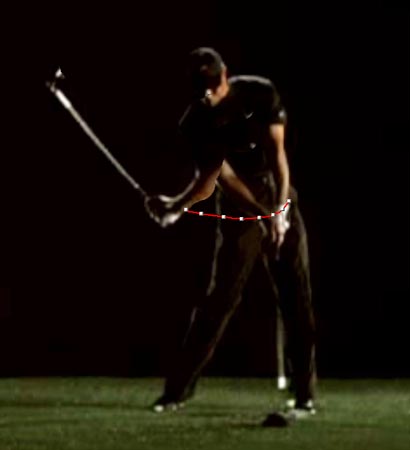
One can see Tiger's left hand slow down just prior to impact in this photo - giving time for release of PA#3 and squaring of the clubface.
I presume that Jamie's hands, and therefore central clubshaft, also slow down just prior to impact - like Tiger's hands. However, the clubhead is traveling so fast that it cannot slow down and it passes the "expected" clubshaft-line and bends the peripheral end of the clubshaft. In other words, it has kicked forwards. When the clubhead kicks forwards, the clubface loft (which could be around 5 degrees) becomes greater (? 9-10 degrees) which allows for an optimum ball flight trajectory. I suspect that Jamie anticipates this clubshaft bending phenomenon, and he therefore places the ball in the optimum position for optimum ball launch conditions.
There are those that argue that Jamie is actually hitting up on the ball. I don't think that its possible for two reasons. First of all, one can see that his central clubshaft near the hands has forward shaft lean, which is consistent with a descending clubshaft path. Secondly, it would make no sense for him to change his downswing thrust direction from down-and-out-and-forwards to going upwards in the later downswing. I believe that Jamie starts his downswing with a thrust towards an aiming point that causes the thrust to be directed down-and-out-and-forwards. That thrust causes release of all the PAs and I suspect that the thrust is maintained until all the PAs have fully released - which is when both arms are straight (end of the followthrough). In other words, the thrust is still directed downwards even when the club has passed the low point of his swing's clubhead arc. So, when one sees the clubhead moving slightly upwards at impact, it doesn't mean that he has changed his thrust direction. It simply means that the clubhead is traveling so fast that it bends the clubshaft forward at its peripheral end as the left hand/central clubshaft slow down just prior to impact.
Regarding the low point of the clubhead arc in long drive competitors who have a lot of secondary axis tilt - is the low point moved forwards? I don't know the answer. If any forum member has access to a slow-mo swing video of Jamie Sadlowski's swing, I would like to examine his clubhead arc to see where his low point is situated.
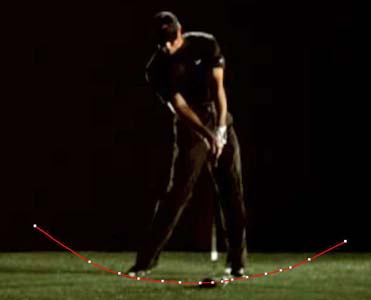
Here is Tiger Woods' clubhead arc through impact.
One can see that the clubhead arc is very shallow pre-impact, and that the low point appears to be behind the ball, or just at the ball - which is a point opposite his left shoulder socket.
Yoda - thank you for very much for giving me a place in your forum where I can ask probing questions, debate the validity of certain TGM concepts etc. It is very gracious of you. There is zero chance that certain others would do this, because it requires a great deal of confidence for a TGM golf instructor to allow certain TGM beliefs to be deeply explored and even challenged.
I will definitely adhere to the guideline of decorous behaviour and I would not think of insulting another forum member who has contrary opinions. I like contrary opinions because it forces me to rethink my own position, and I often change my thinking in response to insightful posts that are contrary to my own thinking.
I also will not expect you to participate in the forum and I will therefore not address my posts to you. Of course, you can post freely if you are interested and you want to selectively make a point.
My interest in participating in this forum is to learn more about TGM and about golf mechanics and biomechanics in general, and any LBG forum member should freely participate if they are interested.
Jeff,
I think your Forum will be a great success and that we will all learn a lot. I will participate when I think I can add value, but only as my time permits.
I expect the decorum to be a two-way street. Respect for opposing opinion -- however hotly debated -- will be the standard.
Originally Posted by Jeff
Regarding the clubhead kick situation. This represents my understanding at present.
Consider this composite photo.
In the final image, I have drawn a yellow line indicating where the clubshaft should be if it were ultra-rigid and incapable of flexing. I base the position of the yellow line on the direction of the central clubshaft, which has a very small amount of forward shaft lean at impact. Note that the clubhead has kicked forwards . . .
No, Jeff. The correct line is the one you drew (at my request) in your post #100. It runs from the #3 Pressure Point to the Sweetspot. Note also that the line points in the direction of the Primary Lever's fulcrum, the Left Shoulder.
The "direction of the central clubshaft" is irrelevant.
Yoda - at this time point we hold contrary viewpoints. I remain open to serious, well-intentioned input from interested forum members and I hope that their input can help clarify matters. I am willing to change my viewpoint in the face of a solidly convincing argument
The problem that I have with the idea that the "sweetspot must be in line with the PP#3 point" is the "belief" that there is a causal connection between the two observed phenomenon. In a swinger, there is no thrust at PP#3. A golfer senses/monitors clubhead lag at PP#3. However, sensing clubhead lag doesn't necessarily prevent a clubhead throwaway problem where the clubhead bypasses the hands near impact, or at impact. In this situation of i) the clubhead traveling at 160mph and the ii) hands slowing down just prior to impact, I can imagine that the golfer can lose his sense of clubhead lag pressure at PP#3 whether he likes it, or not. This loss of a sense of clubhead lag pressure at PP#3 would not necessarily occur if the clubhshaft was not capable of flexing in response to the clubhead's enormous pre-impact momentum, and I could then easily imagine a straight-line relationship between the PP#3 point and the clubface's sweetspot.
Yoda - at this time point we hold contrary viewpoints. I remain open to serious, well-intentioned input from interested forum members and I hope that their input can help clarify matters. I am willing to change my viewpoint in the face of a solidly convincing argument
The problem that I have with the idea that the "sweetspot must be in line with the PP#3 point" is the "belief" that there is a causal connection between the two observed phenomenon. In a swinger, there is no thrust at PP#3. A golfer senses/monitors clubhead lag at PP#3. However, sensing clubhead lag doesn't necessarily prevent a clubhead throwaway problem where the clubhead bypasses the hands near impact, or at impact. In this situation of i) the clubhead traveling at 160mph and the ii) hands slowing down just prior to impact, I can imagine that the golfer can lose his sense of clubhead lag pressure at PP#3 whether he likes it, or not. This loss of a sense of clubhead lag pressure at PP#3 would not necessarily occur if the clubhshaft was not capable of flexing in response to the clubhead's enormous pre-impact momentum, and I could then easily imagine a straight-line relationship between the PP#3 point and the clubface's sweetspot.
Jeff.
Jeff,
How do you think the club flexes during the golf swing? How would you differentiate between flexing and kick? If at all. How would these things change for a hitter versus a swinger? How would these things change if the plane angle was flat or upright? Look forward to your comments.
__________________
Life Goal- Developing a new theory of movement based on Brain Science
Interests - Dabbling with insanity
Hobbies- Creating Quality
Are launch angles like hem lines going down this season?
Originally Posted by Hennybogan
Jeff,
That is a great picture for hitting really far. To my eye, his power package looks good TGM-wise, but his club is moving up because of the extreme tilt., which is a good thing if you want to win long drive contests.
You might notice how much the tilt has changed from the top. It is much more dynamic to change the tilt in the downswing than to pre-set it at address.
But.....Jason does not have to hit his next shot off the ground like a golfer would.
As for how high they launch it. You might try to find some launch monitor numbers for the long drive guys. It is a big adjustment to actually see the ball when you are standing next to them, because it launches so high.
Henny
As a side note and given your experience on tour:
When I get into a launch monitor for a driver fitting the techs are always trying to get me to launch it super crazy high. I can understand how this would max out carry etc but I hesitate to fully embrace it as a standard operating procedure. What do you see guys on tour doing these days? Are launch angles going up or down of late?
The fitting guys are also advocating the same procedure into the wind ,in the belief that a high, low spin ball will push through the wind better. I dont doubt their research results but am still hitting it low or moderately high into the wind, thinking that I dont want it to blow around up there. Perhaps Im merely dating myself. What do you see on tour into a strong wind?
Tiger seems to tee it low and hit it on the downswing a lot. Sometimes he tees it really low, almost old school if you will.
To get even further afield Im seeing some Titleist guys now going to the slightly smaller driver head.
I remember tennis racquets getting huge and then coming back a little.
Those are excellent questions. I don't know the answers.
I can understand that if a shaft flexes, that it has inherent elastic properties that will induce it to spring back to a straight line alignment. Therefore, when one sees a clubhead ahead of the hands/central clubshaft at impact - the question becomes - did that phenomenon happen because the clubhead's momentum caused the clubshaft to flex forwards or could there be a spring-back clubshaft-flex action due to the fact that the clubhead was lagging behind the clubshaft earlier in the downswing, causing the shaft to bend backwards, and now the clubshaft is simply flexing forwards in response to being previously stretched the other way (a whiplash action).
Do you have any insights to share that can differentiate between these two theoretical possibilities?
I imagine that the clubshaft should behave very differently between a hitter and a swinger. A hitter applies a push-force continuously on the clubshaft all the way through impact. I imagine that there is therefore less of a whiplash phenomenon. By contrast, a swinger induces a definitive whip lash motion, in the sense that pull-power is imparted to the clubshaft during the early-mid downswing, and no further power is imparted to the clubshaft during the near-impact phase of the downswing. At that time point, the clubshaft is moving towards impact due to the passive release of PA#2 ( due to centrifugal forces). I could imagine the clubshaft behaving very differently under those conditions.
Please share any insights you have regarding this matter.
I don't imagine that an upright versus a flat plane should have a significant effect. Do you?






 Linear Mode


