Posture. Can you write a Golf Book and not once use the word..... "Posture"?
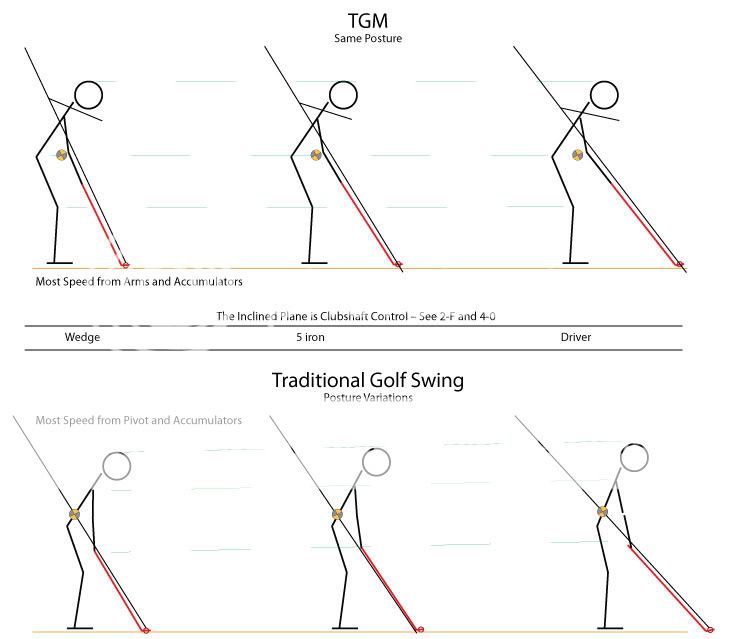
The TGM Golfer in the illustration below is using the "Turned Shoulder" Plane. The Traditional Golfer is using the "Elbow" Plane.
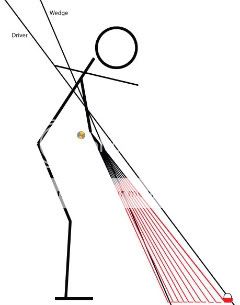
Below are a couple of ideas about posture and TGM compared to the Traditional approach to Golf Swing and Plane Control. Golf Strokes with the greatest mechanical advantage include an On-Plane Right Shoulder at the Top of the Swing and an On-Plane Right Shoulder during the Downstroke. In TGM, the Right Elbow Controls the Right Shoulder Location during and at the Top of the Backstroke. Plane Angles for longer and shorter Clubs are compensated by changes in Power Package Alignments. The significant alignment of the Power Package is the amount of Bend in the Right Arm. More Bend for Longer Clubs and less bend for shorter Clubs. More bend causes shallower planes and less bend causes steeper planes. All of these are Turned Shoulder Planes and all of these are controlled automatically at Address and by the Right Forearm-Extensor Action Takeaway. It doesn't get any easier than that.
Tradition has Golfers adjust their Posture for each Length Golf Club. More upright stance for longer clubs and more bent over for shorter clubs. An indication of Pivot Controlled Hands Procedure. When a Traditional Golfer arrives at Impact and has been fortunate enough to have his Right Forearm On-Plane to support and Guide the Clubhead, he has forced significant posture re-Alignments during the Swing. I wonder what the Bio-Mechanics people would say about that?
I have been drawing similar stick guys to you ...just not so pretty. You think that if you were to draw in the shoulders on the pivot chaps they would have "rotated shoulder" backswing?
I have been drawing similar stick guys to you ...just not so pretty. You think that if you were to draw in the shoulders on the pivot chaps they would have "rotated shoulder" backswing?
No, but the TGM guy in the upper left corner, if he had a lob wedge may appear to be on a "Rotated Shoulder" Plane. Players Height needs to be considered.
So for TGM we should have same bent for every club? Currently I have the longer club more upright (driver) and with elbow bent.
Same Posture for every club. The Right Elbow a Little farther away from the body for longer clubs and closer for shorter clubs (see above illustration)
Each length Club has a different amount of Elbow Bend
Wedge has a steeper Plane Angle than the Driver
Stance is wider for Longer Clubs and narrower for shorter clubs
The illustration represents a Swinger at Standard Address or a Hitter with a Forward Press. If the Hitter relocated his Hands to Standard Address (not recommended), then his Upper Left Arm would be Vertical to the Ground with shorter Clubs and his Elbow would be slightly behind that Location for Longer Clubs.
How do you go about determining the precise amount of elbow bend? I try to establish my wedges on a horizontal plane...then flex my knees and bend at the waist until the club hits dirt. So it would seem that my posture changes and my elbow bend stays more constant. The only other thing that changes is the amount of right wrist bend, based on ball postion.
How do you go about determining the precise amount of elbow bend? I try to establish my wedges on a horizontal plane...then flex my knees and bend at the waist until the club hits dirt. So it would seem that my posture changes and my elbow bend stays more constant. The only other thing that changes is the amount of right wrist bend, based on ball postion.
You're adjusting your Posture to a Fixed degree of Elbow Bend. The problem with this thinking is that you may have enough Elbow Bend to get a Clubhead with a 60" Swing radius through the Release and Impact Zone before the Right Arm Straightens, but not a 70" Swing Radius. Try adopting the same Posture at Impact Fix for each club with an On-Plane Right Forearm, and so, the Major difference between Driver and Wedge is distance from the Ball and Elbow Bend.
If each club has a built-in degree of Shaft Lean, with a constant ball location, then theoretically, our hands would be in a different location for each club at impact. A wedge would have hands more Forward than a Driver. This might lead one to think that you need more Elbow Bend for a Wedge than a Driver. But Hands more forward for a Wedge has a direct relationship to Stance Width. If the Hands need to be Farther Ahead, then Narrow the Stance.
Thinking out-loud: But this also is misleading for two reasons. First, The more Elbow Bend of the Driver is reduced by Higher Hands. With higher Hands, the Hands need to be farther from the Body. Second, the Shoulders are more open at Impact with a Driver, and the Left Shoulder is farther from the Ball at Impact with a Driver than with a Wedge.
So, the 3" of more Flex at Address for a Driver than a Wedge is augmented by Hand Height and Shoulder Turn. However, you Still have Reserve Flex because the Hands with a Driver aren't as far ahead of the Ball as they are with the Wedge. This reserved Flex may be just enough to get the Driver through the Release and Impact Zone before the Right Elbow Straightens.
Quote:
The “flatter” the Plane Angle, the more Shoulder Turn is required to put – and keep – the Right Shoulder On Plane. And vice versa.
And,
Quote:
7-16 KNEE ACTION Knee Action is classified on the basis of (1) combinations of bent and straight conditions and (2) the Reference Points selected at which these combinations occur. The combination and the Reference Points selected will determine the slanting of the Hips during the Pivot. The slant is up in the direction of a straightened Knee. The slant of the Hips affects the degree of Hip Turn. Actually, the primary function of Knee Action – as with Waist Bend – is to maintain a motionless head during the Stroke.
The proper amount of Knee Bend is determined at Impact Fix (7-'8') by the distance the Hips must move to allow the Right Forearm to point at the selected Plane Line per 2-J-3 and 7-3. The amount of Bend will also determine the amount of Backstroke Turn and Downstroke Slide. The amount of Bend will also determine the amount of Backstroke Turn and Downstroke Slide. The less Bend, the more the Pivot and Hip Slide will be restricted in both directions and the more upright the Plane tends to be.
But all of the Above is Controlled by the Width of the Stance. With a Narrower Stance, for steeper Plane Angles, Hip Turn, Weight Shift and Knee Action are all interrelated and reduced a similar amount. So, if you kneed less Knee Action throughout the Stroke, then Narrow the Stance but the Amount of Bend was established at Impact Fix and you'll find this to be practically the same for every club.
Quote:
7-8 THE FIX If there is one mechanical imperative in the Golf Stroke, it is the CORRECT IMPACT ALIGNMENTS. There is no advantage in leaving these to chance if they can be consciously defined and selected by a preliminary positioning. See 3-F-5, 8-0, and 8-2.
There is one imperative definition – except with 10-9-B, Impact conditions are not the same as in the Address except for Clubshaft angle. The most important single difference is that the Left Wrist is Bent at Address but not at Impact. Therefore precision alignment of the Grip can be taken only in the Impact position. Secondly, the Left Shoulder is higher at Impact so the player must be positioned accordingly for proper Shoulder-to-ball distance.
A further advantage of a separate and clearly defined Impact position is that the players have presented, right before them exactly what they will be striving to achieve at Impact. Not merely a vague approximation of the Clubface alignment, but the exact relationship of every single Component. And the opportunity to familiarize themselves with the correct appearance and the correct Feel. And Fix them in mind with more and more precision, especially regarding the Hands. They must appear to be near, or covering, the Left Toe – nowhere near the ball. That will, except as required in 10-8 and 10-9, change their relationship with the ball but they will still be in mid-body location. Move back and forth between Address and Fix until you see that. That difference separates the Pro and Hacker. Much effort and poor results is the giveaway. Without exception. In-put Out-put Power Ratio also is utterly dependent on Hand Location at Impact. (The Flat Left Wrist -2-G and 9-2). Study 4-D-1 and 6-E in this connection.
[quote=Daryl;65219]You're adjusting your Posture to a Fixed degree of Elbow Bend. The problem with this thinking is that you may have enough Elbow Bend to get a Clubhead with a 60" Swing radius through the Release and Impact Zone before the Right Arm Straightens, but not a 70" Swing Radius. Try adopting the same Posture at Impact Fix for each club with an On-Plane Right Forearm, and so, the Major difference between Driver and Wedge is distance from the Ball and Elbow Bend.
Otay that makes sense. how do I go about attempting what you recommend? Will you step it out for me? I sense a wisp of something here. The key for me recently has everything to do with the right elbow i.e. degree of bend, postions, fanning etc.
You're adjusting your Posture to a Fixed degree of Elbow Bend. The problem with this thinking is that you may have enough Elbow Bend to get a Clubhead with a 60" Swing radius through the Release and Impact Zone before the Right Arm Straightens, but not a 70" Swing Radius. Try adopting the same Posture at Impact Fix for each club with an On-Plane Right Forearm, and so, the Major difference between Driver and Wedge is distance from the Ball and Elbow Bend.
Otay that makes sense. how do I go about attempting what you recommend? Will you step it out for me? I sense a wisp of something here. The key for me recently has everything to do with the right elbow i.e. degree of bend, postions, fanning etc.
Get a Wedge and a Driver
Hold the Wedge in your Left Hand
Put the Driver in your Right Hand
Adjust yourself into Impact Fix with the Driver and Right Forearm On Plane and a Wider Stance with your Hand in the Line of Sight to your Left Foot.
Let go of the Driver and let it drop to the ground.
Do not move your Pivot alignments and Right Forearm.
With your Left Hand, put the Wedge in your Right Hand. The Clubhead is above the ground.
Bend your Right Elbow until the Clubhead Touches the Ground. Narrow your Stance until the Hands are over the Left Foot. Simply moving the Right Foot will not reposition the Hand in the Line of Sight to the Left Foot so Don't forget to re-Center your Head.
Thanks, Daryl. That is EXACTLY what I was looking for. Okie needs a step by step...down to brushing his teeth! I will work on it during my next practice session.






 Linear Mode


