h file or directory Homer assumed Separation to be at Low Point but what if it isnt? - LynnBlakeGolf Forums

Homer assumed Separation to be at Low Point but what if it isnt?

The Golfing Machine - Basic

Reply
 
Thread Tools Display Modes
  #1  
Old 09-04-2010, 05:03 PM
O.B.Left O.B.Left is offline
Senior Member
 
Join Date: Mar 2006
Posts: 3,433
Homer assumed Separation to be at Low Point but what if it isnt?
Homer in the diagrams of 2-C , for illustrative purposes (I think) assumed Separation to occur at Low Point. But what if it isnt? What are the implications?

Lynn has said that the impact interval is approx 3/4 of an inch in length , which implies to me that for balls positioned further than 3/4 of an inch back of Low Point, Separation will occur prior to Low Point.

What are the implications of this to the Arc of Approach , the Angle of Approach , the Line of Compression, clubface angle etc etc if any?

In 2-J-3 Homer writes that you determine the Angle of Approach by drawing a straight line from Impact to Low Point. So would I be right in thinking that the Arc and Angle of Approach are unchanged but the clubface angle per 1-L-17 needs to be square to the target at Separation..........

That picture would be a bit of shock to most golfer wouldnt it? A square to the hole clubface at Separation but a clubhead still way back of low point on the Arc of Approach. The clubhead needing to continue its Inside/out journey long after the ball has gone. Most golfers would assume this to be a draw or hook shot deal wouldnt they? But it isnt. Is it?

Sorry I cant do any fancy computer graphics which would help illustrate this. Maybe our good buddy, Daryl could help out.

If this is true , no wonder most divots point to the left ..........a straight line base line has way more Down and Out to it than you'd ever imagine... especially for shots played back in your stance.

Last edited by O.B.Left : 09-04-2010 at 05:08 PM.
Reply With Quote
  #2  
Old 09-05-2010, 11:38 AM
HungryBear HungryBear is offline
Senior Member
 
Join Date: Nov 2008
Posts: 759
Originally Posted by O.B.Left View Post
Homer in the diagrams of 2-C , for illustrative purposes (I think) assumed Separation to occur at Low Point. But what if it isnt? What are the implications?

Lynn has said that the impact interval is approx 3/4 of an inch in length , which implies to me that for balls positioned further than 3/4 of an inch back of Low Point, Separation will occur prior to Low Point.

What are the implications of this to the Arc of Approach , the Angle of Approach , the Line of Compression, clubface angle etc etc if any?

In 2-J-3 Homer writes that you determine the Angle of Approach by drawing a straight line from Impact to Low Point. So would I be right in thinking that the Arc and Angle of Approach are unchanged but the clubface angle per 1-L-17 needs to be square to the target at Separation..........

That picture would be a bit of shock to most golfer wouldnt it? A square to the hole clubface at Separation but a clubhead still way back of low point on the Arc of Approach. The clubhead needing to continue its Inside/out journey long after the ball has gone. Most golfers would assume this to be a draw or hook shot deal wouldnt they? But it isnt. Is it?

Sorry I cant do any fancy computer graphics which would help illustrate this. Maybe our good buddy, Daryl could help out.

If this is true , no wonder most divots point to the left ..........a straight line base line has way more Down and Out to it than you'd ever imagine... especially for shots played back in your stance.
Depends on many factors.

7-2 covers the alignments-per grip

because swinging (horizontal hinge) would be vertival club face, on plane lag pressure- Hitting (angled hinge) would be both clubface and lag pressure on plane. Then the low point can be moved a long way by #2 and even to down and out with an up and in clubface {a bad thing but possible}

The Bear
Reply With Quote
  #3  
Old 09-05-2010, 12:20 PM
Daryl's Avatar
Daryl Daryl is offline
Senior Member
 
Join Date: Feb 2005
Location: Illinois
Posts: 3,521
Impact, Ball Location and Low-Point.
6 Iron. This illustration indicates Impact at 6" behind Low-Point. Ball probably separates at 5 1/2" and Clubhead enters the ground at 5" behind Low-Point. Dirt starts to show at 4" behind Low-Point. Divot depth is 3/8".

Question is: Does one side of Low-Point have more divot? Why?


Innercityteacher played 57 rounds of golf this summer and must have hit thousands of balls. Do you think he ever measured a single Divot?
__________________
Daryl

Last edited by Daryl : 09-05-2010 at 12:27 PM.
Reply With Quote
  #4  
Old 09-05-2010, 12:59 PM
HungryBear HungryBear is offline
Senior Member
 
Join Date: Nov 2008
Posts: 759
Originally Posted by Daryl View Post
6 Iron. This illustration indicates Impact at 6" behind Low-Point. Ball probably separates at 5 1/2" and Clubhead enters the ground at 5" behind Low-Point. Dirt starts to show at 4" behind Low-Point. Divot depth is 3/8".

Question is: Does one side of Low-Point have more divot? Why?


Innercityteacher played 57 rounds of golf this summer and must have hit thousands of balls. Do you think he ever measured a single Divot?

Yes. because #2 accumulator is still going down, until both arms streight. longer in front of LP longer arc. Except with zero (or fixed) #3 then balanced divot. (Scoop)

The Bear

Last edited by HungryBear : 09-05-2010 at 01:02 PM.
Reply With Quote
  #5  
Old 09-05-2010, 01:20 PM
Daryl's Avatar
Daryl Daryl is offline
Senior Member
 
Join Date: Feb 2005
Location: Illinois
Posts: 3,521
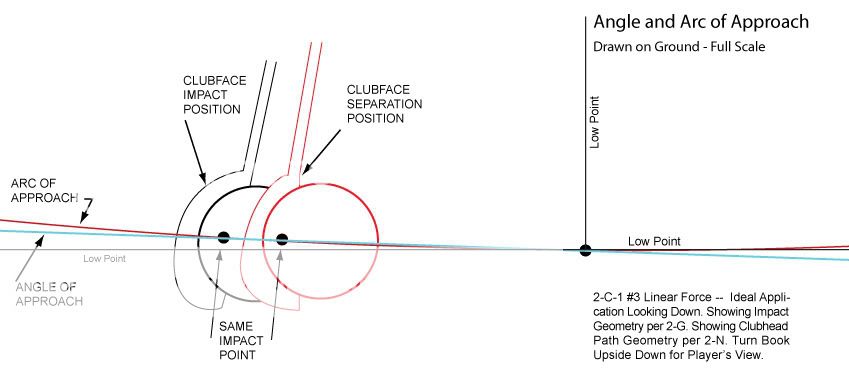
2-C-1 #3 Full Scale
Print this out and turn upside down for Players View. Average Club: Impact 4" behind Low Point.

__________________
Daryl

Last edited by Daryl : 09-05-2010 at 01:23 PM.
Reply With Quote
  #6  
Old 09-05-2010, 02:01 PM
O.B.Left O.B.Left is offline
Senior Member
 
Join Date: Mar 2006
Posts: 3,433
Originally Posted by Daryl View Post
Print this out and turn upside down for Players View. Average Club: Impact 4" behind Low Point.


AWSOME thats exactly what Im talking about.......

Straight shot or draw?

Its very interesting to look at this drawn to scale, thanks D. I always thought Homer avoided scale for illustrative purposes......but now Im also wondering if he did so to heighten the readers appreciation for the Inside-Out nature of Impact along the Arc of Approach. I dunno Maybe. He did say that "its inside-out and should feel inside-out".

Last edited by O.B.Left : 09-05-2010 at 02:10 PM.
Reply With Quote
  #7  
Old 09-05-2010, 03:50 PM
O.B.Left O.B.Left is offline
Senior Member
 
Join Date: Mar 2006
Posts: 3,433
Originally Posted by Daryl View Post
Print this out and turn upside down for Players View. Average Club: Impact 4" behind Low Point.


Thanks Bear. Its interesting isnt it?

Anyone else? Straight shot or not?
Reply With Quote
  #8  
Old 09-06-2010, 09:54 PM
O.B.Left O.B.Left is offline
Senior Member
 
Join Date: Mar 2006
Posts: 3,433
Originally Posted by Daryl View Post
Print this out and turn upside down for Players View. Average Club: Impact 4" behind Low Point.


Im still wondering. Straight shot or Draw? Maybe we have to assume a Hinge Action.......so lets say Horizontal and Arc of Approach, manipulated hands swinging or Hitting. I was initially thinking straight cause its not an inside out stroke but now I honestly dont know.

Life line.....Yoda!!!!!!!
Reply With Quote
  #9  
Old 01-02-2011, 05:15 PM
O.B.Left O.B.Left is offline
Senior Member
 
Join Date: Mar 2006
Posts: 3,433
Originally Posted by Daryl View Post
Print this out and turn upside down for Players View. Average Club: Impact 4" behind Low Point.


Guys I realize I have a bit of unfinished business from 2010. I love D's drawing here. Its a reworking of the diagrams of 2-C but with the Impact Point moved back of low point.......as you would get for balls played back in the stance. The diagrams of 2-C are really about compression to my mind, hinge actions as opposed to ball curvature but the lend themselves well to what Homer discussed in 7-2.

When I started this thread I didnt know the difference between Inside OUt Impact and an Inside OUt stroke in terms of the effect on ball behaviour. I had wrongly assumed the inside out approach angle with a straight plane line to produce a straight shot! Now I know the geometry better.......this after decades of curving golf balls ....sometimes where I wanted them to go, even. Im in good company here so I dont feel like too big of an idiot. No more than usual.

So the specifics of Daryls drawings above aside .....and I do wish that D would continue on with these drawings per 7-2 etc.

If in the process of moving the ball back in the stance you also "Rotate the Grip" (rotate the handle in the loose hands) so the Face is still pointing down the Target Line.... given enough clubhead speed and divergence in path and face, the ball will draw left of the target line. Requiring you to select a Plane Line suitably right of your intended destination in the first place.

If you dont Rotate the Grip and allow the FAce to open as you move the ball back in the stance. Depending on how far back you go , how much divergence ......Push to Push Fade assuming no hand manipulation.

This is for full shots. For chip shots where there isnt enough clubhead speed for the ball to curve in accordance with any ,as Homer put it, "tilted backspin" (not side spin) you will see the ball land where the face is pointing approximately but roll out in different manners Id imagine.

Hope I got this right. 7-2 is one tough read. Homer seemed to have a personal preference for the first procedure where you rotate the grip , be you a Hitter or what he termed a Manipulated Hands Swinger. They're in the same boat geometrically.

A True Swinger on the other hand being one allows CF alone to square the face, no grip rotation , no hand manipulation , no hinge action, just the natural Horizontal that CF produces. All of which I believe requires a slight notation beside 6-H-0-F-3............but thats for Lynn to decide as I could be wrong again......but that particular IMPERATIVE relates to True Swinging only I believe.

Last edited by O.B.Left : 01-02-2011 at 05:21 PM.
Reply With Quote
  #10  
Old 09-05-2010, 01:53 PM
O.B.Left O.B.Left is offline
Senior Member
 
Join Date: Mar 2006
Posts: 3,433
Originally Posted by HungryBear View Post
Yes. because #2 accumulator is still going down, until both arms streight. longer in front of LP longer arc. Except with zero (or fixed) #3 then balanced divot. (Scoop)

The Bear
Interesting point about #2 angle........awsome drawing there Daryl. What software do you use?

In regard to clubface implications for Separation prior to Low Point: Let me try this another way.

First read the first paragraph of 2-J-2 INSIDE OUT IMPACT. (Its a great read but for brevity Ill jump ahead to the main point.) "..........Though it is an "inside-out" Impact it is not an "inside-out" Stroke unless the Plane Line crosses the Line Of Flight as depicted in photo 10-5-E. (closed- closed).

Per 2-J-1 and 1-L-17 while the clubface is positioned in accordance with your Hinge Action at Fix (slightly open for Horizontal etc) at Separation the clubface must be square to the Target Line.

Now look at Picture 2-C-1 #3 and turn it upside down for the players perspective. Its not to scale obviously and assumes Separation at Low Point but lets imagine Separation prior to Low Point......Imagine Separation about where Impact is depicted......the clubface now square to the Target Line and THE INSIDE-OUT ANGLE OF APPROACH LIEING AHEAD OF SEPARATION.

Straight shot or draw?

Last edited by O.B.Left : 09-05-2010 at 01:58 PM.
Reply With Quote
Reply


Thread Tools
Display Modes

Posting Rules
You may not post new threads
You may not post replies
You may not post attachments
You may not edit your posts

vB code is On
Smilies are On
[IMG] code is On
HTML code is Off
Forum Jump


All times are GMT -4. The time now is 09:46 PM.


Design by Vjacheslav Trushkin, color scheme by ColorizeIt!.
directoryDatabase Error: Unable to connect to the database:Could not connect to MySQL