It is one thing to look at something - it is another thing altogether to know what you are looking at.
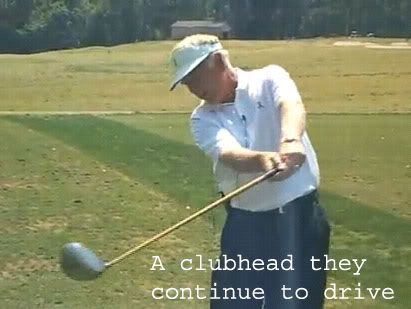
Can someone interpret this photo of Yoda taken from a lesson with Colin Newman please?
Especially in regard to the grip and hinge action employed.
What else do you see?
I am paraphrasing but remember that Homer said to use photos to examine what exactly is being discussed, and other impressions should be minimized.
Please note the wording - clubHEAD - I believe Lynn is demonstrating the maintaining of the flat left wrist through impact and into followthrough; the photo does show him past followthrough where we would expect to see the finish swivel, but I think clubHEAD is the issue at hand.
Lynn's grip shows strong single action - notice #3 behind the shaft - the hinge action looks vertical to angled (more to vertical I think).
Again, I believe the flat left wrist is being discussed - all other incidental references should be ignored.
In 2-R I believe Homer is referring specifically to “the pictures in this book” not pictures in general however I think I see what you are getting at.
The wording “clubhead” is taken from the following passage where Lynn is emphasizing the importance of pressures in the hands.
( The video is here.
)
“It’s all about pressures in your hands and it is so elusive because once you have thrown the club it is gone. It is off on its own. You have to sustain the driving pressures in your hands and once you’ve thrown it you’ve lost it. You’ve got to continue to drive the club. The great players continue to drive the club. Almost everybody else, even tour players tend to throw the club a little bit. They are very expert at throwing it but they still have a thrown clubhead on their hands instead of a clubhead that they are continuing to drive. And that is going to be your goal over the next few years and for the rest of your life, learning to create and then sustain steady driving pressures.”
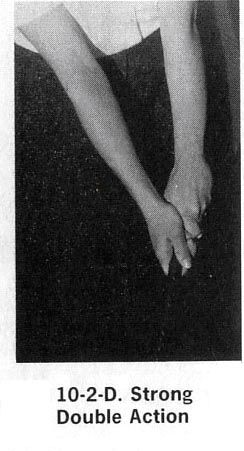
But it is the grip and hinge action in particular that I’m trying to identify. The left hand appears turned to the top of the Clubshaft and the right hand vertical so I was thinking 10-2-D, strong double action but I could be wrong.
Yes, I was referring to pictures in general. The audio describes the need to get the left arm, clubshaft and especially right forearm their impact fix alignment at impact. This would be done through the pressure points. Again, I believe his focus was on how the pressure points allow the club head to be properly released. From the looks, and again, we're past follow through, I think it's a strong single grip, but with vertical (maybe angled) hinging.
Hope this helps - it is hard to tell from that position, but I've watched these videos many times (as everyone has) and I don't remember any discussion of grip beyond strong single.
It is one thing to look at something - it is another thing altogether to know what you are looking at.
Can someone interpret this photo of Yoda taken from a lesson with Colin Newman please?
Especially in regard to the grip and hinge action employed.
What else do you see?
Hey Strav.
Thanks for posting the link to the video. The photo of Yoda you are inquiring about is perfect .......... for the context in which in which that swing was made, only. If that is an actual swing. I see it as a demonstration , an exaggeration of Clubhead Lag as apposed to a Thrown away clubhead which is often a result of Over Acceleration.
Notice how the Clubhead has yet to pass the Hands. The Grip type or Hinge Action on display is irrelevant, thats not what he was demonstrating.
I believe the "Drive" Yoda refers to is not the drive of Drive Loading but the drive of Clubhead Lag Pressure.
Quote:
Per 7-19
Incorrect Clubhead Lag Pressure "Feel" does not set up a steady driving pressure but an impatient THROWING pressure , guaranteeing Clubhead Throwaway. Rolling and/or Uncocking have the assignment of doing any throwing of the Clubhead. Lag Pressure is totally inert. The slightest "pushing away" will produce Clubhead Throwaway. When you find yourself swinging fast whether you want to or not, you are contending with Clubhead Throwaway and it could be induced by improper Clubhead Lag Pressure Point Action. And instead of "driving" the Club you find yourself "chasing" it - and never catching up with it. Obviously , if the thrown Clubhead doesnt pass the Hands until after Impact Fix Position (7-8 ) is reached, it still complies with the Law of the Flail (2-K) but the precision Timing and Clubface alignment becomes difficult and , however widely used , is still an essentially perilous deviation.
"Improper Clubhead Lag Pressure Point action" , refers to the three unique procedures by which clubhead lag pressure can be established; Drive , Float and Drag Loading. They are not the same and do not necessarily share the same Lag pressure point location.
Yoda detected some "over acceleration" and was demonstrating the cure for its associated Throw away.........the sustainment of Lag Pressure. That said a tour pro for instance could make a practice of Throwaway to some extent, develop a feel for throwing it away. If the clubhead doesnt pass the hands prior to impact the shot will not be lost as it would still comply with the law of the flail. The left wrist would still be sufficiently flat in other words, though its in the process of breaking. Rhythm is only just beginning to be lost, but not yet critically so.
Lag Pressure has a feel. Throwout and Throwaway have feels but are not one and the same. Throwout via uncocking or rolling are Power Accumulators 2 and 3 Releasing and part of the Swingers Golf Flail. Necessary for Power generation. Throwaway on the other hand sets up an improper Rhythm, where the clubhead is thrown in a manner where it accelerates to a higher RPM than the rest of the Power Package (hands).......breaking the left wrist. That said you can employ Throwaway intentionally for a deliberate loss of compression, for a specialty type lob shot say. So it can be useful at times.
It is all about the feel in your hands. You have to educate the Hands.
Thanks for posting the link to the video. The photo of Yoda you are inquiring about is perfect .......... for the context in which in which that swing was made, only. If that is an actual swing. I see it as a demonstration , an exaggeration of Clubhead Lag as apposed to a Thrown away clubhead which is often a result of Over Acceleration.
Notice how the Clubhead has yet to pass the Hands. The Grip type or Hinge Action on display is irrelevant, thats not what he was demonstrating.
I believe the "Drive" Yoda refers to is not the drive of Drive Loading but the drive of Clubhead Lag Pressure.
"Improper Clubhead Lag Pressure Point action" , refers to the three unique procedures by which clubhead lag pressure can be established; Drive , Float and Drag Loading. They are not the same and do not necessarily share the same Lag pressure point location.
Yoda detected some "over acceleration" and was demonstrating the cure for its associated Throw away.........the sustainment of Lag Pressure. That said a tour pro for instance could make a practice of Throwaway to some extent, develop a feel for throwing it away. If the clubhead doesnt pass the hands prior to impact the shot will not lost as it would still comply with the law of the flail. The left wrist would still be sufficiently flat in other words, though its in the process of breaking. Rhythm is only just beginning to be lost, but not yet critically so.
Lag Pressure has a feel. Throwout and Throwaway have feels but are not one and the same. Throwout via uncocking or rolling are Power Accumulators 2 and 3 Releasing and part of the Swingers Golf Flail. Necessary for Power generation. Throwaway on the other hand sets up an improper Rhythm, where the clubhead is thrown in a manner where it accelerates to a higher RPM than the rest of the Power Package (hands).......breaking the left wrist. That said you can employ Throwaway intentionally for a deliberate loss of compression, for a specialty type lob shot say. So it can be useful at times.
It is all about the feel in your hands. You have to educate the Hands.
Thats my take on it anyway.
I agree OB. Lag=Sweet Spot On Plane
Constant awareness of the Lag means that the club is moving On Plane. When I Swing or Carry Back and wait for the weight or Pressure to load on PP # 3 , my Right Question Mark or the inside of my Left Question Mark, I can either Drag that weight on a string or Drive it through Impact around a Stationary Balanced Head. The Weight is the Rhythm is the Lag is the Sweet Spot of the Club Face.
Now, it is simple, after 1200 posts and 45 rounds and 4 days with Lynn.
IC T
__________________
HP, grant me the serenity to accept what I cannot change, the courage to change what I can, and the wisdom to know the difference. Progress and not perfection is the goal every day!
Thanks for posting the link to the video. The photo of Yoda you are inquiring about is perfect .......... for the context in which in which that swing was made, only. If that is an actual swing. I see it as a demonstration , an exaggeration of Clubhead Lag as apposed to a Thrown away clubhead which is often a result of Over Acceleration.
Notice how the Clubhead has yet to pass the Hands. The Grip type or Hinge Action on display is irrelevant, thats not what he was demonstrating.
I believe the "Drive" Yoda refers to is not the drive of Drive Loading but the drive of Clubhead Lag Pressure.
In the handful of lessons I've had with Yoda, that particular photo and caption is very reminicient of about 30 minutes or more of instruction on how the #3 pressure point continues to drive down and out, tracing the plane line through, and past impact into the finish swivel. The exercise was, at least in my lesson, about "drive out" and preparation for the finish swivel.
The finish swivel occuring a millisecond after the photo is a quick roll of the left wrist into the finish position.
This photo appears to be a hitting lesson, but I only say that due to the high delay in the finish swivel, but it could be swinging as well depending on steep or shallow swing plane.
__________________
Bagger
1-H "Because of questions of all kinds, reams of additional detail must be made available - but separately, and probably endlessly." Homer Kelly
The audio accompanying the photo makes it patently clear that Yoda is indeed demonstrating the sustaining of steady driving pressures and he reminds Colin that is to be his goal for the rest of his life.
The pic interested me because the alignments depicted were probably arrived at while Yoda's concentration was elsewhere thereby allowing an insight into what comes naturally. Of course this was all conjecture but being a chronic experimenter I tried a few swings with the picture above in mind and found it improved accuracy with my short irons. This may have been because of my tendency to over-roll the left wrist, close the face and hook the ball but in any case I enjoyed the experiment.
It also lead me, rightly or wrongly, to have a closer look at what Homer had to say about 10-2-D “This Grip Type features maximum Wristcocking action and strong support for both Acceleration and Impact loads. The palm of the Right Hand moves toward Impact exactly like a paddle-wheel rotating On Plane—no separate Rolling Motion until after Impact.” which probably helped with my over-rolling problem.
I appreciate the insights from all your posts and have taken them on board.





 Hybrid Mode

