
|
What would you think if I stated it like this...
Original Selection:
Second Selection:
|
The statistics ....
From one of the webpages I just listed http://math.ucsd.edu/~crypto/cgi-bin/monty2?0+4338 Switched - 319 players - 210 Winners - 65.8% Didn't switch - 201 players - 72 Winners - 35.8% |
Quote:
Quote:
Quote:
Quote:
Just because there are four permutations of what can occur doesn't mean you have four choices. It really doesn't matter if you eliminate goat 1 or goat 2 when you have picked the car. If you switch, you will lose either way.... 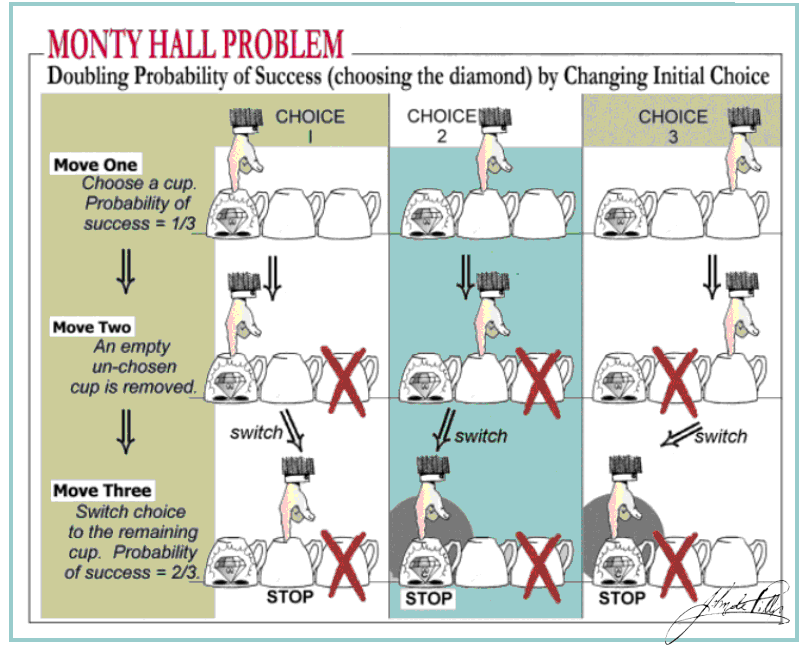 Make this any easier to understand ? |
Quote:
Then what are the odds of switching and getting goat 1? |
Quote:
Your chances that goat 2 is shown after picking the car is 1/2 Half of 1/3 is 1/6 Your chances of switching and getting goat 1 is 1/6 |
..opening the door is not a random choice..
When the door is opened to reveal a goat, that choice is not random. There's always a goat behind one of those doors for them to show you and they only choose after you have chosen. So, that has no bearing on the initial conditions. The probability that you did not pick the car with your first pick is 2/3 and that does not change.
|
Again, look at it with 100 doors...99 goats and 1 car.
You get to pick one door. The chances of picking the car are 1/100. They open the other 98. You can either stick with your original choice or switch to the one remaining door. Your original choice still has a 1/100 chance of being the car. Agreed? The chances of the one other remaining door having the car...99/100? Just because you have two choices doesn't make it a 50/50 proposition. |
Matthew,
It's been fun, but the snow is starting to melt and it's time to start thinking golf. I'll admit I was already familiar with this problem and its "correct" answer a long time ago (I think it was in a column by Marilyn vos Savant), but it's still fun to argue the "wrong" side of an argument. Sorry I couldn't challenge you more. Cheers. |
Quote:
Maybe I should keep this going... Heres another probability problem What is the chances of being dealt the Ace of spades and the Ace of diamonds when playing texas hold'em? Say after the flop comes with 3 spades showing. What is the chances of making a flush with the turn card, the river card and both? Lets say there were $2500 in the pot preflop and your opponent moves all in after the flop and has you covered, and you have $2100 left. Would calling this bet be profitable over the long run? |
Not that familiar with Hold 'em, so I'll sit this hand out. Just to finish up on Monty, here is what I consider to be the correct rundown of the probabilities: (My previous "flawed" argument conveniently excluded possibilities #4 and #6.)
|
| All times are GMT -4. The time now is 08:09 PM. |