
|
Quote:
|
Quote:
Agreed Ted, hitter's have it easy. I have welcomed the dark side into my game much more than I had before. So much fun to be able to use both hitting and swinging! Looking forward to your annimation Mathew. I suspect you'll clear up a lot of fog with many who still don't see 2-S. |
If you look at the hinge assembly as two planes working in conjunction inside a sphere - the right forearm will move directly aft or 'behind the door' of the primary hinge and the angle of the right forearm will remain constant into the point of the sphere on the secondary hinges vertical circle lifts upwards...
The turning or rolling of any singular part (clubshaft(or more ideally longitudinal center of gravity) or forearm) of the right flying wedge will produce a cone shape motion if rotated due to it being locked in impact fix degree of bend. The more bend - the bigger the cone. However if you increase the bend to 90 degrees it will produce a circular shape. |
The right elbow is always going to be touching the outside edge of another sphere made by the upper right arm around its center - the right shoulder. Whilst the shoulder may move to change the location of that sphere and relationship of its place in space per shoulder motions, the internal power package relationships cannot change.
So we have a whole construct of spheres now of the power package The left shoulder - primary lever assembly The left wrist - secondary lever assembly The stationary post or point - either head or point between shoulders The right upper arm - equi-distance either directly from the left (point between shoulders) or at opposite end of a chord from a radius (head). The right wrist - working in conjunction with the left.... Oh and if your 'kuykendall' you may want to add the left elbow too...lol If you look at the right arm structure - there is a basic geometry to it - if you draw a line directly from the hand to the right shoulder - the right elbow is always going to be halfway, forming an isosceles triangle on a plane. The obvious statement would be the closer the hand is moved towards the right shoulder the more the right elbow bends.... |
Quote:
Not sure where your heading with your project or what you want to include- but sounds pretty good- you might want to consider including the sphere of the clavicle motion in your "equation", if you haven't already considered it. |
Quote:
I haven't kept the shoulder flexability due to this is complicated enough. My head is buzzing with considerations...lol Where im headed just now is I am trying to solidify in my head on why the right forearm can or cannot keep its impact fix degree of bend throughout in the stroke in terms of power package geometry. If it is not the case, I want to know what either is my misconception is or work out what is the best way to achieve it... If the right elbow complying with the right shoulder sphere and left shoulders centers can work together due to the right forearm remaining locked in its impact alignments it will be an internal power package structure issue... This thread is just an incubation thread...lol |
The sequenced release....continued
Whilst what I said is strictly true about the left flying wedge not being able to do a pure sequenced releases I have confirmed something. Look at this graph - 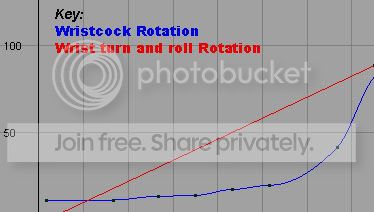 Although not mathematically perfect, this is taken from one of my animation models and the red line is a constant turning(although the rolling will be the same in reverse...)and this is the rate that the wristcock has to work in conjunction to keep the club onplane. Because the acute angle into the plane, the wristcock is allowed to 'almost' release completely - even though its not quite strictly a pure sequenced release - it is close..... |
| All times are GMT -4. The time now is 10:10 AM. |