LynnBlakeGolf Forums

LynnBlakeGolf Forums (http://www.lynnblakegolf.com/forum/index.php)
-   The Lab (http://www.lynnblakegolf.com/forum/forumdisplay.php?f=31)
-   -   Advanced quiz question for you all.... (http://www.lynnblakegolf.com/forum/showthread.php?t=3297)

golf2much 08-31-2006 03:44 PM

Not to be cute...
 
Quote:

Originally Posted by Mathew
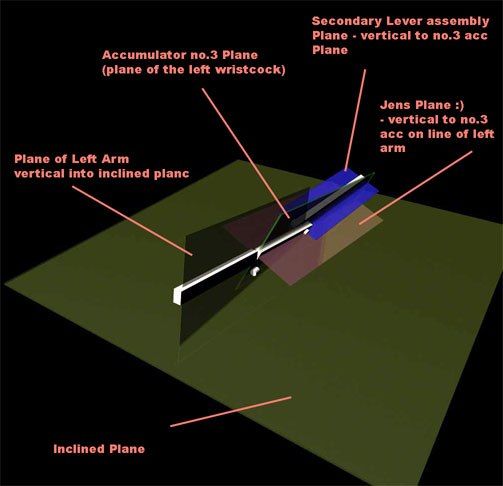
The plane of the left wristcock motion (same as acc no.3 plane) per the flying wedges is a left arm plane. The sweetspot stays in this plane. The left arm nor the left flying wedge sits flat on the inclined plane. It comes from above the inclined plane.

When the hand is not turned towards the plane (which I thought would make the relationships pretty clear...) and is anywhere else - the LCOG will lay on the inclined plane on the angle that accumulator 3 plane makes as it passes through it. The wristcock no of degrees can then be determined by the angle between that line of intersection just described and the angle it makes with relation to Jens plane.

I get the "what your saying" part of it, but am still missing the "why it's important" part, unlelss the important part is to turn this into a mathematical relationship for a correct dynamic model. Otherwise, it seems like a pretty complicated way to measure wrist cock. In an ordinary golfer, why wouldn't you just measure the angle of the wrist cock by comparing the shaft angle to the left forearm?

G2M

Bagger Lance 08-31-2006 03:55 PM

Quote:

Originally Posted by Mathew
When the hand is not turned towards the plane (which I thought would make the relationships pretty clear...) and is anywhere else - the LCOG will lay on the inclined plane on the angle that accumulator 3 plane makes as it passes through it. The wristcock no of degrees can then be determined by the angle between that line of intersection just described and the angle it makes with relation to Jens plane.

OK, I think we've made a mountain out of a mole hill and made it much more complicated than it is. If we are definng a way to measure the degree of wristcock based on a more defined identity for the left arm flying wedge, or more specifically, the left forearm plane (Jens Plane), then it's all good and I commend you Mathew for your work. It has been a very good thought exercise.

You can carry this logic into many more areas. For instance, the c-plane is a plane that helps measure axis tilt. The d-plane measures forward waist bend, the e-plane is right elbow bend...etc...

In my opinion, the real GSED challenge remains. How to use this additional knowledge in practical terms. I believe that is the heart and soul of The Golfing Machine.

Is there anything else we might be missing regarding the significance here?

Yoda - Is there still fog in the swamp? I'm just trying to avoid hatching one of these.


Thanks,

Bagger

Mathew 08-31-2006 06:17 PM

Quote:

Originally Posted by golf2much
I get the "what your saying" part of it, but am still missing the "why it's important" part, unlelss the important part is to turn this into a mathematical relationship for a correct dynamic model. Otherwise, it seems like a pretty complicated way to measure wrist cock. In an ordinary golfer, why wouldn't you just measure the angle of the wrist cock by comparing the shaft angle to the left forearm?

G2M

These things are important - not just for a correct model but to overall increase the understanding of alignments. Only with this highly detailed level of knowledge will you truely understand the golf stroke.

For example now you can say with full knowledge why it is wrong to take a 2d picture from a front on view and then draw lines directly across the left arm to the left hand to the sweetspot and measure the angle.

---------------------
But since we're on the subject of the mathematics, to do this you need yet another plane.

You need to reference the angle of the left arm relative to the inclined plane. If we reference this plane from the inclined plane itself and not the ground like we do for hinge action, it will be directly vertical to the inclined plane through the angle of the left arm. We can then work out the angle that the left arm is above the inclined plane. This can be the same as the angled hinge action (although unrelated) if you are talking about the angled plane that goes through the inclined plane vertically and not one of its other infinite possibilities. This plane will be the same as Jens plane when accumulator 3 has turned directly towards the inclined plane.

So basically

Key

x = no of degrees of accumulator no.3 has turned or rolled relative from the plane just described

y = no of degrees of accumulator no.2 relative to Jens plane and accumulator no.3 plane

z = the left arm angle above (+ degrees) or below (- degrees) relative to the inclined plane and using the plane just described as reference.

so x=y-((x divided by 90) times z)

Edit I forgot to put in the division part....

Mathew 08-31-2006 06:22 PM

Quote:

Originally Posted by Bagger Lance
OK, I think we've made a mountain out of a mole hill and made it much more complicated than it is. If we are definng a way to measure the degree of wristcock based on a more defined identity for the left arm flying wedge, or more specifically, the left forearm plane (Jens Plane), then it's all good and I commend you Mathew for your work. It has been a very good thought exercise.

Bagger

This isn't just a way of measuring wristcock - this ties in many different variables as my mathematical equation just shows.

EdZ 08-31-2006 07:03 PM

Quote:

Originally Posted by Mathew
This isn't just a way of measuring wristcock - this ties in many different variables as my mathematical equation just shows.

Perhaps you have lost me, but to clarify, "Jen's" plane is simply the angle of the left wedge/wristcock relative to 'the' plane?

So taking this a step farther, you can define the ideal angles of the two wedges to Jen's plane by combination of the angles at which the wedges intersect 'the' plane, assuming a 90 degree relationship between the wedges.

Depending on lie angle/length of club/golfer, one would assume that this would ideally be 45 degrees in a motion using the turned shoulder plane, such that the path/plane of the pressure points would be rather verticle to the ground, while still accounting for the #3 accumulator angle and lie of the club and an efficient combination of force vectors.

neil 08-31-2006 08:34 PM

Quote:

Originally Posted by Mike O
Neil,
That's how I see it. Matthew's still has lost me - but with a little work I think we'll get there.

Thanks Mike-My brain was exploding!-now can you deal with bucket?:) :)

golf2much 08-31-2006 08:49 PM

With you so far
 
"if you are talking about the angled plane that goes through the inclined plane vertically and not one of its other infinite possibilities. This plane will be the same as Jens plane when accumulator 3 has turned directly towards the inclined plane."

Matthew;

Never was I debating the importance of these details. I'm an engineer, and spend my career simplifying complex intangible things for non engineers. I understand what you have said in the above portion of your post, but if the "new" plane you mention is the same as Jens plane under certain conditions, then isn't it really just Jen's plane in a different position? Jen's plane as I see it is comparable to the degree of rotation of the left wrist hinge pin rotating from vertical at the top to parallel at impact and then to vertical below (or approximately so) at finish, much like your book cover example previously.

BTW, your graphics are excellent, and have been my key to understanding many of the more complex relationships. I can almost see them in my m inds eye, but your graphics generally cement them. Thanks for the great work.

G2M

Mike O 08-31-2006 11:44 PM

Golf2much
 
Golf2much,
would it be possible for you to summarize and explain this thread? Or Matthew? Or is this some sick Bucket trick so that I'll cut my own head off! I guess I could review all of the posts in this thread- study them - review them- and then try to understand what is parallel to what, etc. but I'm a little worn out.
Thanks

Mike O 08-31-2006 11:50 PM

Undealable
 
Quote:

Originally Posted by neil
Thanks Mike-My brain was exploding!-now can you deal with bucket?:) :)

Neil,
Some things are just too far out there to deal with- too dangerous! You were brave to post this on the forum- I've had thousands of personal PM's on this exact issue- give me time Neil, give me time! Can't rush these things.

I would just like to say to Bucket.....we'll sometimes a picture is worth a thousand words...:hang: :hang: :hang: :hang: I'm coming for that chicken head!

golf2much 09-01-2006 12:17 AM

Initial Summary
 
Quote:

Originally Posted by Mike O
Golf2much,
would it be possible for you to summarize and explain this thread? Or Matthew? Or is this some sick Bucket trick so that I'll cut my own head off! I guess I could review all of the posts in this thread- study them - review them- and then try to understand what is parallel to what, etc. but I'm a little worn out.
Thanks

I'll give it more of a go in the AM. This thread required some serious thinking on my part, and I'm still not sure I get Mathew's full intent yet.

For the first part though, think about a swing fan(one of those training devices) Swing it like a golf club with two blades aligned to your inclined left arm plane. The blades that are 90* to this inclined plane represent Jen's plane and are aligned along, but vertical to the plane of your left arm. As the fan is swung, imagine what happens to the Jen's plane blades; they close to the inclined plane like the book example as you approach impact, and as you approach finish, the lower extension of Jen's plane (the bottom, initially vertical blade) passes through the inclined plane and approaches vertical to it. In short, starts vertical, goes to and past parallel, and to the opposite vertical.

The wrist cock part and it's real world application, I'm still struggling with.

Sleep well
G2M

Yoda 09-01-2006 12:22 AM

Pass the Grapes
 
Quote:

Originally Posted by Bagger Lance

Yoda - Is there still fog in the swamp? I'm just trying to avoid hatching one of these.


Thanks,

Bagger

Hey, you're the guy who 'couldn't help yourself.' [Post #16 (of 91!)]

So...Leave me out of this! :)

I'm perfectly at home watching the 'braintrust' work from the sidelines. Plus, Mathew clued me in before he launched this little TGM soiree. So, I claim disqualification by reason of competitive advantage. Or insanity. Take your pick!

And so it goes...

From the arena floor:

"We who are about to die salute you."

-- Gladiator's Salute :salut:

And from the grandstand: :occasion:

:laughing9

Mathew 09-01-2006 02:38 AM

I want to proceed further mainly to get these never talked about relationships down and ill post a picture at some point to clarify things.

Now the next question is how do we plug the hinge action accumulator3 motion into our previous equation relating to the plane I discussed here.

Quote:

You need to reference the angle of the left arm relative to the inclined plane. If we reference this plane from the inclined plane itself and not the ground like we do for hinge action, it will be directly vertical to the inclined plane through the angle of the left arm. We can then work out the angle that the left arm is above the inclined plane. This can be the same as the angled hinge action (although unrelated) if you are talking about the angled plane that goes through the inclined plane vertically and not one of its other infinite possibilities. This plane will be the same as Jens plane when accumulator 3 has turned directly towards the inclined plane.

Key

a = is the angle of the relationship between the where the plane I quoted above from when it directly goes into the ground plane (low point) vs where it actually is in degrees - relative to the angle this makes on the inclined plane.

b = This angle is the inclined plane going into the ground plane (this isn't exactly true but to elaborate would require more complication) at an angle. If you create a plane that vertically goes through both the ground and the inclined plane at 90 degrees of its intersection which is the plane line, you can find the angle on this plane

c = The hinge action plane off from the horizontal eg - Horizontal hinge action = 0 degrees and Vertical Hinge Action = 90 degrees

The equation is - ill write this like your doing it on a calculator

a divided by 90 times b minus c

Congrats you now know everything there is to know about the left arm in its own seperate compartment and its geometrical relations.

Now you can just mess around with the equations as you see fit - substituting this equation for the x variable on the last one....

Everyone will have to admit this is really cool stuff. This didn't come to me over night - I've just never had to put this into words before because I just visualise these, so I'm sorry if my explanations aren't perfectly clear.

Edit a and b where labeled wrong....

12 piece bucket 09-01-2006 06:02 AM

Quote:

Originally Posted by Mike O
Neil,
Some things are just too far out there to deal with- too dangerous! You were brave to post this on the forum- I've had thousands of personal PM's on this exact issue- give me time Neil, give me time! Can't rush these things.

I would just like to say to Bucket.....we'll sometimes a picture is worth a thousand words...:hang: :hang: :hang: :hang: I'm coming for that chicken head!

Booger Eater.

12 piece bucket 09-01-2006 06:05 AM

Quote:

Originally Posted by Yoda
Hey, you're the guy who 'couldn't help yourself.' [Post #16 (of 91!)]

So...Leave me out of this! :)

I'm perfectly at home watching the 'braintrust' work from the sidelines. Plus, Mathew clued me in before he launched this little TGM soiree. So, I claim disqualification by reason of competitive advantage. Or insanity. Take your pick!

And so it goes...

From the arena floor:

"We who are about to die salute you."

-- Gladiator's Salute :salut:

And from the grandstand: :occasion:

:laughing9

And all that time I thought choking the chicken was . . . uh nevermind.

Bagger Lance 09-01-2006 11:35 AM

The formulas you provided help clarify the roll aspect. Thanks again Mathew.

I can see it more clearly, but what would be great is if you could provide a couple of graphic examples.

On each graphic, pick any angle for #3 accumulator. Say 20 degrees at impact. Then show how wristcock and roll are calculated at the release point based on Jen's plane and the turned shoulder plane. Again, pick any reasonable angles.

Examples would help a bunch.


Bagger

golf2much 09-01-2006 12:07 PM

Fog Alert
 
Quote:

Originally Posted by Mathew

Key
a = This angle is the inclined plane going into the ground plane (this isn't exactly true but to elaborate would require more complication) at an angle. If you create a plane that vertically goes through both the ground and the inclined plane at 90 degrees of its intersection which is the plane line, you can find the angle on this plane Vertical to the ground, or vertical to the inclined plane? Can't be both can it? SO if a= the angle of the inclined plane relative to the ground plane, why do you need the extra plane to calculate this angle?

b = is the angle of the relationship between the where the plane I quoted above from when it directly goes into the ground plane (low point) vs where it actually is in degrees - relative to the angle this makes on the inclined plane.So b really isn't an angle with a specific geometric location, but the difference between two other angles, or the difference between the same geimetric angle in two different positions, right? This would be the "how open does the book get" question? If it is the difference between the angle of Jen's plane to the IP at the low point and the angle of Jen's plant at the top

c = The hinge action plane off from the horizontal eg - Horizontal hinge action = 0 degrees and Vertical Hinge Action = 90 degrees

The equation is - ill write this like your doing it on a calculator

a divided by 90 times b minus c

To simplify then,

a= the angle of the inclined plane relative to the ground plane
b= the difference between ? Jen's Plane at position 1 and Jen's plane at posiition 2?
c = The hinge action plane relative to horizontal or parallel


x=(a/90)*B-C

A labeled graphic would be very helpful

G2M

Mathew 09-01-2006 06:14 PM

Quote:

Originally Posted by golf2much
To simplify then,

a= the angle of the inclined plane relative to the ground plane
b= the difference between ?
c = The hinge action plane relative to horizontal or parallel


x=(a/90)*B-C

A labeled graphic would be very helpful

G2M

I accidently labeled a to mean b....

A graphic would be useful for both equations and will them soon....

The one that your not too sure on is the angle formed by the left arm plane vertical to the inclined plane relative to its low point position on the inclined plane (hence directly towards the ground plane)....

golf2much 09-01-2006 06:18 PM

Quote:

Originally Posted by Mathew
I accidently labeled a to mean b....

A graphic would be useful for both equations and will them soon....

responding to your edit...

To simplify then,

B= the angle of the inclined plane relative to the ground plane
a= the difference between ? Jen's Plane at position 1 and Jen's plane at posiition 2?
c = The hinge action plane relative to horizontal or parallel


x=(a/90)*B-C

Mike O 09-01-2006 06:29 PM

Understood
 
Quote:

Originally Posted by golf2much
Mike; "Lines of Intersection" (with the wall). Of course these will be parallel. Any two lines, starting parallel to one another(the book edges), when extended to infinity, their lines of intersection with a common plane (the wall) will also be parallel.

In your example, you are thinking of the surface plane of the book cover, not the line or edge of the plane When the plane of book cover 1 and the plane of book cover 2 intersect a common plane, like the wall, each transcribes a line. These two intersections will be parallel to one another, even though the direction of the two book covers approaching the plane (wall). Try it for your self. Take a hard v=cover book and hold it against a solid surface that you can write on. Hold the book open to the amount of your choice and while hilding it in that position, trace the edge of the book cover where it touches the hard surface. Try it several times, at different amounts of open or closed. The tracings will always be parallel.

G2M

G2M,
I understand your post- thanks. So the edge of the front book cover and the back book cover edge, as they touch or run through the wall - whether at an angle or when both surfaces are parallel to each other- create lines on the vertical wall that are always parallel to each other- even when the plane of the covers are not- that is when the "up and down" angle of the planes are different for the two- they both still create parallel plane edges on the vertical wall. Now, if the plane angles are not the same "side to side" and they go through the vertical wall then those plane angle edges will not be parallel.

Now, could you make another post and just tell me what edge of the swing plane and what edge of the #3 accumulator plane are parallel? I'm afraid of looking back at all of the other posts-as I have a fear of fog! So don't worry if your answer is really simple- cause that's actually what I'm looking for.
Thanks,
Mike O.

golf2much 09-01-2006 06:52 PM

Quote:

Originally Posted by Mike O
G2M,
I understand your post- thanks. So the edge of the front book cover and the back book cover edge, as they touch or run through the wall - whether at an angle or when both surfaces are parallel to each other- create lines on the vertical wall that are always parallel to each other- even when the plane of the covers are not- that is when the "up and down" angle of the planes are different for the two- they both still create parallel plane edges on the vertical wall. Now, if the plane angles are not the same "side to side" and they go through the vertical wall then those plane angle edges will not be parallel.

Now, could you make another post and just tell me what edge of the swing plane and what edge of the #3 accumulator plane are parallel? I'm afraid of looking back at all of the other posts-as I have a fear of fog! So don't worry if your answer is really simple- cause that's actually what I'm looking for.
Thanks,
Mike O.

The plane Mathew defined as Jen's plane starts out at the top as vertical/perpendicular to the swing plane. As the left arm moves down towards impact, Jen's plane rotates to a point near impact that is parallel to the SP. Picture the book again; if the spine is aligned with the left arm plane and one cover is aligned with the swing plane, place the other cover at 90* to the swing plane. Now mimic the movement of your left arm and wrist as you approach impact and allow the upward pointing book cover to rotate as though the book is closing. The closing cover will move to and through a position where the once upward point book cover is now parallel to the SP. I'm still working on the relationship with the #3acc/wrist cock. Still some fog there for me too. Maybe once the graphic is finished it will be clear to me. I have some thoughts on this but I'm still thinking.

G2M

Mathew 09-01-2006 10:09 PM

Ok so what were have found out here is what accumulator 3 is from the vertical relationship that the left arm has with the inclined plane.

So how do we do that....

We firstly need to know where the left arm is on its circle relative to the plane that is vertical to the inclined plane (think angled hinging). We do this by referencing the vertical relationship with the ground and how many degrees has it moved around relative to that.

Now we need to find out exactly how to calculate the hinge action plane relative to that point - and it best to look at the 90 degree perspective here. The angle of the hinge action in relation to the ground and the angle of the inclined plane relative into the ground also plays a role here.

For example

Lets just look at an example with the inclined plane at 30 degrees and the left arm 90 degrees from low point relative to inclined plane

Hinge action----------Left arm Low Point-----Left Arm 90 degrees

Horizontal(0 degrees)---------0---------------------30
Vertical(90 degrees)----------0---------------------60
Angled (30 degrees)-----0----------------------0

Ok so you can see why the horizontal plane at 90 degrees is exactly the same as the inclined plane with the ground and the vertical plane is - 90 of that figure...

See if that clears much up...

Mike O 09-01-2006 10:56 PM

Plane or Plane edge
 
Quote:

Originally Posted by golf2much
The plane Mathew defined as Jen's plane starts out at the top as vertical/perpendicular to the swing plane. As the left arm moves down towards impact, Jen's plane rotates to a point near impact that is parallel to the SP. Picture the book again; if the spine is aligned with the left arm plane and one cover is aligned with the swing plane, place the other cover at 90* to the swing plane. Now mimic the movement of your left arm and wrist as you approach impact and allow the upward pointing book cover to rotate as though the book is closing. The closing cover will move to and through a position where the once upward point book cover is now parallel to the SP. I'm still working on the relationship with the #3acc/wrist cock. Still some fog there for me too. Maybe once the graphic is finished it will be clear to me. I have some thoughts on this but I'm still thinking.

G2M

Since you previously made the distinction between "plane edge" and "plane surface"- would you re-read your post and make sure that it makes sense in that context or if you used plane when meaning plane edge. I'm so foggy that I'm not asking that because I see an error- I'm just asking it before I start to try to figure it out, I want to make sure that I'm imagining the correct picture for the correct word being used.

Also, can you define Jen's plane- that is give a definition.

Thanks,
Ya it's me :confused1

golf2much 09-02-2006 12:24 AM

Plane Surface it is
 
Quote:

Originally Posted by Mike O
Since you previously made the distinction between "plane edge" and "plane surface"- would you re-read your post and make sure that it makes sense in that context or if you used plane when meaning plane edge. I'm so foggy that I'm not asking that because I see an error- I'm just asking it before I start to try to figure it out, I want to make sure that I'm imagining the correct picture for the correct word being used.

Also, can you define Jen's plane- that is give a definition.

Thanks,
Ya it's me :confused1

No problem Mike: In the answer above, the way I see it, I used plane to mean plane surface. The confusing part is that even as the plane surface rotates (think forearm rotation), and the plane surface approaches parallel to the inclined plane surface the edge also stays parallel at all points. There is little significance in the fact that the edges stay parallel at this point in Mathew's exercise, but I think he has yet grander plans for us. The fact that the edges stay parallel means that you can utilize this plane as a reference plane, a place to compare other variables, not directly related. Like wrist cock, and forearm rotation. (:salut: fog slightly thinner now, sir)

As to a definition; Mathew's definition as I understand it is that jen's plane is simply the plane in which the left wrist hinge pin lies. Directionally, this plane is oriented along the approximate centerline of the left forearm. Functionally, it is a measure of the degree of rotation of the left forearm relative to whatever plane you choose (IP, Ground or vertical thereto)

Hope this helps, it helped me just by writing it.
G2M

Mathew 09-02-2006 01:19 AM

Well lets see all this stuff in action...

Ok lets say the left arm is 30 degrees from low point - we are using Horizontal Hinge action, and the plane angle is 30 degrees

ok so then we can input this into our equation

30 divided by 90 is 0.3333... or 1/3 of 30 so that is 10 degrees accumulator 3 has turned from vertically going through the inclined plane.

Now lets find out the amount of wristcock for the 10 degrees accumulator no.3 and lets just say the left arm is 5 degrees above plane

so pluging this into the first equation

10=y-((10/90)times 5))
10=y-0.555555...
lets rearrange this a little
y=10+0.555555...

So the wristcock is 10.55555...

Magical huh :)

Martee 09-02-2006 09:30 AM

Well here goes, I am about to show my ignorance and stupidity. I have all these posted printed out and lines and numbers on them and I JUST DON'T GET IT.

Jen's Plane? Can you really define a 'set' plane that exists through out the stroke or is that at some instance in time?

Hinge Action, Left Arm Angle? Can you really identify the hinge action being applied prior to the impact interval?

These alignments being discussed are the same for a hitting or swinging motion?

There are more questions that I have cause FRANKLY even with the graphics, nothing is computing.

For example, I thought I understood ACC#3, however defining a plane for itself has left me to wonder what I understand and why the alignment to this plane has any importnance or meaning?

CAN SOMEONE provide a bullet summary of what this is really all about?

Mike O 09-02-2006 12:25 PM

Golf2much
 
Quote:

Originally Posted by golf2much
No problem Mike: In the answer above, the way I see it, I used plane to mean plane surface. The confusing part is that even as the plane surface rotates (think forearm rotation), and the plane surface approaches parallel to the inclined plane surface the edge also stays parallel at all points. There is little significance in the fact that the edges stay parallel at this point in Mathew's exercise, but I think he has yet grander plans for us. The fact that the edges stay parallel means that you can utilize this plane as a reference plane, a place to compare other variables, not directly related. Like wrist cock, and forearm rotation. (:salut: fog slightly thinner now, sir)

As to a definition; Mathew's definition as I understand it is that jen's plane is simply the plane in which the left wrist hinge pin lies. Directionally, this plane is oriented along the approximate centerline of the left forearm. Functionally, it is a measure of the degree of rotation of the left forearm relative to whatever plane you choose (IP, Ground or vertical thereto)

Hope this helps, it helped me just by writing it.
G2M

OK- I feel as if I can get somewhere with your explanations.

So Jen's plane is 90 degrees to the plane of the flat left wrist- the "plane of the left wrist hinge PIN. So at low point assuming the back of the flat left wrist is facing the target- then any MOTION of the cocking left wrist would be straight up and down and the actual hinge PIN would be parallel to the swingplane.

Have I understood you correctly on this particular point.

Thanks for the help.

golf2much 09-02-2006 12:53 PM

You Got It !!!!!
 
Quote:

Originally Posted by Mike O
OK- I feel as if I can get somewhere with your explanations.

So Jen's plane is 90 degrees to the plane of the flat left wrist- the "plane of the left wrist hinge PIN. So at low point assuming the back of the flat left wrist is facing the target- then any MOTION of the cocking left wrist would be straight up and down and the actual hinge PIN would be parallel to the swingplane.

Have I understood you correctly on this particular point.

Thanks for the help.

Yes, exactly as I understand it.

G2M

Mike O 09-02-2006 01:42 PM

Golf2much
 
Quote:

Originally Posted by golf2much
Yes, exactly as I understand it.

G2M

Very good- I understand one item- and thanks for the quick reply. Now, I'll go back and use that one piece of information and see if it makes sense in relation to the previous posts and see what else if anything that I don't understand or what information does not mesh with that explanation.

Thanks,
Mike O

golf2much 09-02-2006 03:18 PM

Mathew
 
Quote:

Originally Posted by Mathew
Well lets see all this stuff in action...

Ok lets say the left arm is 30 degrees from low point - we are using Horizontal Hinge action, and the plane angle is 30 degrees

ok so then we can input this into our equation

30 divided by 90 is 0.3333... or 1/3 of 30 so that is 10 degrees accumulator 3 has turned from vertically going through the inclined plane.

Now lets find out the amount of wristcock for the 10 degrees accumulator no.3 and lets just say the left arm is 5 degrees above plane

so pluging this into the first equation

10=y-((10/90)times 5))
10=y-0.555555...
lets rearrange this a little
y=10+0.555555...

So the wristcock is 10.55555...

Magical huh :)

I thought the point of the exercise was to be able to calculate the wrist cock position, or maybe to measure the release. If you have to assume that the left are is "say 5* below plane" to calculate the wristcock, what is the point. I appreciate the mathematics, and I'm sure the math is right, but for this approach to have value, you should be able to calculate the degree of below plane of the laft arm, and in turn the wristcock. I think I can picture how you would do this, but I'm interested in your thoughts.

Also, as a "real world" issue, what do you think is the significance of being able to calculate the exact degree of wrist cock, or is this just a test question in the making? Another real world issue, is that you would have to put a golfer in a pretty precise and golfer to golfer consistent photo set up to be able to even analyze these issues with any reliability. And finally, other than helping us understand the relationships between the components how would you impart this knowledge as an instructor?

G2M

golf2much 09-02-2006 03:25 PM

Martee
 
Quote:

Originally Posted by Martee
Well here goes, I am about to show my ignorance and stupidity. I have all these posted printed out and lines and numbers on them and I JUST DON'T GET IT.

Jen's Plane? Can you really define a 'set' plane that exists through out the stroke or is that at some instance in time?

Yes, the plane exists throughout the stroke, it is just in different positions. The change in plane position represents the degree of forearm rotation

Hinge Action, Left Arm Angle? Can you really identify the hinge action being applied prior to the impact interval?
good question, Mathew?

These alignments being discussed are the same for a hitting or swinging motion?
I think the plane designation applies regardless of the motion of choice. The movement of the plane would be different depending on the motion of choice

There are more questions that I have cause FRANKLY even with the graphics, nothing is computing.

For example, I thought I understood ACC#3, however defining a plane for itself has left me to wonder what I understand and why the alignment to this plane has any importnance or meaning?

See the previous post in the thread

CAN SOMEONE provide a bullet summary of what this is really all about?

One Bullet summary: Jen's plane and it's change in orientation and interaction with other planes can be used to calculate or measure in particular the degree of rotation of the left forearm, and potentially the degree of wrist cock/release. See the previous post in the thread

G2M

Bagger Lance 09-02-2006 04:17 PM

Quote:

Originally Posted by golf2much
Also, as a "real world" issue, what do you think is the significance of being able to calculate the exact degree of wrist cock, or is this just a test question in the making? Another real world issue, is that you would have to put a golfer in a pretty precise and golfer to golfer consistent photo set up to be able to even analyze these issues with any reliability. And finally, other than helping us understand the relationships between the components how would you impart this knowledge as an instructor?

G2M

G2M,

I've enjoyed the fact that we are seeing the same description of Jen's plane in our minds eye. I'm still incubating as well.

I think there are some steps to knew discoveries.

First - It's prudent to have another qualified 3rd party expert prove the logic and math.

Second - It needs to be well understood enough that it can be clearly articulated to anyone with a High School Geometry level of understanding.

Third - The applications will evolve slowly over time as the practitioners learn to use a new tool. It may never have a practical application but be a jumping point to something else. I have a hunch it will have at least one practical application in computer modeling of the golf stroke.

For the time being, I'm just going to enjoy the discovery process. I don't think Mathew has thought through the applications or had time to. He's too busy fine tuning the new model.

Pretty cool stuff. In the mean time, there's still lots of s'plane'in to do!

Bagger

golf2much 09-02-2006 05:16 PM

Don't misunderstand
 
Quote:

Originally Posted by Bagger Lance
G2M,

I've enjoyed the fact that we are seeing the same description of Jen's plane in our minds eye. I'm still incubating as well.

I think there are some steps to knew discoveries.

First - It's prudent to have another qualified 3rd party expert prove the logic and math.

Second - It needs to be well understood enough that it can be clearly articulated to anyone with a High School Geometry level of understanding.

Third - The applications will evolve slowly over time as the practitioners learn to use a new tool. It may never have a practical application but be a jumping point to something else. I have a hunch it will have at least one practical application in computer modeling of the golf stroke.

For the time being, I'm just going to enjoy the discovery process. I don't think Mathew has thought through the applications or had time to. He's too busy fine tuning the new model.

Pretty cool stuff. In the mean time, there's still lots of s'plane'in to do!

Bagger

Please don't for a minute think I was "busting his chops", quite the contrary, I am very interested in where he is going with this, mostly at this point becaause it makes me think. I want to hear his ideas about how to use this concept to help cultivate my own thoughts. In essence, I am trying to challenge him to think deeper, beyond the geometry, and to the uses of his concepts.

Also, I agree with your evolutionary progression, however, regardless of how precise,logical or well reasoned the concepts might be, if we can't communicate how to apply the concepts, once we are able to explain them succinctly, the likelihood of them being embraced by even the most technical amoung us is low.

Let's keep working at this, pushing the boundary of understanding and see what comes from it; maybe nothing, maybe something fundamental; in any case, all good.

G2M

G2M

Martee 09-02-2006 05:52 PM

G2M, thanks...

A rotating plane (floating/dynamic plane) that exist independent of the type of golf stroke motion.

Obviously I need to wait and see what the value of this floating/dynamic is? The planes we deal with normally are static so to speak, at least there is one part that remains constant, normally the plane line. As far as I can tell this floating/dynamic lacks that quality, the only constant is that it at, I think 90* from the flat left wrist, making this the top of the forearm.

I don't believe it is correct to equate 'wristcock' and 'hinge action'. Maybe I am missing something but the wristcock isn't referred to as hinging, but it is the rotation of the wrist that is referred to as hinging. Maybe this is where Matt is trying to bring hinging in, but if so and if accurate at least my descriptions, then the wristcock has no hinge pin to refernence to.

golf2much 09-02-2006 09:17 PM

Hinge Action NOT=Wrist Cock
 
Quote:

Originally Posted by Martee
G2M, thanks...

A rotating plane (floating/dynamic plane) that exist independent of the type of golf stroke motion.

Obviously I need to wait and see what the value of this floating/dynamic is? The planes we deal with normally are static so to speak, at least there is one part that remains constant, normally the plane line. As far as I can tell this floating/dynamic lacks that quality, the only constant is that it at, I think 90* from the flat left wrist, making this the top of the forearm.

I don't believe it is correct to equate 'wristcock' and 'hinge action'.
Mathew is not equating wristcock to hinge action, the pivot point of the left wrist was refered to by ME as a PIN around which the left wrist moves. This pin would be vertical to the inclined plane and was used by me as a visual descriptor to describe how Mat's new plane works

Maybe I am missing something but the wristcock isn't referred to as hinging, but it is the rotation of the wrist that is referred to as hinging. Maybe this is where Matt is trying to bring hinging in, but if so and if accurate at least my descriptions, then the wristcock has no hinge pin to refernence to.

What Mat is doing is to use the position of his new plane, relative to other planes to measure and calculate. I haven't gotten my mind completely around exactly how he intends to do this yet, but I'm close, I think. The fog is lifting, but is still there

G2M

Mathew 09-06-2006 09:47 PM

Ok I made this picture and hope it helps clear everything up for you :)

golf2much 09-06-2006 10:18 PM

Great Picture
 
NOW I see what I was missing.... the #3acc plane. Very cool. I knew you needed another plane to reference Jen's plane against to calculate wrist cock, and I was hoping Jen had a good looking sister!!!

Thanks Mathew, No more fog (at least on this topic).
G2M

Mike O 09-07-2006 02:32 AM

Golf 2 much
 
Quote:

Originally Posted by golf2much
NOW I see what I was missing.... the #3acc plane. Very cool. I knew you needed another plane to reference Jen's plane against to calculate wrist cock, and I was hoping Jen had a good looking sister!!!

Thanks Mathew, No more fog (at least on this topic).
G2M

G2,
How about a summary of Matthew's new drawing- in regards to all components in the drawing, particularly Jen's Plane, the formula, and a real golfer?

However, I've been busy but I'm starting to get it- just going to take a little longer- Specifically Jen's plane role and definition would be helpful.

Mathew 09-07-2006 03:47 AM

Lets discuss the right arm....

Due to the fact that the right forearm can only move straight up and down from its elbow location this means that at any point the entire right arm is always in a plane....
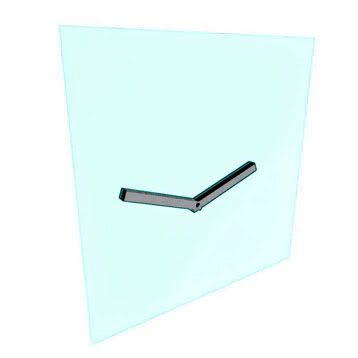


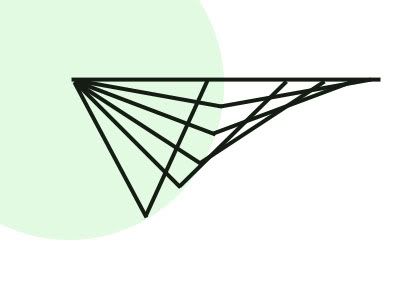
In this plane the closer the right hand goes to the right shoulder - the greater the angle between the upper arm and the forearm. This always creates a triangle shape between the right shoulder to hand - right shoulder to elbow - elbow to hand, except when it is inline. It is actually the right shoulder to hand line that is the third line on the law of the triangle per chapter 6.


PS - Im looking for this to be a active discussion. If you have any input to give or feel you want to add something - please discuss :)

golf2much 09-07-2006 11:07 AM

Initial Summary
 
Quote:

Originally Posted by Mike O
G2,
How about a summary of Matthew's new drawing- in regards to all components in the drawing, particularly Jen's Plane, the formula, and a real golfer?

However, I've been busy but I'm starting to get it- just going to take a little longer- Specifically Jen's plane role and definition would be helpful.

Mike;

I'll try to do a better job with this later, but I wanted to comment on the "real golfer" aspect. My opinion, and sort of along the line that bagger posted earlier, is that I'm not sure, nor I think is Matthew, of the future long term uses of this new information. I can see difficulties in it's initial application to the real golfer, in that the nuances of getting accurate measurements coupled with differeing golfer anatomy will make this difficult to apply. In swing analysis, the camera setup will have to be precisely oriented so that the computations won't suffer from differing camera angle perspectives. Also, the difference between traditional wristcock measurements from a front on photo (shaft angle to left forearm), and that calculated by this will be small since the only real difference is the fact that the #3acc plane and the sweetspot plane are only slightly different. At the top, the SSP, the #3acc plane both are the same. As you move down, the #3acc plane drops slightly below the SSP. If it didn't, the ball would be hit by the hozel. This effect causes the traditional method of determing wristcock, or lag to be slightly incorrect since the points of measurement are not on precisely the same plane. This new calculation allows you to evaluate the difference. More later...

G2M

EdZ 09-07-2006 11:49 AM

So to clarify then, Jen's plane is simply a plane that is 90 degrees (verticle) to the plane of the left wrist cock, through (around) the left arm as the 'hinge pin'.

Which then provides a reference point for the amount of rotation of the left arm flying wedge as it 'turns and rolls' relative to 'the' plane.


All times are GMT -4. The time now is 08:09 PM.