
|
Quote:
I believe in the right forearm being on plane and it's magic 100%! No offense my friend.:salut: Kevin |
Quote:
The problem is with the Book, not my analysis. The Book depicts the Elbow Plane as a Plane the Elbow Traces, not the Hands. That alone makes this Plane different and odd in comparison to any other Plane Angle Variation in the Book. In other words, the Elbow rests on the Plane Throughout the Stroke. The Hands and Clubshaft are raised above this plane during the Backstroke and must be Lowered to the Plane during the Downstroke. This is not a Rigid Power Package Stroke as outline and discussed in Chapter 6. So, if one is using the Elbow Plane, one must bend the Right Elbow to Raise the Club during the Backstroke and Unbend the Right Elbow during the Downstroke. It results in a CONCAVE Plane (ala-Ben Doyle). It's not Anti-Golfing Machine if one merely regards TGM as an explanation of the Golf Swing. But the Nature of this "Flexible" Power Package is not compatible with The Magic of the Right Forearm, Extensor Action, etc, etc. Any explanation of Hogans Stroke as far as concerns TGM, should include this kind of Elbow-Plane - Power Package analysis. Sooooo, needless to say, an Elbow Plane swing is Pivot Controlled Hands and the #3 PP cannot trace the Plane-line. Body Angles must be adjusted for Clubhead - Ball intersection. ANYONE-EVERYONE who bends and unbends the Right Elbow from Start-up to Release will be Swinging on the Elbow Plane. |
Quote:
Obviously, you mis-perceive this matter. You've been hanging with the Bucket too long and the grease has finally gone to your brain. Allow my Vapid response to help clear things up. First and Foremost is your misconception about the TSP. It's not a fixed Plane. Its angle varies by Club Length. The Shorter the Club Length, the Steeper the Angle. OB1: "OK daryl you jerk, then if the TSP angle is different for each club, then what does a Flat Shoulder turn mean?" Daryl: It simply means any angle flatter than a Rotated shoulder turn. OB1: "OK daryl, smarty pants, then how does one know how flat to turn your shoulders for any specific club length?" Daryl: Each Clubs Length changes the angle of the Right Forearm at Address. Then, using Extensor Action Takeaway, your Right Shoulder will be directed to the appropriate height and Location per that angle (Magic of the Right Forearm). Longer Clubs will result in a "Lower Right Shoulder" and Shorter Clubs will raise the Right Shoulder Higher. So, given a short enough shaft, its possible for a Properly applied Flat Backstroke Shoulder Turn to direct the Right Shoulder to the Same Location as a Rotated Shoulder Turn. But it's still called a TSP if it arrive On Plane by Geometrically aligned forces and not a simple 90 degree shoulder-spine rotation. Isn't it obvious to everyone that while using the Elbow Plane, that one cannot have an On-Plane Downstroke Shoulder Turn? EVER. Someone let 'Bucket' know. |
Quote:
Is there more mechanical advantage to having your right shoulder on plane or having the right forearm moving at right angles to the axis of rotation? Pick one and tell me why . . . I'm not quite sure I ever said that the right shoulder could be on plane with the elbow plane . . . however . . . . you have yet to put up anybody that is a living breathing human being that stays on the TSP . . . I await your submission. L8RT8Rnutz. |
Quote:
There is More Mechanical Advantage with a Properly executed Downstroke Acceleration Sequence which requires an On-Plane Right Shoulder than there is with solely the Right Forearm moving at Right Angles to its Center of Rotation. The first, is an accelerating Force. The second, a force you describe, a simple Lever Extension of the Rotating Body, is really great for "Dork Does Ping-Pong". Truly, Dingdong Here is one Human being. Square Shoulder Plane, Flat Backstroke and On-Plane Square Shoulder Plane Downstroke Through Impact to Follow through. This is proof that a Human can Swing on the much steeper Square Shoulder Plane. Then, is it really hard to believe that one can Swing as easily on a TSP? Also, look at the Bend in his Right Arm. 90 degrees at the Top, Halfway down and Impact. This is proof of the Rigid Power Package and Downstroke Acceleration Sequence. 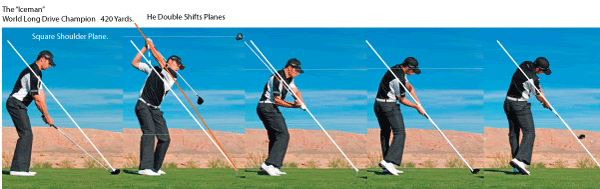 |
Quote:
You know, Rigid Power Package Dude and 90 degrees to the axis of Rotation Man. |
Quote:
All of this TSP stuff is really a fine tuning thing. Most of us are not on plane to begin with or if we are, not on a TSP at Top. The TSP concept is all about the Right Shoulder taking the Power Package down the Inclined Plane Angle in Startdown (that is whatever Plane Angle the Right Shoulder is Aligned to and assuming that the Pressure Points are on this same plane). Words fail us when attempting to describe geometry. Maybe one of the biggest problems with Homers writings. |
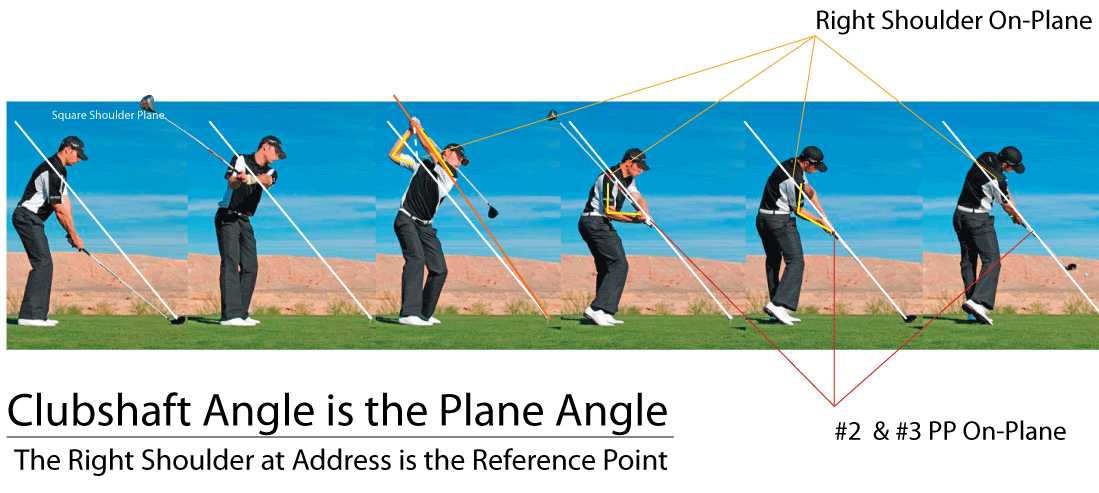 His Power Package is Rigid = He doesn't Change the Bend In his right Arm during the Downstroke. Don't over-bend the Arm during the Backstroke. Keep the left arm about 45 degrees off the chest will help. His clubshaft is on a Square Shoulder Plane. The #2 & #3 PP are ON Plane His Right Shoulder is On Plane. Why is his Right Shoulder On Plane and his Power Package Rigid? Because as his Pivot forces the Right Shoulder Down-Plane On Plane, his hands will be moved On Plane Down-Plane. This occurs because the Power Package is able to drop from the shoulder sockets and doesn't rely on unbending the right arm (a move that throws the Hands off-plane). Pre-Impact Photo: Notice also that His Right Forearm Flying Wedge is On-Plane. On the Plane of the Right Wrist Bend at 90 degrees to the Left Arm Wedge. Quote:
So?? What is learned in this Photo Sequence and TGM?
Performing the above will keep all Power Package Components On Plane driven by the PIVOT via the Right Shoulder. THE GREAT ILLUSION: The Arms don't travel down carrying the Hands with them. The Power Package Lowers as a result of the Hands being Forced Down-plane. Geometric Golf. Geometrically Oriented Linear Force. Don't try to create a force using upper body muscle power. Force dictating alignments (rubbish). Rather, use alignments that will bring about an acceleration sequence. Dear O.B. and Bucket, It cannot be this way with the Elbow Plane. |
Quote:
I have been taking the "plane shifts are hazardous" argument literally. I guess when I look at my model swing, Brian, I see here is a plane shift, if only a small one. Kevin |
D, I like those drawings, lots of effort there. Thanks. Couple of thoughts
-"Rigid Power Package" or Rigid Right Elbow angle . Arent you really talking about a Delayed Release in Accumulator #1? You've got to Release it at some point prior to Impact. You cant hang on all the way to Impact, Steering , fore right! The latest Release Point being Automatic Snap Release. -In regard to your fixed white Plane Line. I wish the 1-L-18 animation would resurface. We lost it during the change over to the new site format. Basically the white line in your drawings never shifts its Plane Angle. Despite the fact that Jason clearly shifts his Plane Angle. To get your drawing into a TGM way of looking at Plane Shifts you must start in the first frame with the white line running along Jason's Shaft Plane. He is not using an Elbow Plane there anyways. The next frame would show him to be slightly off plane with the white line pointing outside the Base Line , Plane Line. Etc etc. You could align your white line to the Sweetspot plane too for further relevance but the shaft is a reasonable approximation of the Plane that his force is traveling. All of this would show a Plane that shifts Angles UP then Down with some off plane meanderings. I agree though he does get back onto the TSP in Downstroke and does appear to stay on it late into Release or Impact even. Interesting. If he set his Right Arm on Plane at Address his Plane Angle changes would be lessened. I hope we can dig out the 1-L-18 animation. |
| All times are GMT -4. The time now is 10:48 PM. |