
|
Spheres ...
An interesting observation about the primary/secondary hinge arrangement and seperately the wristcock/acc#3 in the flail of 2k is that their complete range of movement that they can create in all directions will cover or be inside a completely spherical shape.
|
Another interesting observation is that even though the principle of 1-L is perfect... The actual model itself as printed in 1-L actually has a small flaw. Because the primary hinge itself is slightly away from the secondary hinge, the primary hinge will pull it into the inclined plane as it makes its motion. But if the hinge and secondary hinge was exactly on the same pinpoint location the model would work perfectly and create a perfect sphere. All about controlling that arm from its ballsocket.....
|
Everything in the primary lever assembly produces circles. The primary hinge moves the entire lever assembly in a circle against its blade. The secondary hinge moves the entire lever assembly up and down in a circle around its pin. The wristcock moves the secondary lever assembly up and down in a perpendicular fashion in a circle around its pin. The swivel joint rotates the left clamp (hand) moving the secondary lever assembly around in a circle.
All of these circles are bound together by one constant and that is the inclined plane. So the hinge arrangement can move the left arm and entire primary lever assembly anywhere it wishes as the left shoulder as the center and the lever assembly is a radius of a big sphere and the swivel(2k) and wristcock can move the secondary lever anywhere as the left wrist as the center and the secondary lever assembly is a radius of a smaller sphere, but we are always bound by the secondary levers longitudinal center of gravity staying on the inclined plane. If the wristcock and swivel strictly have to travel up and down an inclined plane their dual motion will always be completely co-ordinate (although the 'degress' of what happens in terms of ratios will be different with accordance to the plane angle(perhaps a good future project)) and actually makes a sequenced release impossible. However if you introduce a third circle - the wristbend (which still keeps it inside a sphere) on the backstroke and downstroke, it can allow a pure sequenced release because the actual left palm can then be placed onplane. The wristcock will still be perpendicular and yet also onplane rather than the left flying wedge going through from above plane at an angle making the wristcock move the clubhead underplane. |
Another point of interest is because the clubshaft rotates around the sweetspot, that right forearm then would also rotate around the sweetspot if it remained absolutely frozen in its impact alignments. Again the right wrist movements if unlimited(vertical, horizontal, and rotational) will move the secondary lever assembly around in a perfect sphere. The right wrist bending, turning, cocking can all be independant of the left wrist depending on the location of the right forearm. The right forearm likewise without regards to any anatomical restrictions can move in a sphere round its clamp...
|
The angle of the left arm as it enters the plane is always dictated by the length of the left arm going from the point of the left shoulder above plane to the hand into the plane... There will be a mathematical correlation (although this list may not be accurate or complete - just noting my thoughts) between the leftwrist cock, the angle of the left flying wedge into the plane, the swivel, the angle of the inclined plane and the starting point of zero acc#3 dictated by reference to the hinge action plane with travel relative to the inclined plane angle.
Heres another way of looking at it also - lets say you where entirely preforming a stroke with the left hand always staying vertical to lets say, the horizontal hinge action. Now if the wristcock was performed without a swivel also in this vertical plane then the clubhead is going off plane.... its going up and down vertical to the ground whilst the plane is inclined..... how can you get it onplane - the only ways is co-ordinately using the swivel in unison with the wristcock to bring it onplane - creating a simultaneous loading and release.... The circles that are created via #2 and #3 are at 90 degrees,and both need to be used relative to each other which will result with a simultaneous release and loading..... so what about sequence releases ... Inside a sphere there are actually THREE 90 degree circles and at least two of them are only needed to move the secondary lever assembly anywhere inside a sphere but unless the motion is exactly on a single circle - at least two of them have to be implimented (with three combinations 1+2,1+3,2+3). Imagine a Globe - you have the equator (circle no.1) - Now draw a '+' side on top of the north pole and continue these lines all the way round to an equivalent '+' on the south pole (circle no.2 and no.3).... These three circles of motion that create a spherical motion of the secondary lever assembly are the left wristcock, the left wrist bending and the rotation of the forearm... since two have to be employed at any one time - for the wristcock to go from cocked to level with the clubhead onplane you must impliment a left wrist bend (double wristcock) to the negative degree of the left arm angle into the plane to inorder to align the circle of the wristcock motion to enable a sequenced release.... |
Mathew's Mind Bender
Quote:
Seriously, I know where you're headed here, and I applaud your effort. That's what this Forum -- The Lab -- is all about. I also know that if you can visualize it, you can animate it. The Golf World awaits! |
Digging into 2-N-1
Matthew,
Seemed a little lonely over here- and I was worried you might start answering or arguing with yourself:eyes: Good digging- some nice observations! :clap: A little difficult to follow- might be helpful to clarify your perspective and also clarify it's relevancy- I get the feeling it's a area your looking into and still looking for final conclusions or discovery which is great!!!- keep digging. Question: If I understand the one section clearly enough- I see your perspective that in regards to a sequenced release- you would need some left wrist bend in order to have the shaft stay on plane IF you were dealing only with the uncocking of the left wrist and the roll of the left forearm. But since the uncocking of the left wrist would put the shaft below plane- wouldn't and isn't the offsetting factor the corresponding outward force of the "body turn" and/or "right arm thrust"- see 2-N-1. That said- your post really takes that concept that I brought up a while back regarding that the left wrist is not on plane- and takes it further by analyzing and isolating how the sequence release can happen and still stay on plane- so very helpful!!:clap: in flushing out some ideas. I'm thinking you're essentially in the 2-N-1 section- "Hey, gotta go- Homer's back and looks like we'll be kicking this around for a few hours!":occasion: |
Quote:
It is a true honour and pleasure to talk to someone so truely intelligent on the golf stroke. There is no one I personally know of who I could have a conversation with like the one we did tonight. You know you 'lose me' often too....:toothy: ...lol You are very gifted my friend :).... |
Quote:
I consider this as my incubator thread where I keep posting my thoughts at a particular time so I can keep track of them, so unfortunately this thread does have a lot of randomness to it. re the question - the two circles of the wristcock and acc no.3 need to be working together whist the left arm is above plane, so the only solution if you desire a sequenced release is introducing the third circle (wristbend) to the negative degree of the left arm angle into the plane (triangle shape - don't tell me I might be able to use that SOHCAHTOA trig stuff from school after all...lol) to align the circle of the uncocking of the left wrist to be on plane otherwise the other two circles have to work co-ordinately . The hinge assembly however depicted in 1-L is what can place the left hand anywhere on the plane as it makes its circular motion in 'its' sphere regardless of how it is driven. Provided the left shoulder is above plane as the left arm makes it motion from the sphere created by the hinge assembly this what must happen because the left arm is going through at an angle..... On another observation I just thought of, this will mean that when the wristbend has to go back to 'flat' it will work co-ordinately when it works with the wristroll to go back to vertical if to stay onplane. |
Vertical planes relative to the inclined plane. This is just a random thought again and may not be totally accurate...
A constant - The vertical plane of any hinge action will go directly through at 90 degrees to the inclined plane and when the blade of the hinge is at 0 (low point) and 180 degrees. However the rest of the time - horizontal will turn the lever assembly the closer it gets to 90 degrees and then rolls back again until 180....vertical the exact opposite. Angled however maintains the same 90 degree constant throughout regardless of where it is on plane.... |
Another cool way to look at hinge action is via spherical circles.
Imagine that globe I described on the left shoulder. For the left arm to be lifted (circle 1). The positioning of the second circle (circle 2) however is dependant on the clubface motion you desire through impact - horizontal hinge action produces a circle horizontal to the ground - vertical will be vertical - angled will be angled ...etc but all referenced to the ground. Homer used hinges as an alternative way to more easily communicate these ideas. I believe that these circles or axis are positioned globally around the left shoulder rather than locally with so that these circles don't chance in regards to what the moving left shoulder does during the stroke.... There is something im missing though with regards to the orientation of the pin relative to the ground and/or inclined plane...just got a feeling about it.... With 1-L and its angled and vertical equivalents, the pin is flat against a plane that goes 90 degrees through the ground and inclined plane. What im wondering is what would happen if you changed this.... |
For a pure sequenced release a double wrist cock must be used.
I want to talk about the plane and the corresponding left arm alignments also. For every out of line alignment whether it be wristcock, wristbend, turning the hand towards the plane and the secondary hinge, it is actually impossible to overdo them on the backstroke provided they stay to the plane and its baseline which is ultimately under the control of the right forearm and pp3. If you were wishing to use a double wristcock in order to align the vertical wristcock motion to the plane - its adherance to the plane would mean that again you can not overdo it. Now when coming down the wrist can cock towards the line completely sequenced, and then since the wristroll and wristbend is two motions working co-ordinately, turning the hand back to vertical will automatically then bring it back to its 'flat' and vertical condition per impact fix... That is how a 'pure swinging' sequenced release works.... I believe though that Homer knew this as it is hinted in 10-18-B double wristcock- "It is restricted to true centrifugal force Swings". Ok so what about swinging with a strict left flying wedge. The lever assembly can still be accelerated via pp4 - the pivot to throw the wristcock which will automatically start the wristroll coordinately and still be by definition a swinger - using the rope handle technique.... The wristroll whilst totally co-ordinate works 'I believe' progressively 'faster' towards the end of the wrist uncock than at the beginning but yet it is still a full overlap of #2 and #3. I need to make up a graph at some point to prove this.... |
spheres
Quote:
Like you, I am a huge fan of 1-L. I think if instructors truly took the time to immerse themselves in the study of the 21 basic concepts, they'd be better teachers. Though, there are some logical limitations in the drawing. In three-dimensional Euclidean geometry, a sphere is the set of points in R3 which are at distance r from a fixed point of that space, where r is a positive real number called the radius of the sphere. The fixed point is called the center or centre, and is not part of the sphere itself. Since humans have to hit the ball, we have a center working around a center. The left shoulder and it's distance away from our Stationary Post make the fixed point no longer fixed. Hence, a spherical shape cannot truly exist. But, as Homer said about golf, "demanding that golf instruction be kept simple does not make it simple - only incomplete and ineffective." This applies to three dimensional geometry as well. We can both agree in the spherical geometry, if we see the left shoulder as the "fixed" center. But, we must also see the center's movement in three dimensional space. With this in mind, we can't even get an oblate spheroid, similar to the Earth's shape, because even this has a fixed center. I appreciate your drive to understand more about this subject. Even more than that, I appreciate your drawings. They are priceless. |
Quote:
I applied both methods today and I think both are a true swinging motions. I used a Strong Single Action Grip for both procedures. The first, which aligns the Clubshaft to both the Left Arm Wedge and simultaneously to the Inclined Plane by Bending the Left Wrist does have good #3 lag pressure and quite easily traces a straight plane line. There seemed to be a lot of overlap of the #2 & #3 release. Also, the #3 pressure point did not return to the aft side of the shaft for me. The second method using a Flat Left Wrist and Cocking on the plane of the Left Arm Flying Wedge has more spacing (less overlap) of #2 and #3 roll and the #3 pressure point returns nicely to the aft side of the shaft before impact for a very solid wallop. I prefer this way. |
Quote:
You're a Great Hitter and a Great Golfer. :occasion: The only thing simple about you, is adding your scores: 3,4,3,3,4,4,4,3,3,3,4,3,3,4,4,2,3,4. :) |
Quote:
Hey Ted :) Your right, the left shoulder does moves around in its own orbit but that is moved by basically yet another another sphere with the point between the shoulders, or the stationary head as its center. My spheres analogy is basically the usage of a center point and the circles of rotation that influence it. This is exactly what Homer used, but in a slightly different way - for him it was hinge pins and swivels which influence a center point to demonstrate the same axis of rotation. For example the end point of the radius of the left arm (hand) if not restricted by anatomy or anything else could touch anywhere inside a sphere with the left shoulder as its center. With 1-L the hinge pin is fixed to a stationary post per my 1-L and 2-K equivalent animation, however in real golf with the shoulder motions, the axis of rotation or 'the circles' of that sphere stay exactly as they where whilst being moved with the orbit of the left shoulder around the head as its stationary point which is ultimately controlled with the right shoulder. So basically the 'left shoulder is moved in the sphere' around the head (which is a moving chord from a radius inside the sphere if the head is taken as the center rather being a purely a diameter when the point between the shoulders is used) but the orientation and the circles of the sphere doesn't get influenced by its own local movement....the vertical plane dictated by the hinge action doesn't not change regardless of the shoulder moving.... All about centered arc :). I know we're for sure we're not in disagreement though - just its me not explaining myself enough...lol Ps wait until you see the new animation when I finish it, its going be wonderful :). |
Quote:
|
Quote:
Can you verify my feeling that the #3 pressure point returns to the aft side of the Clubshaft during the Roll of #3 accumulator using the second procedure? |
Quote:
At impact and through the impact interval where your preforming a hinge action, pressure point 3 will be aft of vertical like it was at impact fix - before your release motions back to vertical for impact, pp3 will be rotated a quarter turn with the loading on the first knuckle for swinging... Also the intention of uncocking the left wrist whilst the right forearm and pp3 keeps the club on plane will automatically produce the wristroll back to vertical... |
I can't wait
Quote:
|
Quote:
|
Quote:
Agreed Ted, hitter's have it easy. I have welcomed the dark side into my game much more than I had before. So much fun to be able to use both hitting and swinging! Looking forward to your annimation Mathew. I suspect you'll clear up a lot of fog with many who still don't see 2-S. |
If you look at the hinge assembly as two planes working in conjunction inside a sphere - the right forearm will move directly aft or 'behind the door' of the primary hinge and the angle of the right forearm will remain constant into the point of the sphere on the secondary hinges vertical circle lifts upwards...
The turning or rolling of any singular part (clubshaft(or more ideally longitudinal center of gravity) or forearm) of the right flying wedge will produce a cone shape motion if rotated due to it being locked in impact fix degree of bend. The more bend - the bigger the cone. However if you increase the bend to 90 degrees it will produce a circular shape. |
The right elbow is always going to be touching the outside edge of another sphere made by the upper right arm around its center - the right shoulder. Whilst the shoulder may move to change the location of that sphere and relationship of its place in space per shoulder motions, the internal power package relationships cannot change.
So we have a whole construct of spheres now of the power package The left shoulder - primary lever assembly The left wrist - secondary lever assembly The stationary post or point - either head or point between shoulders The right upper arm - equi-distance either directly from the left (point between shoulders) or at opposite end of a chord from a radius (head). The right wrist - working in conjunction with the left.... Oh and if your 'kuykendall' you may want to add the left elbow too...lol If you look at the right arm structure - there is a basic geometry to it - if you draw a line directly from the hand to the right shoulder - the right elbow is always going to be halfway, forming an isosceles triangle on a plane. The obvious statement would be the closer the hand is moved towards the right shoulder the more the right elbow bends.... |
Quote:
Not sure where your heading with your project or what you want to include- but sounds pretty good- you might want to consider including the sphere of the clavicle motion in your "equation", if you haven't already considered it. |
Quote:
I haven't kept the shoulder flexability due to this is complicated enough. My head is buzzing with considerations...lol Where im headed just now is I am trying to solidify in my head on why the right forearm can or cannot keep its impact fix degree of bend throughout in the stroke in terms of power package geometry. If it is not the case, I want to know what either is my misconception is or work out what is the best way to achieve it... If the right elbow complying with the right shoulder sphere and left shoulders centers can work together due to the right forearm remaining locked in its impact alignments it will be an internal power package structure issue... This thread is just an incubation thread...lol |
The sequenced release....continued
Whilst what I said is strictly true about the left flying wedge not being able to do a pure sequenced releases I have confirmed something. Look at this graph - 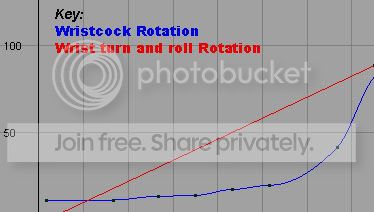 Although not mathematically perfect, this is taken from one of my animation models and the red line is a constant turning(although the rolling will be the same in reverse...)and this is the rate that the wristcock has to work in conjunction to keep the club onplane. Because the acute angle into the plane, the wristcock is allowed to 'almost' release completely - even though its not quite strictly a pure sequenced release - it is close..... |
| All times are GMT -4. The time now is 02:51 AM. |