
|
Closed,Shut,Hooded Clubface
I understand that if you have a problem with your swing you might need to change the clubface first.Now I have played and watched alot of golf and I have noticed a greater percentage of golfers with a severely shut clubface at the top then open.I would even say 85-90% and usually they slice the ball.
Nick Faldo says you can play pretty good golf with a open or square clubface but it becomes harder when the clubface is closed. What does TGM think about this and how do you correct it? I think closed club you better not horizontal hinge but use angled. |
I think you can play better golf with a closed face rather than an open face. From a shut face at the top, you just have to make sure to "hold off" the face coming through impact and usually that'll result in a nice fade. Think Duval, Trevino, Azinger.
|
This is a very complicated discussion because there seems to be so many exceptions. We have to take into account all the different Grip Types, Wrist Actions and Hinge Actions.
The Clubface is always Open relative to the Plane Line at the Top. The question is how open. The "normal" amount accepted by most pros is when the leading edge approximately matches the plane angle. When this happens we say the Clubface is "square" at the Top. If the leading edge is vertical at the top, then it's considered to be "open", and if it's horizontal then it's "closed". Remember that none of the Hinge Actions can Hood (decrease loft) the Clubface through Impact, because the Left Wrist is always "Flat". Only if the Left Wrist is Arching through Impact can we Hood the Clubface. But this violates the number one rule of Hinge Action which is constant RPM (Rhythm). Let's look at real world evidence. Most pros have the leading edge either "square" or slightly "open" at the Top, because most have a neutral grip with a Flat or slightly Bent Left Wrist at the Top. Amateurs have it all over the place. Also, any Bending/Arching of the Left Wrist is considered to be a Horizontal Motion (4-A) and not Rotational (Turning/Rolling 4-C). However, when the club is at the Top, Arching the Left Wrist will "close" the Clubface, and vice versa if you Bend the Left Wrist. But if you go to Impact Fix, Arching the Left Wrist should have no effect on the opening/closing the Clubface. Whether this "closed" clubface position at the top translates to a closed clubface at Impact depends on lots of things. |
Let's look at real world evidence. Most pros have the leading edge either "square" or slightly "open" at the Top, because most have a neutral grip with a Flat or slightly Bent Left Wrist at the Top. Amateurs have it all over the place.
I agree with you that amateurs have it all over the place.Does the flat left wrist fix this fault or is that too simplistic? I'm not a teacher but I see this all the time with higher handicap players and how would you go about fixing it? |
Closed
Quote:
The TOP position is important... due to the effect of the 3rd law(action-reaction). However, golfers do seem to be able to play well from many TOP positions of the clubface. This shows that the TOP position can be important, but not as important as "HOW YOU BRING IT DOWN." Lee Trevion describes himself as "a blocker," because of his STRONG GRIP and Top clubface position. I think he has done pretty well "blocking." The Strong Single Action Grip, which is more of a "neutral grip"(in common golf lingo) usually gives more of an appearance at the TOP of the Square Clubface, and fairly FLAT Left Wrist(not arched). This allows for Horizontal Hinging, or what many would call a FULL RELEASE. So... GRIP, WRIST ACTION, and HINGE ACTION, all working properly together, is what many people need. |
Quote:
|
I like a "Trevino face" for short clubs (Angled Hinge always)...crisper, lower trajectory.
"Hogan face" (more open) for long clubs (less hook prone)....(whatever Hinge I want). |
Quote:
Strong left hand grip, bent left wrist at the top, outside in clubhead path. Fix: First fix everything that looks very obviously wrong, e.g. stance is aimed 40 yards open, spine angle vertical at address, head opposite left foot at address, etc. Then flatten left wrist at the top. This should result in hooks and pull hooks, especially if the student knows how to finish swivel properly. Then neutralise grip. Then fix the clubshaft at the top and startdown. |
Quote:
|
(are you just joking with me??? Can't tell!! Disregard below if it's a yes....ackagabajhajhr! lol)
For me... Esp. with wedges.... I mean.... Still experimenting some but right now it's what I do. ... Jim...how bout I give you an answer in a few days.... (I do think it's better for wedges tho). |
Quote:
was it your own research???......let me see your evidence that this works.....:)) |
Quote:
are you sure? ;) |
Quote:
:clap: ;) |
Quote:
I just find it easier (for now).....esp. for wedges and half wedges. ... BTW I know what you're thinking Jim! Jim:.....(leakage)... ;) |
Quote:
So if you find it easier to hit lower wedges with an angled hinge you probably have a delofted club through the ball, little axis tilt, and probably a back ball position. THOSE all facilitate the the lower ball flight than the angled hinge does. |
Quote:
... I said with a "Trevino clubface"....which I always use an Angled Hinge with..... It generally, and more easily/comfortably (more comfortable for me anyway) flies lower than my other method of clubface control. (no matter what Hinge I use with this other method of clubface control) ... Lots of Axis Tilt BTW..... ... And again....still experimenting (some)......really tho it's closer to fine-tuning than experimenting at this point I think. ... Jim....you have to realize that I mostly only mean for wedges...pitches....etc. I just favour it (SSA grip...i.e. "matching grip".....+ Single WA with slight Arch) more than SSA + Stanard Wrist Action + w/e Hinge....at this point.... .....again....for short clubs/short shots/some punch shots. Like I said....maybe if I tinker a bit I can give you a better answer....I haven't golfed much lately man. |
Angled Hinging -- the Necessity For Varying Trajectory
Quote:
Horizontal Hinging has only "one hole in the sky," i.e., the Clubface Closes Only. Assuming Angled Hinging (some Clubface Layback) or Vertical Hinging (only Clubfaced Layback)... Pick a hole! With Angled or Vertical Hinge Action, the further back (Up Plane) you locate the Ball, the lower the Ball Flight. In contrast, the further forward (Down Plane) you locate the Ball, the higher the Ball flight. So, Horizontal Hinging offers only one trajectory for a given club in a given set of Clubs. In effect, 'one hole' in the sky. Only with Angled or Vertical Hinging can Trajectory -- higher or lower -- be effected. |
Quote:
And you just proved my point... Quote:
|
For those who are still incubating, consider this:
When using Horizontal Hinging, Clubface loft will stay the same from Impact to Low Point even though there is forward lean of the Clubshaft at Impact, and no forward lean at Low Point. |
Yoda, does Angled Hinging produce more backspin than Horizontal Hinging? Angled Hinging has a Layback motion which adds backspin, but also has Compression Leakage unlike Horizontal Hinging which reduces backspin.
|
I like to ask a simple question. At impact isn't the clubface suppose to be shut or hooded? No one really mentions this, and I wonder this is the "hookface" HK is describing that is built in the irons?:golf:
|
Quote:
The Hookface diverts the ball to a Straight Path from a Circular Path. The Clubface should Close Only and not Hood. Hooding produces a Downward Compression which is the job of the Clubhead moving down and out On Plane during the Impact Interval. You could use Hooding as a specialty shot. |
Quote:
|
Quote:
|
Given that a good iron shot is hit ball then turf, it seems to me that the clubface should be facing towards the ground at impact. So a "shutting" clubface IMHO is one that pointing toward ground with big divot. As opposed to a" closing" clubface which I associate with a sweeping feeling taking a little divot.:golfcart:
|
Quote:
Good observations. Yes, certainly for the irons you'd want a shutting clubface FEEL. Versus a closing clubface FEEL. Understand that A) what's happening, B) what you're feeling and C) what you are trying to do - are or can be three very distinct issues in movement. So we need to break them out - based on your post. Yes, the feel is that the clubface is on top of the ball facing the ground. Now, you can't feel clubfaces - so what are you really sensing? - the longitudinal center of gravity of the club. What's that? Well, if you were to lightly hold a club at the grip end and let it hang- because of the attached offset clubhead weight- the shaft would't hang down straight. While you have this club hanging from your finger tips if you were to also hold a piece of string with a weight at the end of it- that would show the longitudinal center of gravity (LCG) of the club and that string if allowed would go right through the clubface- that point it goes through the clubface is the sweetspot. And imagine that that straight string line as what you are sensing in the golf swing. So A) we are sensing that straight line, B) we can't sense the clubface i.e. you wouldn't know if you had 20 degrees or 40 degrees of loft on a clubface unless you visually looked at it - can't sense it by feel. C) since we are hitting the ball before lowpoint- the straight line LCG is leaning forward - hence it will be on top of the ball, facing the ground, "shut". While you are sensing that - the clubface loft is actually facing the sky (whatever the effective loft that you are delivering to impact) and the actual contact point due to loft on the clubface is underneath the ball i.e. below the equator. And while it feels like - ball then turf - normally the sweetspot is sufficiently up the face that the club hits turf then ball - however all of these "What happens" are really insignificant to the issues of A) what are you trying to do and B) what does it feel like. |
Hi Mike,
Glad you were able to convince your parole officer to let you use a computer. nice to see ya online again. Quote:
Image of 3 Iron Impact Sequence: Closing Only (AKA Horizontal Hinge) 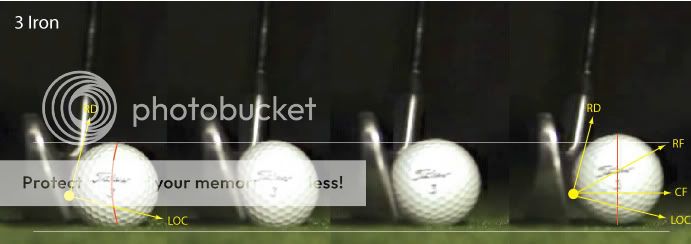 Definitions: (casual) Hooding: is when the Top Edge of the Clubhead is rolling toward or over the Bottom (leading) edge. That would require the Grip moving faster than the Clubhead. Playing the ball back or Leaning the Shaft Forward only de-lofts the Clubface. CLUBSHAFT Shutting: the Clubface, occurs when you independently Roll your Hands (see Swivel). The Clubhead is closing and Hooding simultaneously. Hands Swiveling: is the Tilt of the Sweetspot Plane from On-Plane to Vertical for Impact, or from Vertical to tilt onto the Swing Plane during Start-up. Controlled by both Flying Wedges. Flying Wedges Rolling: is the Body Closing the Clubface relative to the Planeline. Zone 1, Zone 2, Zone 1 and 2, but never Zone 3 (in my humble opinion). Body Horizontal Hinge: is keeping the Left Wrist Vertical to the Ground through the Impact Interval while the Body Closes the Clubface. (Closing Only) Left Wrist |
I know, this is exactly why everyone thinks we are insane. But.......
Hooding is the opposite of Layback. Cant be done dynamically during the impact interval as a Hinge Action or whatever.................can it? Wouldnt that require a horrific slide? I dunno. Hooding at Address, however.........that is a different story, a different definition. Dont scare that guy away, guys. Tell him about Hinge Actions......... |
Quote:
|
Quote:
You're going to get some hooding with the irons due to shaft flex action as a result of impact. Whether that happens during or after impact - whether it's a result of the club contacting the ball or the club contacting the ground -just realize that "hooding" is something that happens in the golf swing. It would fall under Daryl's definition of "That would require the Grip moving faster than the Clubhead" due to the flexibility of the shaft and the deceleration of the clubhead due to impact. You can see that if you look at the hosel above in Daryl's post- leaning more forward in the last frame versus the first frame. Of course, that means that in Daryl's post above - since the face is also closing - that the four frames would also fit under his definition of "Shutting". By the way - you are insane - people realize it - no one thinks that Daryl or I are insane - merely rational normal people. Please don't group everyone together with you. I know you Canadian's like groups but some of us are still into rugged USA individualism! Soon we won't need to deal with you - Bagger is close to perfecting the "Canadian Blocker" on the website- then it will be clear sailing! Is the snow off the ground yet :) |
Quote:
The hosel would be forward due to the ball hitting the face back and the handle keeps moving no? Maybe the ball was hit in the heel . . . |
Quote:
|
Quote:
"Blah blah blah Daryl, blah blah blah Daryl"...............its you two that are forming a group it would appear............not that there's anything wrong with that kind of thing............north of the Mason Dixon anyways. Diam asked a "simple question" ..........he deserves a simple answer..........if that is possible with you two guys..........and you say Im insane! I agree you need some definitions, which Im sure you two "visionaries" can debate for a couple of years, which'll be great reading for the rest of us and all ......... but why dont you just tell him about ball flight laws, Hinge Actions, the Line of Compression. This was Homers biggest revelation to my mind (although he had a few of 'em), what a lot of the book refers to. Diam's sniffing around the right spot, impact. It aint what it first appears to be, an application of straight line, linear force with a club face that stays square through impact. But it isnt a closed or hooded face either...............although I guess it must hood some like you say. Im still hearing guys on tv talking about keeping the face square through the shot, taking the club straight down the line etc ..............despite the fact that 2-C-0 has been in print for 41 years. |
Did you notice how I brought things back to the topic at hand? Beauty eh? Now where'd I leave that Molson?
|
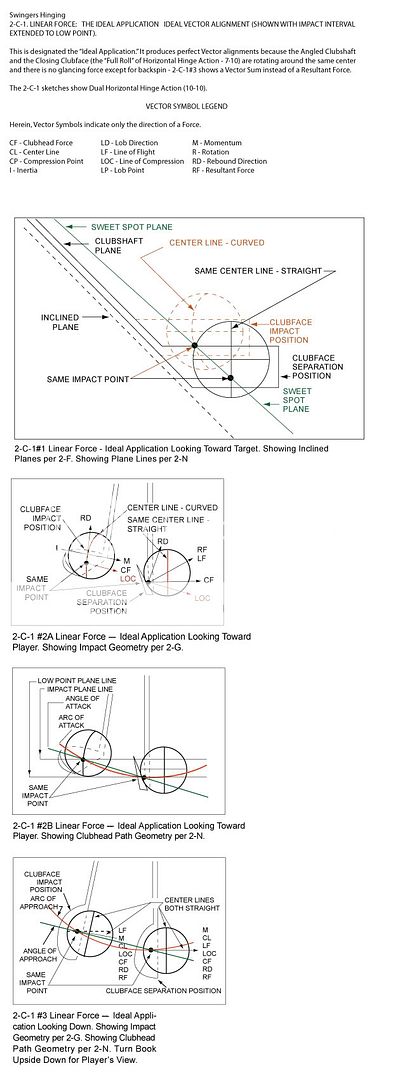 |
Nice one Daryl. The implications there given the direction of the line of compression, hinge action and the point of contact on the ball and face remaining intact, "as if welded together" are so so important to solid, nutted, compressed shots.
What about the text from 2-C-0? You know......."Briefly stated ......etc" And how do you do that anyways? Have you got the book in digital form or something? |
Quote:
You don't think that's insane, do you? :laughing9 |
Umm to paraphrase Mike O. "You'll need to define what you mean by "insane". The process of doing so should be of great benefit to you".
|
Quote:
|
Quote:
Ill see you next week. Ive got another patient coming in a few minutes. Oh by the way , how long have you had this golf simulator envy problem? And Mr Bucket I believe has a goat simulator, for your information. A real nice one too. |
| All times are GMT -4. The time now is 05:36 AM. |