
|
4-D-0 RELEASE MOTIONS
Mr. K states, "RELEASE MOTIONS This term refers to the Release of Accumulators #2 and #3. . . . "Uncocking" (4-B-3) and "Roll" (4-C-3) are two separate motions: 1) Wrist Motion and 2) Hand Motion - coordinate but very independent (4-0). . . . Normally, Uncocking is a function of the Wrist actuating the Clubhead (4-B). See 5-0 and 7-11. It has nothing to do with Clubface alignment at Impact - that is the function of the Hands, executing the Clubface Motion (4-C) - Accumulator #3 (2-G)."
Later he states: "The Hitter concentrates on Hand Motion, while the Swinger concentrates on Wrist Motion." And per 4-C-1 "VERTICAL The wrist is VERTICAL when the back of the Hand would lay flat against a swinging door mounted per the selected Hinge Action, (2-G) with the Shoulder at the Hinge Line." Why should the Hitter concentrate on Hand Motion? And how should the Hitter do this? |
Re: 4-D-0 RELEASE MOTIONS
Quote:
Hitters don't need to concentrate on Left Wrist Motion because it is taken care of by the Angled Hinge Action (10-18-C-2). This Angled Hinge Action is compatible with the Simultaneous Release which is characteristic of Hitters. You do this by making sure any Hand Motion is a result of your Hinge Action. Also, remember, Swingers like to Swivel, and Swivel = Left Wrist Action. Hitters, on the other hand, only uses a finish swivel. I am sure Yoda can give a more authorititive answer! |
4-D-0
12 Piece,
This is a section where Mr. Kelley's 7th edition revisions make an important change in his wording- he changes "concentrates" to "is aware of". You're not the first to bring this important clarification up- more than 25 years ago others had the same questions/issues and after contemplation Mr. Kelley understood that the term "concentrates" implies that you are "doing" something with the hands. The change to "is aware of" more properly denotes the Release Motions as effects of the movement and not something that you have to concentrate on in order to make it happen. This is in the context of the perfected motion, AS OPPOSED to a particular stage of development where the individual may be learning, changing, looking, looking, "concentrating" on perfecting and/or changing the release motions. I know that, the above feedback may not answer your entire question- but I think it is an important first step- please feel free to re-ask or reclarify your question if necessary. Hope that helps. Mike O. |
Re: 4-D-0
Quote:
It's good to have you out here posting! You are one of the best IMO. I was trying to understand why the Swinger would "concentrate" on Wrist Motion and the Hitter would "concentrate" on Hand motion. My questioning this was due to my understanding (or possibly misunderstanding) that the Swinger has CF that would essentially perform the release of #2 ideally. So why would the Swinger need to concentrate on something CF does for him? And with Hitting, since the Hitter's preferred Hinging is Angled Hinging which on an inclined plane has a no-Roll feel, then why would the Hitter need to concentrate on Hand Motion? Since Hand Motion is Turn/Roll, why the need to concentrate on a no-Roll feel? It could be I have missed the boat. Your participation in this forum is much appreciated! Regards, Richard-RUNDMC-Bucket |
Oops!
Well,
How do I talk myself out of this one!? I guess my post doesn't hold water :oops: I didn't thoroughly take the time to research my post and now I am thinking that the above change never made it into the 7th edition. I had it in my book as a revision but I think Mr. Kelley must have changed his mind on making that change. Anyway, I still think the post is valid but I guess he must have had it as a revision and then pulled it. Now back to the regular scheduled show! Mike O. |
Quote:
First, sometimes when we ask these insane questions - I dont know if Homers thought process is in relationship to a 'true' swinger or a 'manipulated hands' swinger. Anyways... Why should a hitter concentrate on hand motion? I believe I asked this question to someone and for the life of me cannot remember the response. I am thinking the hitter would concentrate (or as Mike stated, be aware of) hand motion versus wrist motion because the hitters thrust would not result in sequenced release - so conversly, if he 'concentrated' on wrist motion, then he would be concentrating on the left wrist uncocking - a direct conflict with his prescribed release motion as a hitter. For a swinger, kinda makes sense. Throwout from uncocking left wrist then roll - if you dont uncock, no roll (hypothetically). Heres the issue with the true swinging comment I made. A true swinger has no concern for clubface alignment - the face will align same place ever time regardless of grip type. Ball placement, yes, but not clubface. However, the hitter does have a concern because the face will not automatically align - so he has to worry about the face/grip type to a certain extent. So is Homer talking True or manipulated? Try to decipher that post. Two perspectives on interpretation. And I am sure I made no sense. And if I did, then you got major issues. Patrick |
Concentration
You concentrate on what you intend to do.
For example, If you try to "Snap-Release", you concentrate on the "Release" action and feel (or "be aware of") the "Release" motion. I don't concentrate on "Release" action, if I try to "Sustain the Lag" (by pushing or pulling), but can still feel (or "be aware of") the "Release" motion, if I want to. |
I have not seen any rational answer to the question as to why a hitter has to concentrate on hand motions. What hand motion? Also, doesn't the hitter also have a 90 degree angle between the left arm and clubshaft, and surely the left wrist needs to uncock during the downswing. Does the left wrist uncock differently in a hitter due to the right hand applying force in a radial direction (presumably against PP1) rather than pulling on the club along its longitudinal axis? In a swinger, there is apparently a sequenced power accumulator release (2 before 3) while those two power accumulators are apparently released simultaneously in a hitter? What does that difference really mean in terms of the hand delivery path/arc and the release motion?
Jeff. |
Remember that the position and alignments of the hands, pressure points, forearms and sweetspot are different in the loading action for hitters and swingers....7-3
Until you see, understand and can experience that bit...then you should not be thinking about release motions... Once you understand the loading actions...then the release motions become easier to understand. That is my opinion and experience of learning this stuff... look under 7-3...there were some good threads on that with some photos that helped me. |
Golfbulldog
I cannot understand the second paragraph in 7:3. Could you please refer me to threads and photos that explicate that issue. I don't want to open a new thread on this topic if the issue has been thoroughly explained in a previous thread. I asked Bagger Lance that same question in another thread (on the right forearm), but he didn't want to answer the question in that particular thread. So, I still cannot understand that important "difference". Jeff. |
Quote:
Watch this video and see if it clears up a few things for you. http://www.lynnblakegolf.com/gallery...hereAreYou.wmv |
Bagger - thanks for referring me to that video. I enjoyed it. However, it still doesn't help me understand the difference between loading in swinging versus hitting. I can understand why Yoda states that the swinger loads against the top of the shaft with his PP3 when he eventually gets to the end position. However, what happens if a swinger decides to limit his backstroke to the top position (hands opposite the right shoulder like a hitter) because he cannot get a full shoulder turn. Then his PP3 position could be said to be behind the shaft - like a hitter. In that situation, I cannot understand the difference between a swinger (who has limited his backstroke to the top position and doesn't get to the end position) and hitter. It would seem to me that the PP3 point (established when gripping the club at address) aways contacts the shaft at the same point in a swinger, but it is called "under" the shaft or "behind" the shaft depending on where the clubshaft is located in space. However, a different semantic label doesn't necessarily imply different biomechanical loading actions in a swinger versus hitter - or does it?
Jeff. |
Lots of good questions Jeff.
We'll take them in bite size chunks. First difference; a swinger loads pressure point 3 with a quarter turn roll of the sweetspot at the top. 10-11-0-3 Remember, with Swinging, Pressure Point #3 must have a Feel of being rotated a quarter turn at The Top with Standard Wrist Action (10-18-A), just and only because of Loading Action direction- no actual movement of anything. So from The Top to Release, the Loading put the top side of the Clubshaft against the first knuckle of the forefinger. But with Hitting there must be NO change whatever. When the Wrists "Swivel" back to the Vertical Position (4-C-3) during Standard Wrist Action (10-18-A) per 6-B-3. Pressure Point #3 may -but need not- return to its "strong" position (Aft side of the Clubshaft). That is - if left in "Top-of-the-Clubshaft" position it becomes a Weak Single Action Grip (10-2-A) and the interchangeable equivalent to 10-2-C for Swingers. But both are improper for Hitters using Single Wrist Action (10-18-C). |
Bagger
I cannot understand your posted answer. How can the PP3 point be rotated another 1/4 turn if the backstroke is limited to below shoulder height and doesn't get beyond shoulder height (and doesn't get to the end position where the top of the shaft [which is now parallel to the ground] rests on the PP3 point)? Surely, if the backstroke is limited to a 3/4 swing, then the PP3 point is always behind (aft) of the clubshaft because that was where its position was at address setup? A golfer, who has a limited backstroke action, is not moving his PP3 point from its aft position during the swing. I definitely cannot understand paragraph 2, which seemingly implies that if a golfer adopts a strong single action grip at address (10-2-B), that PP3 will not necessarily end up aft of the club at impact when the wrists swivel back to the vertical position (per 4-C-3) using standard wrist action (10-18-A). It seems to imply that PP3 can remain/become on top of the club. How is that possible in a swinger's 3/4 action as described above - when the PP3 point is never against the top of the shaft when using a standard strong single action grip and a limited backstroke action? Jeff. |
A swinger using horizontal hinging will have rotated the clubface a quarter turn by the time the parallel to the ground position of the clubshaft is reached -from there there is no more rotation -it is purely "back and up" .
So with a "top" rather than "end", backswing, you've still "rotated" a 1/4 turn. From there it is all just Rotation- ON PLANE.:golf: |
Quote:
So take your hands to Top . . . arms in line with your shoulders. Now change the position of your right forearm. Notice with swinging the forearm will be more under and the club lays down more and thus the load is on your knuckle. Now change your forearm to supporting the LEFT ARM and club. Notice how the pressure is more aft of the club and on the "fleshy pad" And the clubhead goes "HIGH." Homer said that the hitter has a "high" clubhead as a result of the loading. |
Loading
A swinger loads the left wrist.
A Hitter loads the right elbow. For a swinger, it makes no difference whether its a chip, pitch, 3/4 swing or full swing. When the left wrist is loaded, there can be a 1/4 turn loading on the right index finger knuckle. No movement of anything, just a shift in the loading as the clubhead reaches the end of its arc. Ask John Riegger about how effective this is for Bunker Shots. Along these lines, the right elbow is in a pitch position for swinging vs a punch position for hitting to accomodate the drag (via the number 4 accumulator) or drive (via the #1 accumulator) of the clubshaft and the associated amount of right wrist bend. |
Neil and 12 piece bucket - thanks for your input.
Unfortunately, I still cannot grasp the difference. Neil - you state that one institutes a 1/4 turn of the clubface by the end-takeaway and after that there is only rotation. How does one turn the clubface 1/4 turn if not by rotation? What is the difference in rotary technique employed in turning the clubface 1/4 turn during the start-up swivel versus the technique of rotation of the left arm/forearm that occurs throughout the remainder of the backstroke? I can understand the idea of a start-up swivel, but are you asserting that the total amount of left arm/forearm rotation is different in swingers versus hitters if both stop their backstroke at the 10:30 o'clock position. Does that cause their clubshaft to lie at a different angle at the 10:30 o'clock end-backswing position, and can you definitively know if a golfer is a swinger versus a hitter by simply looking at their clubshaft angle when the left arm gets to the 10:30 o'clock position? 12 piece bucket I know that HK states that the right forearm supports the primary lever assembly in hitters and only the clubshaft in swingers, but I cannot clearly envisage the difference because I think that the left arm and clubshaft are essentially in the same plane during the late backstroke when the hands are reaching shoulder height (as the left arm flying wedge), and that if the right forearm is held at right angles to the primary lever assembly it is also at right angles to the clubshaft. Am I wrong? Consider the following photo sequence of Stuart Appleby's backswing. 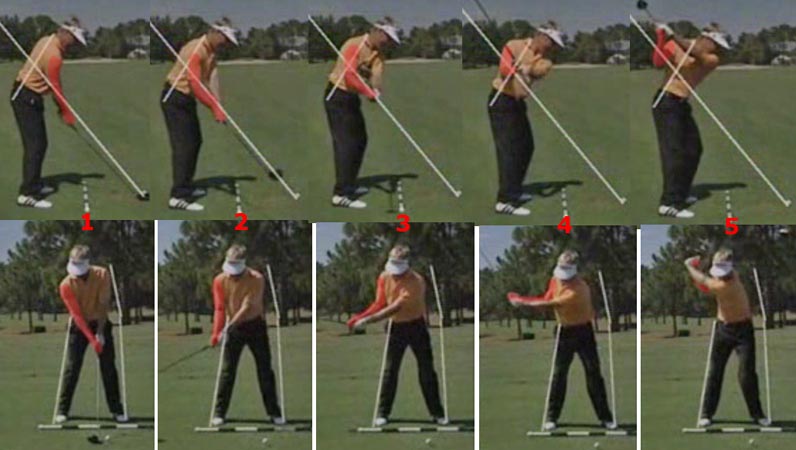 Note that he doesnt get his clubshaft to parallel to the ball-target line at the end of his backswing because he stops his backswing earlier than the end position. At the top of his backswing his right forearm is held roughly perpendicularly to both his left arm and clubshaft because they are on the same inclined plane. Can you definitively state that Stuart Appleby is a swinger or a hitter based on his right forearm alignments? Neil - does Stuart Appleby have a 1/4 turn start-up swivel, or not? Here is another photograph of a golfer who has a shortened backswing - Aaron Baddeley. 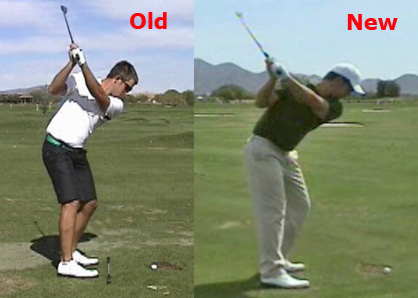 The left photo is his old swing and the right photo is his new Bennett/Plummer-taught swing. His left arm is lower/flatter in his new swing, but in both his new/old swing his left arm and clubshaft are in the same plane at the top of his backstroke so the right forearm is in opposition to both the left arm and clubshaft (similar to Stuart Appleby's situation). Can you definitively tell if Badds is a hitter or swinger based on these forearm alignments? Jeff. |
Quote:
Bagger - I have seen those statements previously. I can understand the concept of loading the right elbow if one simply stops the backswing when the right elbow stops folding. However, if a swinger stops his backswing at that same time-point in the backstroke, is he also not loading the right elbow? Also, if a hitter gets a 90 degree angle between the left arm and clubshaft at the end of his 10:30 o'clock backstroke, and a swinger gets a 90 degree angle between his left arm and clubshaft at the end of his 10:30 o'clock backstroke, then in what sense are they loading the left wrist differently? You also seem to be implying that a swinger makes that 1/4 turn loading of the right index finger at the end of the backstroke. Hmm! That is very different to Neil's suggestion that the 1/4 turn occurs during the start-up. Does that 1/4 turn involve a hand rotation, and does that hand rotation occur due to forearm rotary movements or rotary movements at the left shoulder socket level? Jeff. |
I was editing my post above when you posted. Don't confuse visible plane angles with hitting or swinging. Its very difficult to see the differences visually in shorter backstrokes. Elbow position through release is one clue and finish swivel is another.
The quarter-turn doesn't have anything to do with the startup swivel and the swinger doesn't "make" it happen. Again, there is no effort in "moving" anything. The visual clues might make a good thread. |
Quote:
  Ok so bottom line according to Mr. Kelley Hitting is PUSHING . . . Swinging is PULLING. So you have to get your right forearm in a relationship to the lever assembly being loaded to do just that. With Hitting the right forearm is going to DRIVE the structured unit of the left arm and shaft through the ball ala a 2x4 . . . With Swinging you are pulling the club LONGITUDINALLY. So you are pulling the the shaft or really the longitudinal center of grativity. Homer describes it as pulling an arrow out of a quiver. |
Quote:
Quote:
Quote:
The left hand/leading edge of the clubface begin at approximately 90° to the plane line at address. At the top, the left hand/leading edge are laying on the plane angle (in Mr. Appleby's case, the Turned Shoulder Plane). The forearms need not rotate any more than to accomplish this. Once you reach Station 5, the forearms have rotated enough to allow the left wrist/leading edge of the clubface to open about 90° such that they are now more or less parallel to the plane line. From Station 5 to the Top (8-6), the right forearm is pulling the club back, up and in (on-plane) with the result that the left hand will lay on the plane angle without much more, if any, forearm rotatation. In my own case, I have almost no further forearm rotation. Do some very slow motion backswings watching only your forearms and I think you find this is the case. The combination of pivot and right forearm movement is post-Station 5 "rotation" to which Neil referred. |
12 piece bucket
You wrote-: "Ok so bottom line according to Mr. Kelley Hitting is PUSHING . . . Swinging is PULLING. So you have to get your right forearm in a relationship to the lever assembly being loaded to do just that." If there is different loading positions of the right forearm at the top (presuming a 10:30 o'clock left arm top position) in a hitter versus a swinger, could you clearly demonstrate the differences? Are those photos supposed to demonstrate a particular point? rwh I have no problem understanding how you rotate your left/right forearm based on your description and how the left hand lies on the inclined plane at the top. However, you have not delineated the difference in forearm rotation between hitters versus swingers during the backstroke and described the exact right forearm alignment at the 10:30 o'clock position in both hitters and swingers. Jeff. |
Quote:
Ideally the right forearm alignment is 90 degrees to the loading action. Is this a test? :) |
Jeff,
http://www.lynnblakegolf.com/forum/s...ht=loading+lag Look at the pics I did last year...they may not be "pure" TGM but they should allow you to experience the differences that are being described....it work best if you make a definite effort to go to "end" when swinging (so that you feel the force is "behind"you...and go to right shoulder high and minimum left wrist cock when doing the hitting (so that you can push it)... remember that the book is about forces - and you just have to experience them....the book provides lots of descriptions.... So look at the pictures I did...imagine that you have not read any of the golf books or web forum stuff that you have digested . If someone said to you push (as in the hitter) against the elastic bungee in a straight line towards the ball...in such a way that your head stays pretty steady and you are in balance....push so that you feel almost all your effort is in your right triceps... Try it in a variety of ways until you have found what feels to you to be the most mechanically sound way to push...THEN look at your right forearm and elbow position....it will be in a semi "flying elbow" position...with the force applied to the aft part of the shaft... then read the 7-3 bit again... Now do the same with the swingers photo...forget about golf...just ask your body to pull the force which is on the top side of the shaft...using your lower body to feel and initiate the pull... NOW look at your right elbow...it is in different position to the hitter because it is mechanically more advantageous when pulling to do it that way... If you get that bit then you are there....you identify different right elbow and forearm positions at loading....so to arrive at that position you should have a backswing that is heading in that specific direction...and a downswing right forearm that continues to maximise the mechanics....the swinger readily goes to pitch and the hitter readily goes to punch elbow position.... all of those positions/alignments are there as a consequence of lag loading and efficiency. Good luck. |
Quote:
CG |
Quote:
Question 2 . . . Sure . . . Look at the respective elbow positions and the positions of the clubhead at top . . . look at the elbow positions at release point. There are clearly differences. Is one Swinging and one Hitting? Probably . . . Tell me what you see . . . Question for you . . . what do YOU think about the loading? Legitimate or not? |
Quote:
Do the same thing but this time . . . lead deeper with your right elbow more infront of your right hip ala Pitch Elbow as Homer has described it. Stop. Now take it to the top from there. Is there a difference in the right forearm alignment? Remember ALL GEOMETRY IS DERIVED FROM IMPACT GEOMETRY . . . including the Right Elbow location/Basic Stroke. So if you intend to have your elbow in a Punch Basic Stroke alignment your Top should comply with that alignment . . . and vicey versey with Pitch. Work from Impact back . . . that's why Fix is so important. |
Quote:
|
Quote:
The position of the right arm at Section 6 is a function of how and when you set your Flying Wedges. If you watch Lynn Blake, he set's up with the Flying Wedges in place at Address and keeps them there. Unless you look for some other tip-off, start up swivel for example, you can't tell the difference in right arm position at Section 6 whether he's Hitting or Swinging. This is because the right forearm flying wedge should always be at right angles to the left arm flying wedge. This is going to look the same, Hitting or Swinging. If your arms are hanging straight down at address and you don't have a clue and/or don't care about flying wedges, then the right forearm will probably appear to be more vertical with a swinger. But Hitters (Ted Fort) almost always set up with Flying Wedges assembled (right forearm in line with and at right angles to the shaft) and they stay that way from start up to impact. |
Thank you all for your helpful comments.
Golfbulldog - I find your description most helpful. I will describe it in my own words and you can decide whether I understand the backstroke action of the hitter/swinger correctly. The hitter takes the club back from an impact fix alignment and rolls the left arm gradually through the backstroke to an endpoint where the right elbow "feels" fully bent and acts as checkrein to the backstroke action. During this backstroke action, he resists the "carry back" and therefore feels constant pressure at the PP3 point aft of the club. At the top of the backstroke, the back of the left hand is parallel to the inclined plane, and the right forearm is perpendicular to the left arm flying wedge (primary lever assembly). The right elbow is flying slightly and not near-vertical to the ground because it is perpendicular to the inclined plane eg. turned shoulder plane, or an inclined plane which is slightly flatter than the turned shoulder plane. The swinger takes the club back from the adjusted address position, and allows the club to swivel during the takeaway so that the back of the left hand is already parallel to the inclined plane at the end-takeaway position. The swinger then continues to gradually rotate the left arm/torso to the end-backstroke position. However, the swinger also allows the clubshaft to rotate another 1/4 turn at the end of the backstroke so that the clubshaft falls against the PP3 point (which is slightly more under the clubshaft than behind the clubshaft). This extra 1/4 rotation means that the clubshaft is slightly flatter than a hitter's clubshaft at the top of the backstroke. The right forearm is positioned perpendicular to the clubshaft (secondary lever assembly rather than primary lever assembly) and because the clubshaft lies in a slightly flatter plane, that means that the right forearm must be slightly more vertical (compared to the hitter's right forearm position). The swinger's right forearm position is therefore more conducive to allowing the left arm to pull the grip end of the club down via a longitudinal path in a karate-chop action, while the hitter's right forearm is better positioned to push down on the PP1 point via a radial thrust action in a straight line towards the aiming point. If my understanding is correct, then the right forearm should appear more vertical in swingers, and less vertical and more parallel to the bent-over spine in hitters. This difference in right forearm alignment should theoretically be demonstrable/discernible in still photos of golfers at the top of their backstroke. Bagger - if my above description is correct, and you state the right forearm is perpendicular to the loading action, then surely the hitter must be loading against the left arm flying wedge (left arm + clubshaft), while the swinger is only loading against the secondary lever assembly (clubshaft). Please correct me if my understanding is incorrect. rwh - you wrote-: "This is because the right forearm flying wedge should always be at right angles to the left arm flying wedge. This is going to look the same, Hitting or Swinging." If you are correct, then my understanding is still impaired because my description above doesn't comply with your assertion. 12piece bucket - Regarding those photos, when I look at Hogan's downswing action I can see his right elbow slide to a point in front of his right hip - like a pitch elbow, while the other golfer has his right elbow behind the right hip - like a punch elbow. Hogan also seems to have an extra 1/4 of rotation at the end-backswing, and that gets his clubshaft to become parallel to the ground and his PP3 point to lie under the shaft. Hogan's right forearm at the end-backswing is more vertical suggesting a swinger's loading action. Am I right or wrong? Jeff. |
I think that you get the idea... I am not TGM pure enough to say whether every exact word is correct....but if you see that the right forearm/elbow has to differ to provide mechanical advantage/support for the left arm pull versus the right triceps push.... and then everything else is SECONDARY to that loading action alignment....then you get the key difference...IMO.
You can not push something that is behind you.... but you can pull something that is behind you.... so swingers can go to "end"....but hitters should not unless they want to add compensation....Read the thread where Yoda describes the patterns being used by David Toms and KJ Choi....it is very incisive and shows that they go to END but then rearrange their actions on the downswing for a hitters pattern...very wise words...:salut: So the hitting action (IMO) is experienced with a shorter backstroke /less wrist cock/shaft more vertical at TOP (this is the re-arrangement that Toms and Choi achieve in early downswing). The one thing I did not get in your description was the bit about "resisting carry back"....but do not get hung up on the words...you really have to feel the forces in their respective manners and then your body will understand. The hitter backsrtoke has no conscious 'turn to the plane' ...it keeps the clubface more "looking at the ball"...so the blade of clubface stays perpendicular to the inclined plane for longer than a swinger (a bit like the old square to square pattern of the '70s).... in fact most modern teachers probably teach this takeaway...in what they believe is a swingers overall pattern.... but the TGM influenced swinger turns the clubface to the plane using radius and ulnar action....early swivel action that is reversed in their sequenced release on the downswing (think of peoples descriptions of Hogan and his fanning the clubface 'open' (actually turning it to the plane...like Tiger trys/tried to do) and then Hogan kept the clubface turned against the plane for a very long time (probably for most of his shots...ignore the Ballard teaching ) and whilst the clubface is turned to plane on the downswing and you are PULLING...then pp3 remains quarter turned as it was at loading action....so pp3 gives info about lag and clubface...see the video in gallery about "pp3 where are you"...see the pressure point advice in "Modern Fundamentals" and the Hogan video in the gallery about grip and pressure point through impact...i'm sure that you have seen it before but watch it again now that you have read this... ..... the hitter has a slow and simultanteous cock and turn of the left arm on back and downswiing...no independent radius and ulnar action Homer really wanted the feel of the downstroke to have a similar feel to that to that of the backstroke....not just in programming feel of release but also loading action and release...."snap with snap" etc...for snap loading and snap release....can't remember the reference in the book for this bit. Hope this helps and not confuse you! |
 This man drag loaded...his right forearm was aligned perfectly at "end" for pulling and he had had no compensatory movement to get into the "slot" that he is in here... If he were pushing pp3 and pp1 in a straight line towards ball or aiming point he would not have adopted a right forearm alignment like this. You can pull much more effectively with this alignment than the hitter's "top" right forearm alignments.... |
hitters pattern
Mind if I come in here,I keep my cluface square to the I/planeline from I/fix to Impact,I was under the impression this is the right way to "HIT"
this way the R/elbow remains in correct position all the way,this also keeps pressure point and acc all in line Simple and uncomplicated |
| All times are GMT -4. The time now is 04:42 PM. |