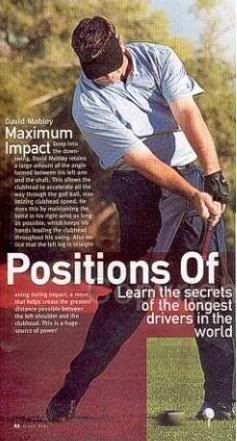
This obviously shortens the Swing Radius considerably because it now only extends from the Clubhead to the Left Wrist rather than to the Left Shoulder. It moves Low Point forward -- rather than being opposite the Left Shoulder, it is now opposite the Left Wrist.
But surely a Long Drive Champion such as David Molbey wouldn't be using an inferior procedure like this. He has one of the slowest clubhead speeds in the business, yet he is one of the best. Could this be the reason why?
How can TGM explain this?
Lets say he does this because he wants to hit down on the ball. But what's the advantage of this procedure compared with the standard one where you just place the ball behind the Left Shoulder without changing Low Point location?
I have more comments later. I'd like to hear what you guys have to say.
I am not so sure that Mr. Kelley will actually classify this as a shortening of a swing radius.
Per 7-17, halting the backstroke with the feet and letting the same tension pull the Downstroke through Impact is "swinging from the feet" and gives the Stroke maximum Swing Radius.
The difference between this look that Mobley exhibits and a bent left wrist at impact is that the former does not result in disruption of clubhead orbit and throwaway, while the latter does.
That Mobley is Long Drive Champion despite a "shortened swing radius" proves that there is more to long drives than just pure clubhead speed.
Per 2-M-1, power is mathematically expressed as 1/2 Mass x Velocity Squared.
Per 2-M-2,
Mass is varied by Acceleration Rate and Swing Radius.
Clubhead speed is varied by Acceleration Time and Release Interval.
Other factors that need to be considered is centeredness of impact, wind, equipment etc...
1. 2-K Compare the Primary Lever Assembly (6-A-2) with the common flail. While the “swingle” is seeking its “in-line” (full extension ) relation with the “handle” (catching up) there is “Centrifugal Acceleration.” When it becomes “in-line” (caught up) this settles into “Centrifugal (Angular) Momentum” (Full Extension). If it passes its “in-line” relation, it again seeks its “in-line” relation (backs up) and “Centrifugal Deceleration” sets in with a huge power loss. These three phases demonstrate what is termed herein “The Law of the Flail” – the Swingers primary concern.
2. 2-P . So as the Clubhead moves from minimum to maximum radius, its Surface Speed (6-N-0) in miles per hour (MPH) increases geometrically. However, the RATE at which the Clubhead radius increases is an additional velocity factor – that is, its “Overtaking Rate” (6-F). Which is dictated by Hand Speed, Trigger Delay (7-20, 7-23) and Travel and which continues until the In-Line (6-B-0) FULL EXTENSION of the Lever Assembly (6-A) is achieved. So for maximum Power at any Clubhead Speed, the Ball must be struck before Full Extension per 2-N-1. Full Extension (Angular Momentum 2-K) can occur at any time or exist all the time during a Stroke per Pattern, regardless of Impact Point or Low Point (2-N). Impact during Full Extension produces a “soft” Impact and is a very useful simplification. See 2-K and 2-L#2.
1. 2-K Compare the Primary Lever Assembly (6-A-2) with the common flail. While the “swingle” is seeking its “in-line” (full extension ) relation with the “handle” (catching up) there is “Centrifugal Acceleration.” When it becomes “in-line” (caught up) this settles into “Centrifugal (Angular) Momentum” (Full Extension). If it passes its “in-line” relation, it again seeks its “in-line” relation (backs up) and “Centrifugal Deceleration” sets in with a huge power loss. These three phases demonstrate what is termed herein “The Law of the Flail” – the Swingers primary concern.
2. 2-P . So as the Clubhead moves from minimum to maximum radius, its Surface Speed (6-N-0) in miles per hour (MPH) increases geometrically. However, the RATE at which the Clubhead radius increases is an additional velocity factor – that is, its “Overtaking Rate” (6-F). Which is dictated by Hand Speed, Trigger Delay (7-20, 7-23) and Travel and which continues until the In-Line (6-B-0) FULL EXTENSION of the Lever Assembly (6-A) is achieved. So for maximum Power at any Clubhead Speed, the Ball must be struck before Full Extension per 2-N-1. Full Extension (Angular Momentum 2-K) can occur at any time or exist all the time during a Stroke per Pattern, regardless of Impact Point or Low Point (2-N). Impact during Full Extension produces a “soft” Impact and is a very useful simplification. See 2-K and 2-L#2.
In other words, the Clubhead should be accelerating all the way until the Clubhshaft reaches its in-line condition with the Left Arm. Which should mean that maximum power is achieved before Full Extension -- but how far? Common sense says that it probably wouldn't be five feet before Full Extension is reached. It should be just slightly before.




 Hybrid Mode


