I may be missing the point but it looks like both shoulders of the stickman (in both examples) are on plane through to the end of impact. Seems ideal to me.
The left shoulder is not onplane for the entire downstroke till the point of where the left arm is inline and the left wrist assumes its uncocked state at followthrough which is by definition both arms straight. The right shoulder is onplane to just before impact where it then must depart the inclined plane.
Both shoulders are definately not onplane...at any point of the golf stroke...
The left shoulder is not onplane for the entire downstroke till the point of where the left arm is inline and the left wrist assumes its uncocked state at followthrough which is by definition both arms straight. The right shoulder is onplane to just before impact where it then must depart the inclined plane.
Both shoulders are definately not onplane...at any point of the golf stroke...
Got cha. I'm sorry Matthew I really didn't say what I meant in that post. I meant to say that the left and right shoulders look as if they are on the same plane at impact.
not only that, its unhuman and it ain't happening...lol
I mean really, is this what you and tongzilla recommend as the most important alignments?
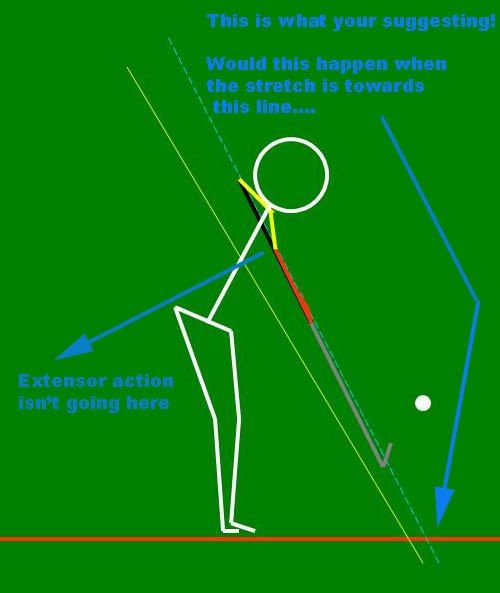
Cool pic Mathew, and exactly what I'm suggesting, although I'm not really bringing extensor action into it. Basically I think it is not ungolflike nor unhuman. To align your shoulders with your spine (which is pretty near the back of your torso, I actually think you probably need to make an effort to pull them back a bit, which is ungolflike). But we can agree to disagree if you like. I don't feel massively strongly about this, but I don't think you've provided a 'logical proof' that both shoulders cannot be onplane in the golf stroke!
Maybe from your pic you think I'm suggesting a backward curve of the shoulders, but I'm not, I'm suggesting a forward curve (that was what I saw in your diagram by the way - sometimes hard to tell with stick figures!)
And stop picking on Tongzilla! His list was really good!
Banging my head against the proverbial brick wall...
I crushed the idea of an onplane shoulder at followthrough and you both know it.... yet find yourselves unable to admit it. Of course both of you would let hell freeze over before that would happen. But your arguements are absolutely pathetically absurd!
Now your plan is to make Tongzilla, the bully act the victim. It kinda like the kid that beats up on other kids and eventually goes against one that beats his brains out and then wants sympathy.
I crushed the idea of an onplane shoulder at followthrough and you both know it.... yet find yourselves unable to admit it. Of course both of you would let hell freeze over before that would happen. But your arguements are absolutely pathetically absurd!
I think you should add a MWWWWHAA-HA-HA-HA to this for effect!
Got cha. I'm sorry Matthew I really didn't say what I meant in that post. I meant to say that the left and right shoulders look as if they are on the same plane at impact.
Thanks
Thats cool
If you observe Hunters stickman drawing at low point here - you can see that they are on a parallel angle as the plane yet still above the plane. This parallel above the plane is a reasonable approximation at this point for the dimensions of this stickman diagram (and in real life the center I think would be further above plane).. because the right shoulder and the left are in the transition of swapping over as to say...
Note that again the shoulder flexability will be stretched by extensor action towards the plane line - and not being stretched directly backwards. As an analogy, if those shoulders where a bow and the arms the string - the shoulders would not be pulled backwards (or forwards ...lol) so that they would touch the inclined plane....
If you observe Hunters stickman drawing at low point here - you can see that they are on a parallel angle as the plane yet still above the plane. This parallel above the plane is a reasonable approximation at this point for the dimensions of this stickman diagram.... because the right shoulder and the left are in the transition of swapping over as to say...
Note that again the shoulder flexability will be stretched by extensor action towards the plane line - and not being stretched directly backwards. As an analogy, if those shoulders where a bow and the arms the string - the shoulders would not be pulled backwards so that they would touch the inclined plane....
Pretty awesome,dude..clearing it up! thanks.
Just a quickie. How would a really good horizontal hinge action effect the shoulders after this paralell to the plane moment?
Just a quickie. How would a really good horizontal hinge action effect the shoulders after this paralell to the plane moment?
No problem
Hinge action is something completely seperate.
Ask the same questions. Does hinge action stop the left arm becoming inline at followthrough... it doesn't. Does hinge action stop the pivot center from being above the plane... it doesn't. Does hinge action stop extensor action pulling the shoulder flexability towards the plane line...it doesn't...
So regardless what Hinge action you employ it makes no difference to the fact that the left shoulder is onplane at followthrough and not the right shoulder.


 I'm sorry Matthew I really didn't say what I meant in that post. I meant to say that the left and right shoulders look as if they are on the same plane at impact.


 "Solid powerful impact always be there at the second loop on the way down along the K& line of educated hands!?"


 Linear Mode


