Also, as a "real world" issue, what do you think is the significance of being able to calculate the exact degree of wrist cock, or is this just a test question in the making? Another real world issue, is that you would have to put a golfer in a pretty precise and golfer to golfer consistent photo set up to be able to even analyze these issues with any reliability. And finally, other than helping us understand the relationships between the components how would you impart this knowledge as an instructor?
G2M
G2M,
I've enjoyed the fact that we are seeing the same description of Jen's plane in our minds eye. I'm still incubating as well.
I think there are some steps to knew discoveries.
First - It's prudent to have another qualified 3rd party expert prove the logic and math.
Second - It needs to be well understood enough that it can be clearly articulated to anyone with a High School Geometry level of understanding.
Third - The applications will evolve slowly over time as the practitioners learn to use a new tool. It may never have a practical application but be a jumping point to something else. I have a hunch it will have at least one practical application in computer modeling of the golf stroke.
For the time being, I'm just going to enjoy the discovery process. I don't think Mathew has thought through the applications or had time to. He's too busy fine tuning the new model.
Pretty cool stuff. In the mean time, there's still lots of s'plane'in to do!
I've enjoyed the fact that we are seeing the same description of Jen's plane in our minds eye. I'm still incubating as well.
I think there are some steps to knew discoveries.
First - It's prudent to have another qualified 3rd party expert prove the logic and math.
Second - It needs to be well understood enough that it can be clearly articulated to anyone with a High School Geometry level of understanding.
Third - The applications will evolve slowly over time as the practitioners learn to use a new tool. It may never have a practical application but be a jumping point to something else. I have a hunch it will have at least one practical application in computer modeling of the golf stroke.
For the time being, I'm just going to enjoy the discovery process. I don't think Mathew has thought through the applications or had time to. He's too busy fine tuning the new model.
Pretty cool stuff. In the mean time, there's still lots of s'plane'in to do!
Bagger
Please don't for a minute think I was "busting his chops", quite the contrary, I am very interested in where he is going with this, mostly at this point becaause it makes me think. I want to hear his ideas about how to use this concept to help cultivate my own thoughts. In essence, I am trying to challenge him to think deeper, beyond the geometry, and to the uses of his concepts.
Also, I agree with your evolutionary progression, however, regardless of how precise,logical or well reasoned the concepts might be, if we can't communicate how to apply the concepts, once we are able to explain them succinctly, the likelihood of them being embraced by even the most technical amoung us is low.
Let's keep working at this, pushing the boundary of understanding and see what comes from it; maybe nothing, maybe something fundamental; in any case, all good.
A rotating plane (floating/dynamic plane) that exist independent of the type of golf stroke motion.
Obviously I need to wait and see what the value of this floating/dynamic is? The planes we deal with normally are static so to speak, at least there is one part that remains constant, normally the plane line. As far as I can tell this floating/dynamic lacks that quality, the only constant is that it at, I think 90* from the flat left wrist, making this the top of the forearm.
I don't believe it is correct to equate 'wristcock' and 'hinge action'. Maybe I am missing something but the wristcock isn't referred to as hinging, but it is the rotation of the wrist that is referred to as hinging. Maybe this is where Matt is trying to bring hinging in, but if so and if accurate at least my descriptions, then the wristcock has no hinge pin to refernence to.
A rotating plane (floating/dynamic plane) that exist independent of the type of golf stroke motion.
Obviously I need to wait and see what the value of this floating/dynamic is? The planes we deal with normally are static so to speak, at least there is one part that remains constant, normally the plane line. As far as I can tell this floating/dynamic lacks that quality, the only constant is that it at, I think 90* from the flat left wrist, making this the top of the forearm.
I don't believe it is correct to equate 'wristcock' and 'hinge action'. Mathew is not equating wristcock to hinge action, the pivot point of the left wrist was refered to by ME as a PIN around which the left wrist moves. This pin would be vertical to the inclined plane and was used by me as a visual descriptor to describe how Mat's new plane works
Maybe I am missing something but the wristcock isn't referred to as hinging, but it is the rotation of the wrist that is referred to as hinging. Maybe this is where Matt is trying to bring hinging in, but if so and if accurate at least my descriptions, then the wristcock has no hinge pin to refernence to.
What Mat is doing is to use the position of his new plane, relative to other planes to measure and calculate. I haven't gotten my mind completely around exactly how he intends to do this yet, but I'm close, I think. The fog is lifting, but is still there
NOW I see what I was missing.... the #3acc plane. Very cool. I knew you needed another plane to reference Jen's plane against to calculate wrist cock, and I was hoping Jen had a good looking sister!!!
Thanks Mathew, No more fog (at least on this topic).
G2M
NOW I see what I was missing.... the #3acc plane. Very cool. I knew you needed another plane to reference Jen's plane against to calculate wrist cock, and I was hoping Jen had a good looking sister!!!
Thanks Mathew, No more fog (at least on this topic).
G2M
G2,
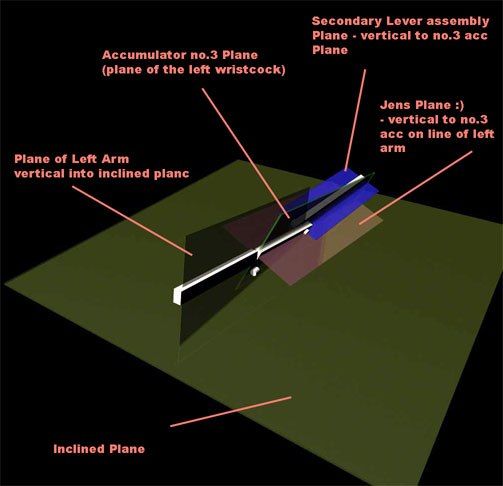
How about a summary of Matthew's new drawing- in regards to all components in the drawing, particularly Jen's Plane, the formula, and a real golfer?
However, I've been busy but I'm starting to get it- just going to take a little longer- Specifically Jen's plane role and definition would be helpful.
Due to the fact that the right forearm can only move straight up and down from its elbow location this means that at any point the entire right arm is always in a plane....
In this plane the closer the right hand goes to the right shoulder - the greater the angle between the upper arm and the forearm. This always creates a triangle shape between the right shoulder to hand - right shoulder to elbow - elbow to hand, except when it is inline. It is actually the right shoulder to hand line that is the third line on the law of the triangle per chapter 6.
PS - Im looking for this to be a active discussion. If you have any input to give or feel you want to add something - please discuss
G2,
How about a summary of Matthew's new drawing- in regards to all components in the drawing, particularly Jen's Plane, the formula, and a real golfer?
However, I've been busy but I'm starting to get it- just going to take a little longer- Specifically Jen's plane role and definition would be helpful.
Mike;
I'll try to do a better job with this later, but I wanted to comment on the "real golfer" aspect. My opinion, and sort of along the line that bagger posted earlier, is that I'm not sure, nor I think is Matthew, of the future long term uses of this new information. I can see difficulties in it's initial application to the real golfer, in that the nuances of getting accurate measurements coupled with differeing golfer anatomy will make this difficult to apply. In swing analysis, the camera setup will have to be precisely oriented so that the computations won't suffer from differing camera angle perspectives. Also, the difference between traditional wristcock measurements from a front on photo (shaft angle to left forearm), and that calculated by this will be small since the only real difference is the fact that the #3acc plane and the sweetspot plane are only slightly different. At the top, the SSP, the #3acc plane both are the same. As you move down, the #3acc plane drops slightly below the SSP. If it didn't, the ball would be hit by the hozel. This effect causes the traditional method of determing wristcock, or lag to be slightly incorrect since the points of measurement are not on precisely the same plane. This new calculation allows you to evaluate the difference. More later...
So to clarify then, Jen's plane is simply a plane that is 90 degrees (verticle) to the plane of the left wrist cock, through (around) the left arm as the 'hinge pin'.
Which then provides a reference point for the amount of rotation of the left arm flying wedge as it 'turns and rolls' relative to 'the' plane.
__________________
"Support the On Plane Swinging Force in Balance"
"we have no friends, we have no enemies, we have only teachers"
Simplicity buffs, see 5-0, 1-L, 2-0 A and B 10-2-B, 4-D, 6B-1D, 6-B-3-0-1, 6-C-1, 6-E-2





 Linear Mode


