I am always very confused about the plane and zero shifting.
If I address with the right forearm on plane with the shaft, with bent elbow, then just bend and fan the right elbow up and then just pushing down with #1 pressure point, am I zero shift with turned shoulder plan (since is on plane at address)? or am I at the elbow plane? Appreciate your help.
I am always very confused about the plane and zero shifting.
If I address with the right forearm on plane with the shaft, with bent elbow, then just bend and fan the right elbow up and then just pushing down with #1 pressure point, am I zero shift with turned shoulder plan (since is on plane at address)? or am I at the elbow plane? Appreciate your help.
Elbow Plane. If the Right Forearm is On the Swing Plane at Release and In-Line with the Clubshaft, then you are swinging on the Elbow Plane.
All Swinging should have an On-Plane Forearm at Impact (Right Forearm is On the Swing Plane at Impact). At Release, the Right Forearm should at least be On Plane, at 90 degrees, to the Left Arm Wedge; Flying Wedge geometry.
Thanks, Daryl, I am hitting, am I zero shift as right forarm on plane at address and just bring it back and push it down. Does zero shift must be for Turned Shoulder Plane?
Thanks, Daryl, I am hitting, am I zero shift as right forarm on plane at address and just bring it back and push it down. Does zero shift must be for Turned Shoulder Plane?
If you bring it back and up and then take the hands straight to the plane line without going up or down on the way, with the left arm wedge intact, then you're using a Zero Shift on the downswing. Zero Shift means no plane shift.
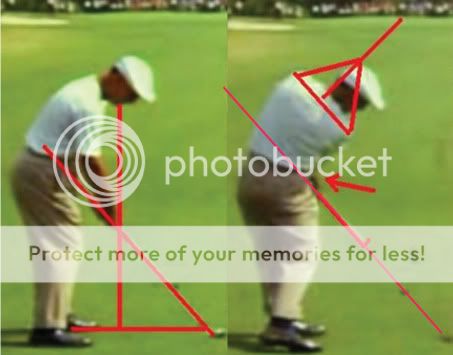
Whether it's an Elbow Plane or Turned Shoulder Plane, we're always talking about the Clubshaft angle. The following Image of Ben Hogan indicates that the Clubshaft angle at Impact points to the location on his side where his right elbow would touch.
So, regardless bobbing or swaying, it's the clubshaft that defines the plane.
To be more precise....
Although they are great pictures, they are worthless for proving anything about the Plane. The camera is not "On Plane". So, the pictures are poor views of the geometry. Only with a camera's eye "On Plane" can lines or conclusions be drawn.
Homer - TGM:
2-F
(6th Edition)
Regardless of where the Clubshaft and Clubhead are joined together, it always feels as if they are joined at the Sweet Spot – the longitudinal center of gravity, the line of the pull of Centrifugal Force. So there is a “Clubshaft” Plane and a “Sweet Spot,” or “Swing”, Plane. But herein, unless otherwise noted, “Plane Angle” and “Plane Line” always refer to the Center of Gravity application. Study 2-N. Except during Impact, the Clubshaft can travel on, or to- and – from, either Plane because the Clubshaft rotation must be around the Sweet Spot – not vice versa.
(7th Edition)
Except for Impact, the Clubshaft is an acceptable Visual Equivalent for both Planes - especially if the Clubface is Turned "On Plane".
So, the travel of the "Sweet Spot" defines the Plane. The line drawn on the Clubshaft at Address does not define the Plane.
Zero Shift, as I understand it, is the "Sweet Spot" traveling on a single Plane.
I found them on the internet with the lines already drawn. So much for trusting Golf Instructors to draw lines. I didn't want to embarrass anyone by mentioning names. I guess I'll just have to draw them myself from now on.
Does that mean we can't discuss the Swing Plane anymore or does that just limit our visual props to illustrations and/or approved photographs?
Yodasluke has the point correct about the camera needing to be 'on the plane' otherwise you have a distortion to deal with. Using no planed photos you just have to realise that appearances can be deceptive.
Follow the sweet spots travel and life gets easier to grasp in terms of plane shifts.
Yodasluke has the point correct about the camera needing to be 'on the plane' otherwise you have a distortion to deal with. Using no planed photos you just have to realise that appearances can be deceptive.
Follow the sweet spots travel and life gets easier to grasp in terms of plane shifts.
In your opinion, how far off-plane are the above photos?
The above photos were offered in an earlier post to explain why the "Elbow Plane" is called the "Elbow Plane". Would you approve the photo's within that context?
It's easy to mistake what I want to say with what I said. And its easy to mistake what you think I said with what I wanted to say. That wasn't well said but I'm sure you get what I mean.
Separated by thousands of miles, discussing a very complex subject, without the artistic talent to draw what one thinks, confined by a limited vocabulary, and limited mental faculty for 3 dimensional visualization, it's a wonder we can understand each other at all. And that's just you!
I, have even less. A little breathing room please.
Know what you mean I cannot even draw my own thumb.
The photos taken are from way to the right of the real plane so hard to use. It makes BH look like he is pulling way left too (sound a familiar argument??!!) with a bent plane line.
Context is king of course. A good pic is as handy as a perfect one to get the general concept fired up. A perfect one leaves no ambiguity. Guess Homer worked that out over the years doing the book


 That wasn't well said but I'm sure you get what I mean.

 Linear Mode


