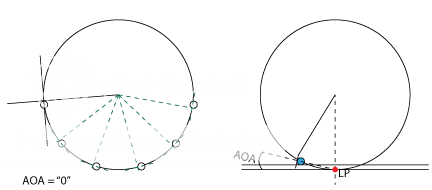
Another need for a “perfect circle” motion is for directional control. If the Clubface is maintaining a constant relationship to the radius of its rotation – whether the face is open, closed or square – then the direction imparted at any one point of the arc will always be the same for “centered” (Sweet Spot) Impact (2-F).
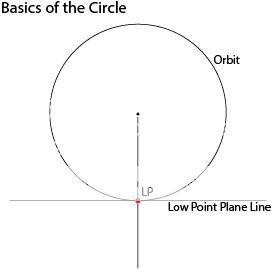
When the Target Line is introduced, the intersection is called Low Point.
What do you say we call the target line in your drawing the LOW POINT PLANE LINE . It is one and the same as the target line in your drawing given that geometry/ball placement at low point, but the target line and the low plane line diverge as the ball moves back , up and in along the arc of approach. Eh?
We're getting ahead of ourselves maybe but what do you think D?
Two new points:
Quote from D above-then the direction imparted at any one point of the arc will always be the same for “centered” (Sweet Spot) Impact (2-F).
2-D-O - Par.2 "the Angular Motion in a Golf Stroke is compounded by its dual Center. One Center is for Clubhead as a whole, and the other Center is for Clubface position."
note- great care is also/always needed in application of HK 's use of Cap's, "quotes" and Ital.
That being said- It would be that the golfer could strike the ball at any point on the "circles" with the same results relative to the tangent to the circle at the point struck. ??
Which then leads me to the 2 thoughts. 1. Is the circle shape important beyond practical use? 2. Is anything important beyond alignment of the clubface relative to the direct of the clubface at impact?
In the mean time, before we try try to draw the club face lets nail a few more things in the basic drawing.
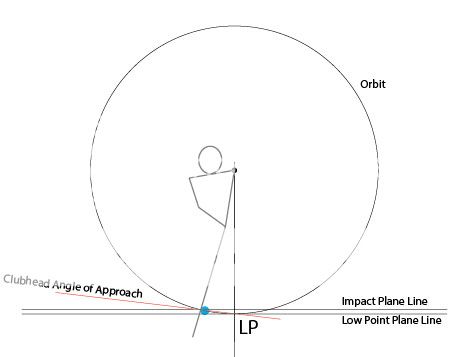
-add a stick man golfer guy, with the centre of the radius at his left shoulder and a head.
-have him address a ball back of low point and draw the Impact Plane Line .
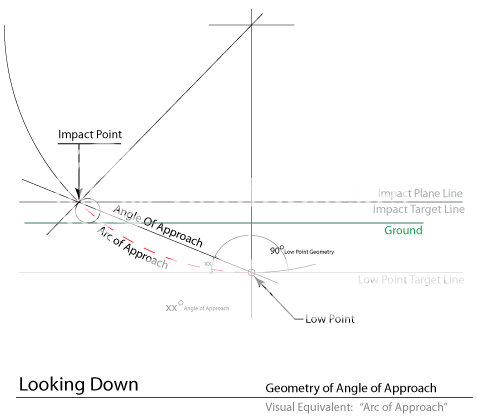
-note the increased Angle of Attack.
This is still in a purely vertical plane as D noted above . Things start to get interesting when you lay the whole shebang on an inclined plane with the guys head and eyes (the golfers perspective per 2-C whatever) above the plane . There are unique perspectives to most of Homers definitions that must be recognized . IMO this is the key to being able to understand Homerian geometry speak , words. You must be able to mentally jump from one perspective to another . Golfers view , caddy , down the line , true path of the clubhead even. Vagueness on this breeds misunderstanding when communicating. It is so easy to get mixed up on this and when communicating geometry in words. Easy for folks to use the same words but with vastly different "perspectives", definitions. Once cracked , what at first seems like Homerian code language becomes profoundly useful. You could call up Yoda long distance and clearly , precisely discuss the mechanics necessary for the progression your own procedure for instance. As he did with Homer .... many times.
Guys this geometric perspective is also a language . This thread could get interesting if its possible for us speak the same language. Much of our discussions around here get bogged down in the mud of differences in definition. Not saying Im any better or worse just saying. Who knows maybe Mike O. will come on down with some stuff that shocks the world . Double D 's just itching to unleash a whirlwind of drawings I bet. Lets get the language straight and then roll with it.
Not saying the whole book will come together ... I still think Homer was nuts. As are we probably.
Here's an old doodle of mine. Guys submit drawings you did on a napkin or toilet paper or whatever if you want. Take a photo of it on your phone and post it !!!
Rule #2 Unused toilet paper only! This is for all those Viking fans out there.
That being said- It would be that the golfer could strike the ball at any point on the "circles" with the same results relative to the tangent to the circle at the point struck. ??
Which then leads me to the 2 thoughts. 1. Is the circle shape important beyond practical use? 2. Is anything important beyond alignment of the clubface relative to the direct of the clubface at impact?
HB
That's it. Well said.
Quote:
"It would be that the golfer could strike the ball at any point on the "circles" with the same results relative to the tangent to the circle at the point struck."
So what do we call that point on the orbit when the tangent to the circle is aimed at the Target?
The Club is designed with length and lie angle and loft. The loft plane is a vertical plane. Rebound will be at right angles to the face. When this geometry (Shaft in a vertical plane at the correct lie angle) intersects the bottom of the circle, we have Low Point. That alignment at separation causes the rebound to occur along the Target line (clubface alignment).





 Hybrid Mode

