Jeff, I hope this reply finds you well. Obviously, you're confused. Concerning your last paragraph: If the Right Wrist remains Level and Bent throughout the Backstroke and Downstroke and leads the Club into impact, then how does the Uncocking Left Wrist Increase the Speed of the Clubhead greater than that which has already been provided by the Right Forearm? It's not a trick question.
You didn't need to go through all of that research just to find out that most pro's have hands decelerating before impact. You could've just asked me.
If you want to use the pro's for research in how to compete on tour, I'm all for it. But if you think that by studying the way the pro's swing that you'll uncover a secret, then good luck and when we meet on the other side, you can tell me all about it.
If you want to believe that the only way to swing is by dumping all of the energy on the ball at an impact location then go ahead. Impact is incidental. But explain why some golfers have the club twisted around their bodies at the end of their swing. Is that Fall-out?
Quote:
6-M-0 GENERAL The Release triggers into action all the Power Accumulators employed in the Power Package and starts the Components toward their respective pre-selected Impact Positions. All practice is focused on mastery of this Moment of Truth. All Concentration is directed toward holding the attention to the requirements of the Total Motion during the Downstroke sequence – that it will flow smoothly through Impact from The Top directly to The Finish ( at least the Follow-through) without the slightest disturbance from – or for – Impact (12-13).
6-M-1 DOWNSTROKE SEQUENCE The Downstroke sequence of the Stroke Components is dictated essentially by Centrifugal Force; acceleration of a lagging Component will cease at the instant it achieves an “In-Line” position with its immediately preceding Component.
Centers and Accumulators can be sequenced, overlapped, omitted, emphasized, triggered, and timed as the players understanding and skill permit. But the Club’s Swing Radius (6-B-0) ends at the “non-lagging” Component nearest to the Clubhead. The “Centers” of the Stroke start with the Feet or the employed Component nearest to the feet in the following order: Knees, Hips, Shoulders, arms, Right Elbow, Left Wristcock and/or Left Hand Rotation. For maximum Power, the position of must be taken with that will allow Delay of the Release until all Components, except the Right Foot and Right Shoulder, have reached, or passed the Line-of-Site-to-the-Ball per 6-B-1-C. Then the Accumulators must move very rapidly toward their “In-Line” Position. But none should actually arrive (lose all their Lag and Drag until well after Impact. Also see 6-H-0.
Power Accumulators Release sequence is #4, #1, #2, #3 – regardless of which ones are being employed. Any Accumulator number may overlap or replace its preceding number but cannot precede it. Increase Overlap to increase THRUST – decrease Overlap to increase Velocity.
So Jeff, did he just say to blast the Left Arm off of the Chest at the Beginning of the Downstroke? Where is that? I must be misreading the Downstroke Sequence. I changed the text to red so that it won't take you too long to find it.
Quote:
6-C-2-B ANGULAR ACCELERATION The Clubhead “overtaking” speed is governed by the Law of Conservation of Angular Momentum whereby the increased Mass resulting from any extension of the Swing Radius decelerates the hands and unless they are supported by Power Package Thrust (6-B-1) or Throw Out Action (2-K), can result in great loss of Clubhead Speed. Rely on Clubhead Lag to meter out the necessary support for the Primary Lever Assembly. Strictly speaking, any increase in the product of Mass times Velocity is Acceleration whether or not the Speed is changed. But the formula for Kinetic Energy gives Velocity the greater value. And, actually, the acceptable tolerance in the Ball-to-Clubhead weight ratio is quite small.
And Lastly:
Quote:
6-B-4-0 THE FORTH POWER ACCUMULATOR The angle formed by the Left Arm and Left Shoulder forms the Forth Power Accumulator. It is not only an independent Power Accumulator, but its Triggering function as the Checkrein of the Right Elbow is also vastly important and it thus can be the Accumulator of the Accumulators – or Master Accumulator. Also see 2-M-4.
As Accumulator #4 it is Pivot (Body) Power supplying the initial acceleration of the Downstroke to throw the Lever Assemblies toward Impact by the Thrust of the Shoulder Turn. See 7-13. Another major contribution to Impact Power is geometric – it is the first link in the Swing Radius power train between the Club and the Feet.
[B]“Left Arm Power” in any form or amount can still be considered #4 Accumulator Action.[/b] Otherwise it actually substitutes for the Pivot to introduce the circular motion required to produce Centrifugal Force.
Bold and Red by me. So, my ART stands the way I see it. Jeff, for anyone who wants to copy my art, it's only 5 cents, but for you, it's 10 cents.
You wrote-: "I hope this reply finds you well. Obviously, you're confused. Concerning your last paragraph: If the Right Wrist remains Level and Bent throughout the Backstroke and Downstroke and leads the Club into impact, then how does the Uncocking Left Wrist Increase the Speed of the Clubhead greater than that which has already been provided by the Right Forearm?"
I have no idea what you are talking about!
In a swinger, the club release phenomenon occurs passively due a centrifugal action (law of the flail - law of the double pendulum swing model). The right forearm does not apply any swing power or actively influence the club release action.
You write-: "So Jeff, did he just say to blast the Left Arm off of the Chest at the Beginning of the Downstroke? Where is that? I must be misreading the Downstroke Sequence. I changed the text to red so that it won't take you too long to find it."
I never stated that the left arm must be blasted off the chest wall at the beginning of the downswing. I stated that the left arm gets passively blasted off the chest wall when the pivot action subsides and that usually happens in the mid-downswing.
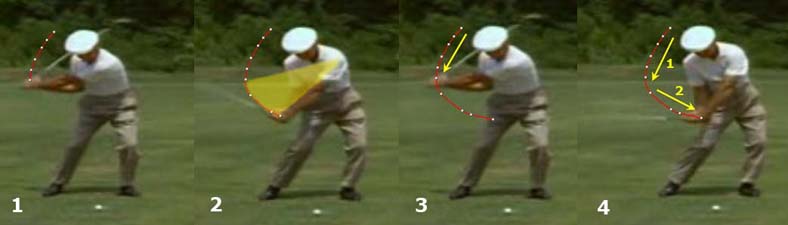
Here is a video of Hogan's PA#4 release - note at what point in the downswing Hogan's left arm starts to move away from his chest wall.
Here is a more precise rendition of the timing of Hogan's PA#4 release.
It is my opinion that Hogan's PA#4 is being released in the yellow colored zone (image 2).
Daryl
I have no idea what you are talking about! .
I know Jeff, but you should.
Originally Posted by Jeff
I never stated that the left arm must be blasted off the chest wall at the beginning of the downswing. I stated that the left arm gets passively blasted off the chest wall when the pivot action subsides and that usually happens in the mid-downswing.
This is one of the subjects where you lack understanding. This isn't the thread for this but I'll say it anyway. In the "Mechanical Checklist For All Strokes", #25, Extensor Action - Rhythm. It says "Rhythm" because Extensor Action should be used to prevent the Left Arm from Releasing too early. If you understand Extensor Action and its below plane force then you would understand that you can increase Clubhead Mass by increasing the Acceleration Rate which is done by increasing the amount of pressure that you create on the Pressure Points. Anyone can increase pressure on the presure points but without Extensor Action you can't choose which ones nor direct them to apply force to the ball.
#4 is Body power and as long as the Pivot is leading and pulling the Left arm, then the left arm (body power) is still contributing.
If it gets "passively blasted" off the chest wall when the pivot action subsides, then perhaps it wasn't pushed off the Chest but rather it Accelerated away from the Chest as in Momentum Transfer. The pivot is providing centripetal acceleration which induces and sustains that throwout (centrifugal).
Quote:
Rotation induces a Throw-Out action, pulling the centers of gravity of every movable component, In-Line and On Plane with its axis or center, whether or not they were originally In-Line or On Plane.
Originally Posted by Jeff
Here is a video of Hogan's PA#4 release - note at what point in the downswing Hogan's left arm starts to move away from his chest wall.
It is my opinion that Hogan's PA#4 is being released in the yellow colored zone (image 2).
Jeff.
When and Where #4 begins to release is not the point of our disagreement. I claim that the #4 Accumulator is still seeking its in-line condition while the #2 Accumulator has already become in-line. And because it's seeking its in-line condition, #4 is still Active after #2 has been spent as long as the Pivot train is still operating.
You wrote-: "I claim that the #4 Accumulator is still seeking its in-line condition while the #2 Accumulator has already become in-line. And because it's seeking its in-line condition, #4 is still Active after #2 has been spent as long as the Pivot train is still operating."
What is your definition of the in-line condition of PA#4? At what point in the swing does PA#4 reach its in-line condition, and where in the TGM book does Homer define that in-line condition?
You also wrote-: "Extensor Action should be used to prevent the Left Arm from Releasing too early."
Where in the TGM book does Homer state that extensor action should be used to prevent an early release of PA#4.
Here is a perfect example of a swinger's action - using PAs 4:2:3 in the optimum sequence. There is no right forerarm action or extensor action in his swing, and he has no problem with releasing PA#4 too early.
Jeff.
Last edited by Jeff : 05-15-2009 at 11:23 AM.
Reason: add comment
You write-: "I claim that the #4 Accumulator is still seeking its in-line condition while the #2 Accumulator has already become in-line. And because it's seeking its in-line condition, #4 is still Active after #2 has been spent as long as the Pivot train is still operating."
What is your definition of the in-line condition of PA#4? At what point in the swing does PA#4 reach its in-line condition, and where in the TGM book does Homer define that in-line condition?
Jeff.
Good Question. The Left Arm is in-line technically, according to HK, as it becomes in-line with the Shoulders. If it's not in the 7th edition, then it's in the First Edition of the Book, a short obscure statement, but I don't have any of the editions of the book in front of me at my office. Homer never said that the Right Arm prevents the Left Arm from ever getting In-line, but that simple fact doesn't negate that as long as the Pivot is pulling the Left Arm that it still complies as body power.
Sometimes you'll see golfers let go of the club with their right hand after impact or unbend or flip with their right hand in an attempt to prevent the right arm from restricting Left Arm Acceleration after both arms straight.
6-B-4-0. THE FOURTH POWER ACCUMULATOR The angle formed by the Left Arm and the Left Shoulder forms the Fourth Power Accumu¬lator. It is not only an independent Power Accumulator, but its Triggering function as the Checkrein of the Right Elbow Power is also vastly important and it thus can be the Accumulator of the Accumulators or Master Accumulator.
As Accumulator #4 its function is to actuate the Primary Lever Assembly when using the Pull Basic Stroke, which requires a non-participating Right Arm. It is "supported by" rather than "operated through" its Pressure Point-#4. Which is any point along the Left Side contacted by the straight Left Arm.
It qualifies as #4 Accumulator only when the Shoulders are Turning and the Left Arm seeks its "in-Line" position with the Shoulders. Otherwise it actually substitutes for the Pivot to introduce the circular motion required to produce Centrifugal Force.
This is from the 7th Edition
Quote:
6-B-4-0. THE FOURTH POWER ACCUMULATOR The angle formed by the Left Arm and the Left Shoulder forms the Fourth Power Accumulator. The In-line condition it seeks is with the Shoulders. It is not only an independent Power Accumulator, but its Triggering function as the Checkrein of the Right Elbow is also vastly important; it thus, can be the Accumulator of the Accumulators - or Master Accumulator. (Also see 2-M-4.)
As Accumulator #4, it is Pivot (Body) Power supplying the initial acceleration of the Downstroke to throw the Lever Assemblies toward Impact by the Thrust of the Shoulder Turn. (See 7-13.) Another major contribution to Impact Power is geometric - it is the first link in the Swing Radius power train between the Club and the Feet.
"Left Arm Power" in any form or amount can still be considered #4 Accumulator Action. Otherwise, it actually substitutes for the Pivot to introduce the circular motion required to produce Centrifugal Force.
How do you interpret the statement "in line with the shoulders"?
In a previous thread on PA#4, a number of forum members defined that in-line condition as being met when there is a 90 degree angle between the chest wall and the left arm at the left shoulder area.
I have a serious problem with the idea that the pivot is still driving the left arm during the left hip clearing action - when the pivot drive direction is left and inside. I can only perceive a pivot drive being useful from a swing power perspective when the left arm/left hand/club is being driven down-and-out-and-forwards towards the ball.
You also wrote-: "Sometimes you'll see golfers let go of the club with their right hand after impact or unbend or flip with their right hand in an attempt to prevent the right arm from restricting Left Arm Acceleration after both arms straight."
I think that a swinger may allow the right hand to leave the club, or straighten, post-impact because they have run-out-of-right arm. In the standard followthrough (using a horizontal hinging action), the left hand is moving inside and left very fast immediately post-impact. If the right shoulder has not moved sufficiently far/fast downplane in the late downswing, it may be extremely difficult for the golfer to keep the right wrist bent (and the right palm firmly attached to the grip) all the way to the end of the followthrough (when drag loading) - especially when the club is moving very fast through impact (eg. Driver swings of Phil Mickelson, VJ Singh and Fred Couples).
Where in the TGM book does Homer state that extensor action should be used to prevent an early release of PA#4.
12-3-0 #25
Quote:
How do you interpret the statement "in line with the shoulders"?
By the book. 6-B-4-0 #2 (Picture)
Quote:
I can only perceive a pivot drive being useful from a swing power perspective when the left arm/left hand/club is being driven down-and-out-and-forwards towards the ball.
If that’s what you believe, then at least you have lots of company with the rest of the golfing world.
Yes Jeff. Rhythm. It only looks simply stated. Look it up.
No Jeff. 90 degrees to the Shoulders. Are your shoulders parallel to the plane-line at impact?
You've seen the video? Why don't you see the Pivot swinging his arms - while still at full extension - until the clubshaft is parallel to the ground after follow through. Could the Power of his Pivot (Pivot Power) be continuing to lead and move the shoulders. Body Power? = #4 Accumulator as long as the Left Arm is against the chest.
Are you even reading the Book or are you so arrogant to believe that you capture the concepts, fully understand their meaning so comprehensibly that you are able to apply them by only reading them?
You know what they call someone who's just graduated medical school? ......They call him "Doctor". Give me a break. You know as well as I, that reading "it", understanding "it", and being able to apply "it" are very different types of knowledge.



 My ART lives.

 Linear Mode


