Originally Posted by Jeff

|
12PB
It is my mistake for posting that capture frame from a swing video lesson where I didn't turn my hips but just assumed a hitter's end-backswing position to demonstrate a point in my swing video lesson on hitting (for my personal website).
Here are capture frames from a swing video of my driver swing.
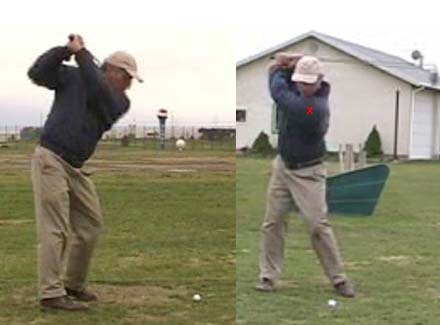
I think that I get an adequate hip turn. However, I cannot get my left arm across my chest and my hands far enough back, so my left arm bends at the elbow and also slides up my chest (off plane) and my hands get too high above my neck causing an across-the-line clubshaft position. I placed a red X to show you where my left humeral head is located.
I didn't want to focus on my personal (imperfect) swing. I merely wanted to talk about biomechanical factors that may cause a golfer to choose a reactive pivot swing rather than an active pivot swing.
I think that if you consider my test for determining hula hula flexibility, that I am correct to state that I have zero hula hula flexibility - defined as an inability to turn the hips forward in the downswing without immediately feeling the shoulders turn passively due to forces transmitted up the spine. If someone holds my right shoulder back in that test, then I cannot rotate my pelvis forward even 1 inch.
Here is another biomechanical factor that I have never seen discussed re: limitations in getting your hands far enough back in the backswing - a limitation being due to left scapula movement limitations rather than an inability to rotate the upper torso. I think that many people regard a shoulder turn as being equivalent to an upper torso turn. However, I think that the left shoulder socket can move >3-4" further than the upper torso turn due to the sliding of the left scapula forward.
Here is an example.
Anthony Kim
Here is a capture image from that video
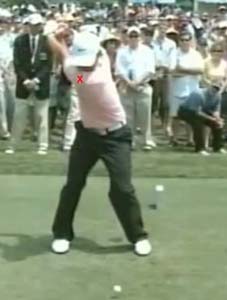
I have placed a red "x" at the location where I think that his left humeral head is situated. Can you see how much he can slide his left scapula forward across his left upper back thus allowing his left shoulder socket to get far more around to the right (compared to me).
I personally have far more limitations in left scapula movement than upper torso rotational movements and it is the main reason why I cannot get my left arm/hand far back.
Jeff.
|
Jeff . . . . I don't know if I get your test deal . . . dude you have plenty of differentiation of the hips shoulders on that backstroke! Just do the same thing on the down stroke??? Actually if you compare where your upper spine is to Kim's . . . you're not in that bad of a spot. Looks like you just slid your hips too much. Straighten your right leg a little (Standard Knee Action). Your arms are probably getting blocked from going back up and in because your right hip is in the way.
Also your arms are getting way lifted off of your chest . . . I mean if you want to get on the turned shoulder plane that's fine but you got some excessive lifting. Feel like you have somebody holding a dowel directly behind you and touching you at the bottom of your neck. Swing the club under that. You'll have to get your hands in and deeper. And your right elbow won't shoot up and off your body as bad.
That's a big part of your OTT issue. If your hands are "high" and you spin they shoot over really fast. So you have to slide EARLY and A BUNCH to keep them on the plane. A lot of that has to do with right elbow location. You need to feel like you are swinging in a room with a 6 foot ceiling.


See how right elbow location effects the plane angle? Also to keep the hands from flying out over the plane you have to SLIDE to keep the hands from flying OUT over the plane . . .PLUS you have to release #4 FAST FAST FAST . . . Furyk releases #4 as fast as anybody in the game. Hogan had a really fast release of #4 too . . . but notice that he doesn't have that much range to cover to keep his hands coming down his selected plane. Check Snead's start down . . . he doesn't release #4 as early and shifts it OUT more . . . Then down the plane.