Target Line is an invisible straight Line from the Ball to your intended Target. Line of Flight is the initial straight-away flight of the Ball in the context and aligned to the vertical Plane.
Daryl,
In the world according to Homer:
That's not correct - hopefully someone else can verify via book quotes the right answer.
The drawing's you did are really awesome - great skills to have - although they are not correct - again - you guys are wearing me out - maybe someone else can bring up the issues that are incorrect in them.
__________________
Life Goal- Developing a new theory of movement based on Brain Science
Interests - Dabbling with insanity
Hobbies- Creating Quality
The divergent Impact and Separation Vectors (2-C-1-1/2/3) are always equal in Angle and Force and therefore produce a bisecting Resultant Force Vector, square to both the Clubface and Leading Edge, and the Line of Flight Vector will be on a Centerline parallel to that Vector.
Sorry Mike. I stand corrected. I tend to take for granted some things after years of this. That's a good reason to memorize the book.
Quote:
2-N-0 CLUBHEAD LINE OF FLIGHT The line of flight of the Clubhead and the Line of Flight of the ball are not the same but touch momentarily during Impact. 2-N-0 CLUBHEAD LINE OF FLIGHT The line of flight of the Clubhead and the Line of Flight of the ball are not the same but touch momentarily during Impact. The one has a vertical plane of action, the other an Inclined Plane.
TrackMan is wonderful and anyone wanting to learn more should read all of their newsletters on their website. It truly does "locate" the inclined plane. The Plane Line is termed Horizontal Swing Plane and is measured in degrees to the Target Line, which is user-specified. But TrackMan is not the first or only machine to measure Path and Clubface angle. In fact, TM doesn't actually "measure" Clubface, but rather, deduces it from other measured conditions. P3PRO can actually measure Clubface, with Path and Angle of Attack as well, for under a grand. I can tell you what the swing plane is with my V1 video analysis software. But I do want a TrackMan.
[Font enhancements by Yoda.]
In 1969, when conventional wisdom screamed that "Clubhead Path" determines the initial direction of the Ball, Homer Kelley published The Golfing Machine and said "No. It is the Clubface."
Today, Mr. Kelley is lauded as being both correct and well ahead of his time. His work done, those of us seeking Golfing Perfection now need only a 'nod' to Path -- downward and outward -- but then look to the Clubface alignment at Impact. In recent weeks, I have been to the top of the TrackMan 'food chain', and they accede that Max Impact's statement is true: Namely, that the Clubface 'at Impact' is not a measured alignment. Instead, it is a derived alignment.
So, please . . .
No more of this nonsense of the Clubface alignment being measured at Impact; or, at Max Compression; or, at Separation.
At least not where TrackMan is concerned.
Why?
Because those measurements do not exist.
I do know that, years ago, the U.S. Bureau of Standards changed their definition -- and physical measurement -- of the Impact Interval from 'point of impact' to 'point of maximum compression'. Why? Because Homer Kelley challenged their published measurements. And they changed.
Today, I know that TM is 'on call' on the practice tee at every PGA TOUR event. If you've been out there a while -- -- you've been there a bunch, and you've seen a bunch. Most important . . .
Know that the guys in the TOUR equipment vans are in the trenches every day. They are on the tee in 'real time', watching their players launch it and making recommendations. It is not unusual for a player to do so perfectly while generating some TM numbers that collectively make no sense. Their players know this, too.
TrackMan is an important input, but in the end, getting the right club into the hands of the player -- pro and amateur alike -- is, indeed, as much art as science. As is delivering competent golf instruction.
Point is . . . in all this stuff . . .
The jury is still out.
Let's find out exactly what is being measured and how.
Then, and only then, will we be able to compare "apples with apples".
If I may....It is a widely-accepted condition of the impact collision, scientifically, today, that the ball starts off in a direction which is, on average, in the neighborhood of 80% of the difference between the horizontal clubface alignment and the horizontal clubhead path, favoring the former. The actual number varies with friction. In fact, it is solely friction which causes the ball to leave the face at any angle other than 90*. That's true vertically as well as horizontally. But none of this is new, as it was well documented in "Search For The Perfect Swing", which came out in 1968, one year before Homer's first edition.
If I may....It is a widely-accepted condition of the impact collision, scientifically, today, that the ball starts off in a direction which is, on average, in the neighborhood of 80% of the difference between the horizontal clubface alignment and the horizontal clubhead path, favoring the former. The actual number varies with friction. In fact, it is solely friction which causes the ball to leave the face at any angle other than 90*. That's true vertically as well as horizontally. But none of this is new, as it was well documented in "Search For The Perfect Swing", which came out in 1968, one year before Homer's first edition.
You know, I have such a hard time taking all these "new" ball flight laws seriously. Thanks to Homer Kelley, I've been teaching them for more than thirty years.
Regarding Search For the Perfect Swing. Yes, it came out in the year before the first edition of TGM, but it was far from 'perfect'. In fact, in our January 1982 Master Class, though Homer applauded its efforts to quantify impact -- "We need more studies like this." -- he also used it as an example of how very smart, well-intentioned individuals couldn't get it right, especially regarding the application of Principle to Procedure.
He also said that, because of the inherent conflicts evidenced between the various authors/researchers, there would never be a second edition.
2-A RESILIENCE The response of the ball to different applications of force is the factor that determines how force must be applied to produce a desired result.................
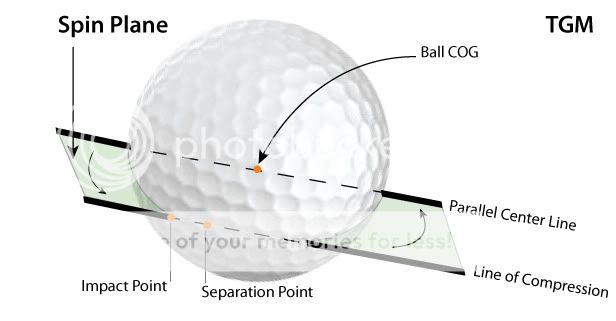
........ Roll of the ball on the face of an inclined striker does not account for all the action produced by such an impact, especially in imparting spin to the ball. When the direction of the compressing force does not pass exactly through the center of the ball, a spin will be imparted to the ball. It will rotate on the plane of a line drawn from the line of compression to a parallel center line.
Bold by Daryl
Below, is the explanation to what Homer said in the sentence that I highlighted in bold:
Imagine drilling an off-center hole through a ball (bottom line of compression) on the line of compression and pushing a stick through it so that it sticks out both ends. This stick doesn't pass through the center of the ball. Now drill a second hole through the ball that passes through the center (Top line) and is perfectly parallel to the first hole, then insert a stick. Those two sticks represent the Spin Plane caused by the Line of Compression of that Impact. The Spin Plane is highlighted in green.
After you insert both sticks, no matter how you rotate or orient the ball, the spin plane will always be represented by those two sticks as long as "The original contact points of the Clubface and ball remain in contact throughout the entire Impact Interval". Any Impact that doesn't maintain the impact as also the separation point, unless done intentionally, is a "Mis-Hit". Furthermore, the rate of Spin is determined by the distance between those two Parallel Lines for any given Clubhead Speed.
The "Search for the Perfect Swing" does not include this information. "The Search for the Perfect Swing" and "The Physics of Golf" only outline the conditions of "Mis-Hit" Impacts.
"D Plane" is not the Science. "D Plane" (Path and Face) is Application (How to mis-hit the Ball). TGM is the Science.
You know, I have such a hard time taking all these "new" ball flight laws seriously. Thanks to Homer Kelley, I've been teaching them for more than thirty years.
Regarding Search For the Perfect Swing. Yes, it came out in the year before the first edition of TGM, but it was far from 'perfect'. In fact, in our January 1982 Master Class, though Homer applauded its efforts to quantify impact -- "We need more studies like this." -- he also used it as an example of how very smart, well-intentioned individuals couldn't get it right, especially regarding the application of Principle to Procedure.
He also said that, because of the inherent conflicts evidenced between the various authors/researchers, there would never be a second edition.
He was right.
Kelley was small in stature and soft-spoken, but he had big plans for his system, and could be scathing to those who offered a different view. I get the sense that he felt threatened by this study. So he steered his disciples away from it. If a single man, with no formal degrees, dismisses the findings of a team of decorated professors and experts in various disciplines, and just so happens to also have a book offering a science-based solution to golf.....well, that throws up a red flag for me. I've heard several TGM disciples now, repeat Kelley's contention of errors in "Search". But the team didn't present anything that they couldn't prove, using standard procedures and the "scientific method". That's the way trained scientists do things. And "Search" never claimed to be a "complete" anything. It simply asks and answers questions on golf using standard scientific research protocol. In the end, it provides a very detailed, easy to follow, explanation of, among other things, how and why the flight, spin, and curve of the ball is created. "New" Ball Flight Laws? Hardly. Why was Kelley so critical? The team had no agenda. Most of the professors and universities donated their time and equipment for the study. How many dismissed the book because of what they heard Kelley had said about it? What a shame. Come to think of it, I've never heard any of them point out exactly WHAT is "wrong" with the research findings of scientists in "Search"? Before they do, they should probably read it first.
Kelley was small in stature and soft-spoken, but he had big plans for his system, and could be scathing to those who offered a different view. I get the sense that he felt threatened by this study. So he steered his disciples away from it. If a single man, with no formal degrees, dismisses the findings of a team of decorated professors and experts in various disciplines, and just so happens to also have a book offering a science-based solution to golf.....well, that throws up a red flag for me. I've heard several TGM disciples now, repeat Kelley's contention of errors in "Search". But the team didn't present anything that they couldn't prove, using standard procedures and the "scientific method". That's the way trained scientists do things. And "Search" never claimed to be a "complete" anything. It simply asks and answers questions on golf using standard scientific research protocol. In the end, it provides a very detailed, easy to follow, explanation of, among other things, how and why the flight, spin, and curve of the ball is created. "New" Ball Flight Laws? Hardly. Why was Kelley so critical? The team had no agenda. Most of the professors and universities donated their time and equipment for the study. How many dismissed the book because of what they heard Kelley had said about it? What a shame. Come to think of it, I've never heard any of them point out exactly WHAT is "wrong" with the research findings of scientists in "Search"? Before they do, they should probably read it first.
I'll bet Homer got cranky arguing with the leaders of the PGA who taught us all that the ball starts on the path. What did he know?
Kevin
__________________
I could be wrong. I have been before, and will be again.
Kelley was small in stature and soft-spoken, but he had big plans for his system, and could be scathing to those who offered a different view. I get the sense that he felt threatened by this study. So he steered his disciples away from it.
In our January 1982 Master Class, I never once heard Homer Kelley raise his voice in anger or deliver any critique that could be considered "scathing". He talked of many competing ideas, but never did I hear an attitude of "They're wrong, and I'm right." Nor did he give the impression he was "threatened" by the work of others. He asked only that they prove their ideas (as he had his).
Regarding 'Search', he never steered us "away" from it. To the contrary, he introduced us to it. He applauded much that was good and spoke of the need for more and more research along the lines presented. Much of his relatively minor criticism was directed at the sin of omission, i.e., "They had the data, and they could have gone 'this way', but they didn't."


 -- you've been there a bunch, and you've seen a bunch. Most important . . .


 Linear Mode


