That MacDonald exercise 4 is a distortion because she is standing erect. If the she performed that same pivot maneuver while bending over 40 degrees, she would develop a reverse K posture - because the degree of rightwards torso tilt increases slightly more with each degree of forward bending.
She? Heck, Jeff, we can't even agree on gender. I think a closer look will convince you of the fact that this is a 'he' and not a 'she'. [Short hair and no boobs are two of the more obvious clues.] If still confused, please see the remaining ten exercises here: http://lynnblakegolf.com/forum/showthread.php?t=4435.
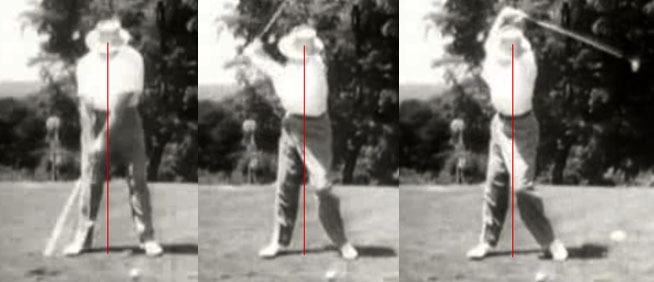
And trust me, the Hogan Backstroke Pivot is a model for the MacDonald Pivot.
Head position, degree of Hip and Shoulder Turns, the Flat Backstroke Right Shoulder Turn, Knee and Foot Action . . . it's all there. The Pivot illustrated in the 'Guardsman' drill is a distortion of the Standard Pivot as defined (7-12) and illustrated (9-1 and 10-12-A #1) in The Golfing Machine.
I strongly suggest you adopt the MacDonald / TGM model and leave the 'guard' duty to others.
MacDonald's is simple - and guess what? It works! Golly, I spent my entire life examining 1000's of women and Mr MacDonald doesn't resemble any of my former patients. I wonder!
You wrote-: "Jeff . . . Why should we pivot like that?"
Because there is no other way. What I mean is that if a human being does nothing more than rotate the pelvis 45 degrees by moving the right femoral head backwards/leftwards, and he lets his body/head move naturally/passively in an unrestricted manner, then he will end up with a reverse K posture. BM is exaggerating the upper body rightwards tilt motion.
In a human golfer, who consciously decides to keep his head stationary during the 45 degrees pelvic rotation movement, the natural movement of the upper torso becomes restricted and that is why the mid-upper thoracic spine becomes verticalized (when it would normally continue to spiral rightwards in a natural spiral arc).
You wrote-: "Jeff . . . Why should we pivot like that?"
Because there is no other way. What I mean is that if a human being does nothing more than rotate the pelvis 45 degrees by moving the right femoral head backwards/leftwards, and he lets his body/head move naturally/passively in an unrestricted manner, then he will end up with a reverse K posture. BM is exaggerating the upper body rightwards tilt motion.
In a human golfer, who consciously decides to keep his head stationary during the 45 degrees pelvic rotation movement, the natural movement of the upper torso becomes restricted and that is why the mid-upper thoracic spine becomes verticalized (when it would normally continue to spiral rightwards in a natural spiral arc).
Jeff.
Jeff,
Couple of questions would like to ask...
Is there any way to have a "look" of 45 degrees hip turn that did not come from rotation?
If you practice your quoted "drill", did you hit fat?
__________________
If you cannot take the shoulder down the clubshaft plane, you must take along some other path and add compensations - now, instead of one motion to remember, you wind up with at least two!
You wrote-: "Jeff . . . Why should we pivot like that?"
Because there is no other way. What I mean is that if a human being does nothing more than rotate the pelvis 45 degrees by moving the right femoral head backwards/leftwards, and he lets his body/head move naturally/passively in an unrestricted manner, then he will end up with a reverse K posture. BM is exaggerating the upper body rightwards tilt motion.
In a human golfer, who consciously decides to keep his head stationary during the 45 degrees pelvic rotation movement, the natural movement of the upper torso becomes restricted and that is why the mid-upper thoracic spine becomes verticalized (when it would normally continue to spiral rightwards in a natural spiral arc).
Jeff.
Fine with me . . . I'm sticking with my "unnatural" pivot then . . . Low Point and being able to draw the ball trumps "natural" in my world.
And what's the problem with "the natural movement of the upper torso becoming restricted and that is why the mid-upper thoracic spine becomes verticalized (when it would normally continue to spiral rightwards in a natural spiral arc)." Sounds like the way it should work to me.
If it's optimum to have the head move off the ball . . . what's optimum the other way? Let it move forward and keep your waist bend? Why wouldn't you want to tilt your teacup on both sides?
I've done a bunch of "unnatural" stuff in my day . . . so I ain't stoppin' now.
How about this backswing? Unnatural? I think this is your pic too right? Is the Slammer servin' up pie?
__________________
Aloha Mr. Hand
Behold my hands; reach hither thy hand
Last edited by 12 piece bucket : 12-10-2008 at 11:11 PM.
If the pelvis is square to the ball-target line at address, and then 45 degrees angled to the ball-target line at the end of the backswing, then it has rotated 45 degrees. How it got to that 45 degree rotated position could vary from a biomechanical mechanism perspective. For example, in my diagram I show how the right femoral head has moved backwards and leftwards. That could occur via different biomechanical mechanisms. One could use pelvic girdle muscles to pull the right pelvis back and secondarily the right femoral head back (because of its snug-relationship to the hip socket joint). Alternatively, one could shift the torso right-laterally against the resistance of a "fixed" right knee => that causes the deflected forces to slant the right thigh to the left => that drives the right femoral head left-backwards => then the pelvis moves secondarily to the movement of the right femoral head.
I only tried the drill once to understand the biomechanics. I think that BM was using that drill to teach golfers not to sway the pelvis laterally, but to rotate the pelvis.
Brady Riggs is teaching the same basic principle is this swing video lesson.
You wrote-: "And what's the problem with "the natural movement of the upper torso becoming restricted and that is why the mid-upper thoracic spine becomes verticalized (when it would normally continue to spiral rightwards in a natural spiral arc)." Sounds like the way it should work to me."
I agree. I stated the same thing in the previous post. It is a good idea to keep the head stationary.
That is my photo of Snead. It is interesting because Snead turned his pelvis more then 45 degrees (? 70 degrees). That causes the lower lumbar vertebra to move so far leftwards that the front of the lumbar spine will almost be facing away from the target. With the addition of an erect posture, one could then rotate the upper torso around a near-vertical spine. Then, one would not end up with a reverse K posture - like Hogan. In fact, Snead has a small degree of reverse pivoting. The reason is that he has a near-vertical spine, and then the addition of a >100 degree shoulder turn torques his upper thoracic spine even more left-of-vertical.
If the pelvis is square to the ball-target line at address, and then 45 degrees angled to the ball-target line at the end of the backswing, then it has rotated 45 degrees. How it got to that 45 degree rotated position could vary from a biomechanical mechanism perspective. For example, in my diagram I show how the right femoral head has moved backwards and leftwards. That could occur via different biomechanical mechanisms. One could use pelvic girdle muscles to pull the right pelvis back and secondarily the right femoral head back (because of its snug-relationship to the hip socket joint). Alternatively, one could shift the torso right-laterally against the resistance of a "fixed" right knee => that causes the deflected forces to slant the right thigh to the left => that drives the right femoral head left-backwards => then the pelvis moves secondarily to the movement of the right femoral head.
I only tried the drill once to understand the biomechanics. I think that BM was using that drill to teach golfers not to sway the pelvis laterally, but to rotate the pelvis.
Brady Riggs is teaching the same basic principle is this swing video lesson.
Jeff.
Jeff,
I am seeing it a little differently. I am seeing Mr. Manzella creating some tilt by moving his head and shoulders back over the right foot. I am seeing Mr. Riggs create some tilt by moving his hips forward while keeping his head more stationary. Mr. Riggs motion reminds me a lot of VJ Trolio's Hogan "secret" move. I really like that motion.
What am I missing?
Kevin
__________________
I could be wrong. I have been before, and will be again.
I think that BM and BR are performing the same pelvic rotational movement from a biomechanical perspective, except that BM is deliberately allowing his head and upper torso to rotate as far as possible to the right (head is outside his inner right foot) to exaggerate the drill effect and to get that clubshaft perpendicular to the ball-target line. By contrast, BR is probably attempting to keep his head more stationary and within the boundaries of his stance.




 Linear Mode


